
TEFAF New York 2026: The Room as Market Form
As TEFAF New York nears closure, its tenth-anniversary edition shows how historic architecture, disciplined scale, cross-category collecting, museum presence, and object pressure convert market assurance into an atmosphere before the fair has fully ended.

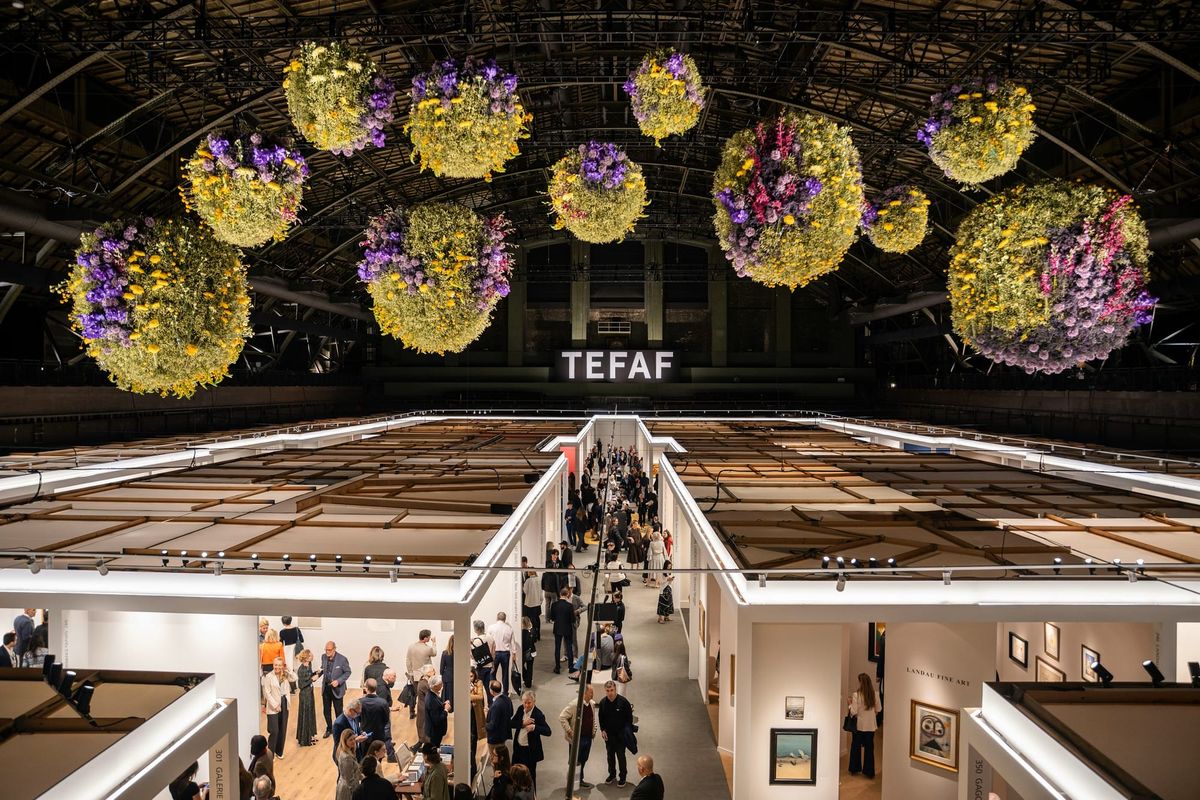
Before TEFAF New York closes, its room has already made the argument.
The final day will supply the audit: what sold, what held, what entered institutions, what remained atmosphere. But the fair’s operating logic is visible earlier, in the way the Park Avenue Armory converts a smaller field into a denser one.
The anniversary matters less as celebration than as consolidation: ten years after TEFAF crossed from Maastricht into New York, the fair no longer needs to prove that the format can travel, but what kind of New York condition it has become.
TEFAF New York does not operate by reproducing Maastricht at reduced scale. It works by compression. The encyclopedic sweep associated with the Dutch fair is narrowed into the Armory, where fewer exhibitors, heavier architecture, disciplined stands, and cross-category adjacency make density do the work of breadth.
The result is not simply a smaller fair. It is a different market form.
In New York, TEFAF organizes the feeling that range has already been edited into confidence.
Confidence as Reduced Hesitation
Confidence here does not mean optimism.
Optimism belongs to opening lines, full aisles, early sales reports, and the language fairs use when they need to stabilize momentum before closure. Confidence is more technical. It is the reduction of hesitation: the sense that an object has already passed enough tests—scholarly, spatial, social, institutional, and material—for a decision to feel protected.
TEFAF New York is built around that reduction.
Vetting supplies one layer. The Armory supplies another. Museum attendance adds a third. Cross-category adjacency adds a fourth, because objects are not judged only within their own fields, but by what they can withstand beside them.
A contemporary sculpture has to hold near jewelry. A design object has to hold near painting. An antiquity has to remain active inside a present-tense market room. A rediscovered artist has to carry enough density to survive proximity to names already secured by recognition.
The result is a market atmosphere in which buying can appear less like appetite than confirmation.
Compression, Not Scale
Maastricht begins from breadth. New York begins from constraint.
The fair brings together modern and contemporary art, jewelry, antiquities, and design, but it does so inside a tighter field, where each presentation has to carry more pressure. This year’s edition gathers 88 dealers from 15 countries across the Drill Hall and the Armory’s historic period rooms, with material spanning modern and contemporary art, jewelry, antiquities, and design.
The Armory cannot absorb scale the way MECC Maastricht can. It does not offer the same encyclopedic expansion. It asks the fair to become concentrated, legible, and atmospherically convincing almost immediately.
That compression changes how objects behave.
A painting, a jewel, a design object, an antiquity, and a contemporary sculpture are not encountered as separate categories moving in parallel. They press against one another. Each object has to withstand proximity to unlike things: a Calder near design, a contemporary painting near antiquity, a Tiffany object inside a room already marked by decorative history, a new sculpture placed within a fair still governed by inherited standards of expertise.
This is where TEFAF New York distinguishes itself from the city’s other May fairs. It is not only less contemporary in emphasis. It is less dependent on contemporaneity as the primary language of relevance. The twentieth century remains central. So do design, craft, provenance, material intelligence, and the kinds of objects that carry authority through use, rarity, condition, and room presence.
The fair does not ask the visitor to choose between categories.
It asks whether the categories can be made to cohere as taste.
The Armory as Second Vetting
At TEFAF, vetting begins before the public sees the work. But in New York, the Armory performs another kind of vetting after admission.
The building does not simply frame the fair. It tests the objects.
The Drill Hall gives TEFAF its fair structure: aisles, stands, circulation, density. The historic rooms do something else. They slow the fair into interiors. They make objects appear not only available, but already situated. Woodwork, ironwork, patterned surfaces, fireplaces, staircases, and Gilded Age rooms absorb the works into an atmosphere of prior authority.
TEFAF’s own framing emphasizes the 16 historic rooms as spaces where artworks are placed in dialogue with New York architecture. That dialogue is not decorative. It is structural.
TEFAF New York is not only a marketplace of objects. It is a marketplace of placement.
The question is not only whether a work is strong. It is whether it can hold a room. Whether it can carry history without becoming inert. Whether it can enter a collector’s interior, an institutional context, or a cross-category conversation without needing the protection of a single-specialist frame.
Macklowe Gallery’s Tiffany material made this logic explicit. Lighting associated with the period of the Armory’s own decorative culture did not appear as historical illustration. It closed a circuit between object, architecture, and New York memory. The room did not decorate the stand. It completed the argument.
The same was true in a different register for Ida Barbarigo at Axel Vervoordt. Her paintings gained force not by being isolated from the Armory’s historic surfaces, but by using them. The room gave the work a density that a neutral booth would have had to manufacture differently. The New York Times singled out Barbarigo’s presentation upstairs as one of the fair’s discoveries, noting how the paintings made use of the Armory’s iron and woodwork.
This is the fair’s architectural advantage.
The Armory does not guarantee authority. It makes authority easier to stage when the object can carry it.
Objects Under Compression
Compression only works when objects can carry more than one register at once.
Kathleen Ryan’s gem-encrusted fruit at Gagosian did not function only as contemporary sculpture. In this setting, the work moved across sculpture, jewelry, craft, spectacle, decay, and market image. Its surface made decomposition collectible without removing its discomfort. The fair’s cross-category structure helped that translation. The work could be read as contemporary, but also as mineral, decorative, excessive, and materially obsessive.
Eva Helene Pade’s paintings at Thaddaeus Ropac moved differently. They entered the fair as new work, but not as novelty. The scale, figuration, mythic ambiguity, and theatrical installation allowed the paintings to absorb older languages: history painting, allegory, ceremony, the body in collective pressure. Their reported placement with U.S. institutions confirms how quickly discovery can become legible when the work arrives already capable of carrying institutional speech.
Anna Zemánková’s works at Gladstone operated through another form of compression: rediscovery, intimacy, botanical abstraction, outsider adjacency, and spiritual image-making condensed into works on paper small enough to invite close attention. Their strength inside TEFAF’s environment was not scale, but pressure of concentration. They did not compete with trophy objects by becoming louder. They made another claim for endurance.
Jewelry sharpens the same logic. FORMS’ debut at the fair, with diamond and shakudo works moving between ornament, engineering, and collectible object, showed how jewelry at TEFAF is not treated as accessory to the art market but as one of its tests of material intelligence. The category’s success depends on collapsing wearability, rarity, craft, and sculptural presence into a single object. TEFAF’s opening report noted FORMS as a first-time exhibitor with a successful debut, including the sale of diamond and shakudo earrings featuring 20.24 carats of diamonds.
David Aaron’s Egyptian stele carried the opposite temporal weight. Its value did not come from discovery in the same sense, but from age, survival, provenance, and the ability of antiquity to remain active inside a contemporary market room. At TEFAF New York, an ancient object does not sit outside the present. It tests the present’s appetite for duration.
Galerie Patrick Seguin’s Prouvé material pushed design toward inhabitable architecture. The proposition was not furniture alone, but transferability: structure, domesticity, mobility, and the idea that a house can circulate as a collectible object. Within TEFAF’s cross-category logic, that expansion is not eccentric. It is a demonstration of how far the category of collectible design can stretch before it becomes environment.
These presentations clarify the fair’s operating condition.
The strongest objects do not simply belong to categories. They move between them without losing authority.
Assurance Under Selective Conditions
The assurance around TEFAF New York matters because the market in which it appears is not uncomplicated.
Collectors are active, but more selective. Auction confidence has been uneven. Luxury spending has softened in parts of the global economy. Speculative heat is no longer enough to organize a room. In that context, TEFAF’s crowded aisles, early placements, sold-out presentations, and institutional attendance do not simply indicate appetite. They suggest where appetite is currently willing to concentrate.
The fair’s answer is not speed. It is defensibility.
Objects that carry rarity, condition, provenance, craft, recognizable authorship, or institutional relevance are easier to defend in a cautious market. So are works that can be placed within longer stories: rediscovered women artists, overlooked modernists, transhistorical design, major contemporary names with material spectacle, antiquities with narrative force, twentieth-century works that feel both historical and newly available.
TEFAF New York produces market belief by making these defenses visible.
Early sales are part of that process, but they are not the whole process. A swift sale tells one story. A crowded stand tells another. Museum directors and curators moving through the aisles tell another. So does a room where a contemporary object can sit near design, antiquity, or jewelry without appearing diminished.
The fair reported strong opening momentum, including sold-out booths, seven-figure sales, and significant institutional engagement before the fair had closed. The point is not only that the market moved. It is how the movement was given form.
Assurance here is cumulative. It is produced by alignment.
Cross-Category as Collecting Grammar
The fair’s cross-category identity is often described as breadth. In New York, it functions more specifically as a grammar of collecting.
A collector moving through TEFAF is not only moving from one category to another. They are moving through possible relationships between objects. A jewel can speak to sculpture. A chair can carry architectural ambition. A painting can behave as an interior anchor. An antiquity can stabilize a room by extending its time horizon. A contemporary work can gain depth by being seen against older material rather than only against the latest cycle of production.
This is why the fair’s mixture feels different from simple variety. The categories are not merely adjacent. They are made to authorize one another.
The ideal collector imagined by TEFAF New York is not a specialist in the old sense. Nor is the collector simply contemporary-facing. The fair addresses someone fluent in placement, advised across categories, responsive to rarity, and increasingly comfortable with transhistorical rooms.
The Art Newspaper framed this as one of TEFAF New York’s continuing distinctions: its commitment to cross-category collecting, its disciplined stands, and its balance of twentieth- and twenty-first-century material inside a compact New York format.
That shift matters.
A previous collecting model often treated category as discipline. TEFAF New York treats category as relation. The value of an object is not only what it is, but what it can sit beside, what kind of room it can produce, and what form of cultural self-description it allows the collector to inhabit.
The room does not erase private motive. Desire, advice, habit, interior planning, liquidity, estate logic, and financial caution all move through it. What TEFAF does is give those motives a disciplined public language.
This is where wealth becomes structure rather than atmosphere.
Recognition and Discovery
Every compressed fair needs stabilizers.
At TEFAF New York, recognizable names perform that function. Hockney, Warhol, Kusama, Calder, Fontana, de Kooning, Lalanne, Hammershøi, Prouvé: such names give the fair an immediate language of recognition. They let the visitor know what level of market they have entered before the slower work of looking begins.
But recognition is not enough.
If the fair only confirmed what collectors already knew, compression would harden into repetition. The more interesting movement happens when discovery is able to operate inside the structure of assurance rather than outside it.
That is why the less familiar or newly reactivated artists are so important to this edition’s meaning. Pade, Zemánková, Barbarigo, Ithell Colquhoun, Olga Fröbe-Kapteyn, and others do not sit outside the fair’s market logic. They test it. They ask whether TEFAF’s room can still make space for material that has not already been exhausted by name recognition.
The answer is conditional.
Discovery works here when it can be routed through depth. Through rediscovery, scholarship, installation, institutional interest, material concentration, or a convincing relation to older forms. The fair does not reward every form of opacity. It rewards opacity that can be held long enough to become legible.
That is not a failure of the model. It is the model.
TEFAF New York makes discovery possible by surrounding it with confidence. The cost is that discovery must learn to speak in a room already organized by protected decision.
Institutional Time
The presence of museum representatives during the preview does not simply validate the fair. It changes the rhythm of attention.
Institutional attendance introduces another tempo into a commercial setting. It slows the room without removing urgency. A work seen by a museum director, curator, trustee, or acquisition adviser does not become less commercial. It becomes differently charged. Interest begins to operate through placement, public meaning, and longer institutional futures.
TEFAF reported more than 100 museum representatives at the Collectors Preview, including figures from the Metropolitan Museum of Art, MoMA, the Frick Collection, the Morgan Library & Museum, the Guggenheim, the Neue Galerie, Yale University Art Gallery, and other institutions.
For dealers, this can be stabilizing and complicating at once. Institutional attention can elevate a work, but it can also delay release. It can dignify the object, but it may lengthen the path to transaction. For collectors, the same attention can sharpen desire by implying that the work belongs not only to private taste, but to a broader cultural conversation.
This is one of TEFAF New York’s strongest mechanisms.
The fair holds commerce close to scholarship without pretending they are the same thing. It allows acquisition to appear as stewardship, and stewardship to remain adjacent to buying.
That adjacency is delicate. It is also central to the fair’s authority.
What the Room Favors
The room favors objects that can withstand pressure.
Pressure from architecture.
Pressure from neighboring categories.
Pressure from institutional attention.
Pressure from provenance.
Pressure from recognizability.
Pressure from being seen quickly by people trained to make distinctions.
It favors dealers who can stage an argument without overexplaining it. It favors works that can be understood at first encounter and still deepen under scrutiny. It favors artists whose rediscovery can be made durable. It favors design that can behave as architecture, jewelry that can behave as sculpture, antiquity that can behave as present tense, and contemporary art that can survive proximity to older forms of authority.
It does not favor everything equally.
Some practices need more time than a compressed fair can offer. Some forms of ambiguity weaken when forced into quick legibility. Some categories arrive with deeper documentary infrastructure than others. Some dealers can afford patience; others need the room to convert more quickly.
These asymmetries do not sit outside the fair.
They are part of what the fair organizes.
TEFAF New York’s elegance lies in how little of this feels forced. The room makes its own hierarchy appear natural.
Before Closure
A final article after closure would need to ask a different question.
It would need to examine what remained once the atmosphere ended. Which early signals held. Which sales became meaningful beyond announcement. Which discoveries continued to carry weight after the week’s concentration dissolved. Whether institutional interest translated into lasting placement. Whether the tenth-anniversary edition marked a durable sharpening of the fair’s New York role, or simply a well-calibrated performance inside a crowded May calendar.
That audit belongs after the fair closes.
For now, the map is clearer than the conclusion.
By its final stretch, TEFAF New York 2026 has made visible that its strength is not scale, but the conversion of constraint into authority. It compresses a broad field into a sequence of rooms where objects are asked to carry more than category, more than price, and more than recognition. They are asked to produce reduced hesitation quickly, while still appearing capable of duration.
That is the fair’s New York condition.
Maastricht asks what can be admitted.
New York asks what can hold the room.
© ART Walkway. All Rights Reserved.


