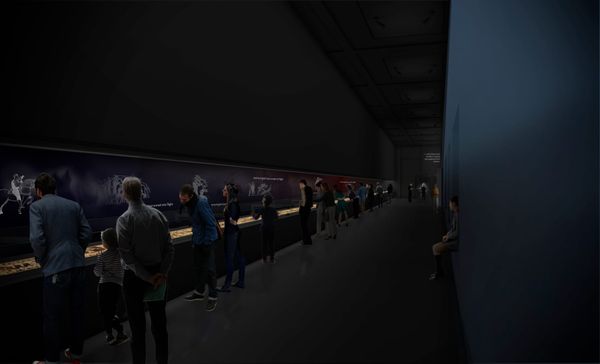
Scale Forces the Museum to Rethink Who the Visitor Is
As museums navigate unprecedented scale, technological mediation, and shifting demographics, the question is no longer only how to attract audiences, but how institutions organise themselves for the publics already shaping their future.


There are roughly 35,000 museums in the United States alone. Together, they once drew more than 800 million visits a year. Europe’s density is comparable, even where funding structures differ. What this produces is not simply cultural abundance, but saturation.
The issue is no longer only how museums attract visitors.
It is how they decide which future visitors they are organising for — and which assumptions they are quietly carrying forward.
Much of the recent institutional response has focused on technology. Interactive displays, immersive interpretation, AI‑assisted mediation, personalised content layers — tools designed to meet audiences whose expectations have been shaped by platforms that anticipate intent and compress friction. Museums are adapting to this condition with increasing speed, often under explicit mandates tied to attendance, accessibility, or public value.
But technology is only one register of the pressure now reshaping the field.
Another is demographic, and it has been slower to register as structural.
Museums have always been visited by families. Children have long moved through galleries framed as dependents — managed through education departments, children’s trails, activity rooms, and school programmes that sit alongside rather than inside core curatorial thinking. Their presence was acknowledged without fully reorganising exhibitions themselves around how curiosity actually arrives.
That division is becoming harder to sustain.
Across institutions, exhibition design now absorbs assumptions once reserved for educational programming: clearer pacing, legible narrative movement, moments of surprise, and spatial modulation that invites attention rather than commands it. These shifts are rarely announced as responses to younger audiences, but their effects are visible in how galleries are being choreographed.
This is already producing divergence.
Some museums are redesigning encounters to hold multiple forms of curiosity at once. Others continue to operate as if interest must be trained before it can be trusted.
The distinction matters because children are not a marginal public.
They are the longest temporal constituency museums have. They return repeatedly, shape family itineraries, and carry institutional memory forward long before they carry art-historical language. They register atmosphere, generosity, and coherence before they register explanation.
Most curatorial models, however, were built for an adult subject already fluent in cultural decoding — someone expected to translate silence, chronology, and text into meaning. Difficulty signalled seriousness. Distance signalled respect. Learning was presumed to occur elsewhere.
What is changing now is not a pedagogical fashion.
It is an institutional reckoning with what opacity actually communicates under contemporary conditions.
In a crowded cultural field, museums are being forced to ask whether difficulty still operates as invitation, or whether it increasingly reads as withdrawal. The question quietly shifts from how do we protect complexity? to how do we keep complexity alive once attention becomes fragile?
This is where curatorial risk concentrates.
Every additional interpretive layer — digital, narrative, experiential — resolves certain uncertainties while foreclosing others. Clarity enables access, but it also renders decisions visible. Once meaning is scaffolded, it becomes disputable. When ambiguity retreats in space, it must be defended in judgment.
Curators increasingly work inside this pressure, often without full discretion. Expectations arrive from boards, funders, public agencies, and audience metrics simultaneously. Interpretation becomes not only a cultural responsibility, but an administrative one.
Technology intensifies this condition.
Systems designed to scale experience require curatorial decisions to be fixed earlier and encoded more thoroughly. Once interpretation is embedded into platforms, interfaces, or programmed pathways, flexibility becomes difficult to retrieve. Authority does not disappear — but it migrates.
Less at the wall. More in the system.
This relocation does not inherently impoverish curatorial practice. But it changes where judgments must be made, and how early consequences are set in motion. Decisions about pacing, legibility, surprise, and friction increasingly determine whether encounters remain open or prematurely resolved.
The forward question, then, is not whether museums should embrace technology or family audiences.
It is whether they can distinguish between tools that accelerate attention and those that hold it.
Not every institution benefits from competing on smoothness. Some will find relevance precisely by defending moments of slowness, interruption, or unresolved relation — provided these are designed conditions rather than inherited habits.
This is where institutional futures quietly separate.
Museums that organise themselves around inherited assumptions — equating silence with seriousness, opacity with authority — are unlikely to collapse. The more probable outcome is misalignment: institutions continuing to function while slowly losing resonance with the publics already moving through their spaces.
Others are already doing something subtler.
They are recalibrating exhibitions to allow curiosity to surface without embarrassment, to permit wonder without reducing stakes, and to trust that meaning can thicken over time rather than arrive fully armed. These institutions are not simplifying culture. They are redistributing where entry is allowed.
In that sense, the future museum is not only negotiating with technology vendors or platform logics.
It is negotiating with inheritance.
With what kinds of attention it legitimises, what forms of curiosity it protects, and which visitors it quietly assumes will matter later because they matter now.
The question museums are increasingly unable to avoid is not how to manufacture engagement.
It is how to recognise that care arrives early, often untrained, and frequently underestimated — and how to build institutions capable of carrying that care forward without flattening what culture is meant to hold.
© ART Walkway. All Rights Reserved.