Biennale Arte 2026: In the Absence of… 2/2
Maja Ćirić reviews the second part of Minor Keys, the 61st Venice Biennale, tracing Koyo Kouoh’s absence through delegated curating, mourning, accumulation, and polyphonic form.

The central Venice Biennale exhibition, Minor Keys, curated by Koyo Kouoh (1967–2025), is marked by a rupture in temporal perspective: the difference between a biennial situated within an ongoing curatorial trajectory and one that, following her passing, comes to be read as a final curatorial statement. In the first instance, the curatorial hand operates with systemic restraint, understanding that it need not vocalise every structural alliance nor exhaustively map its entire network of references. Yet when a biennial comprising 110 “galactic” artists, collectives, and organisations is viewed in light of Kouoh’s death a year before its opening, the exhibition acquires a different structural and affective charge.
Delegated Curating
It is well documented that the committee appointed by Kouoh, comprising Gabe Beckhurst Feijoo, Siddhartha Mitter, Marie-Hélène Pereira, Rasha Salti, and Rory Tsapayi, met on several occasions with her, working within a curatorial framework and direction already defined. One such meeting took place in the vicinity of a mango tree in the courtyard of RAW Material Company in Dakar, founded by Kouoh.
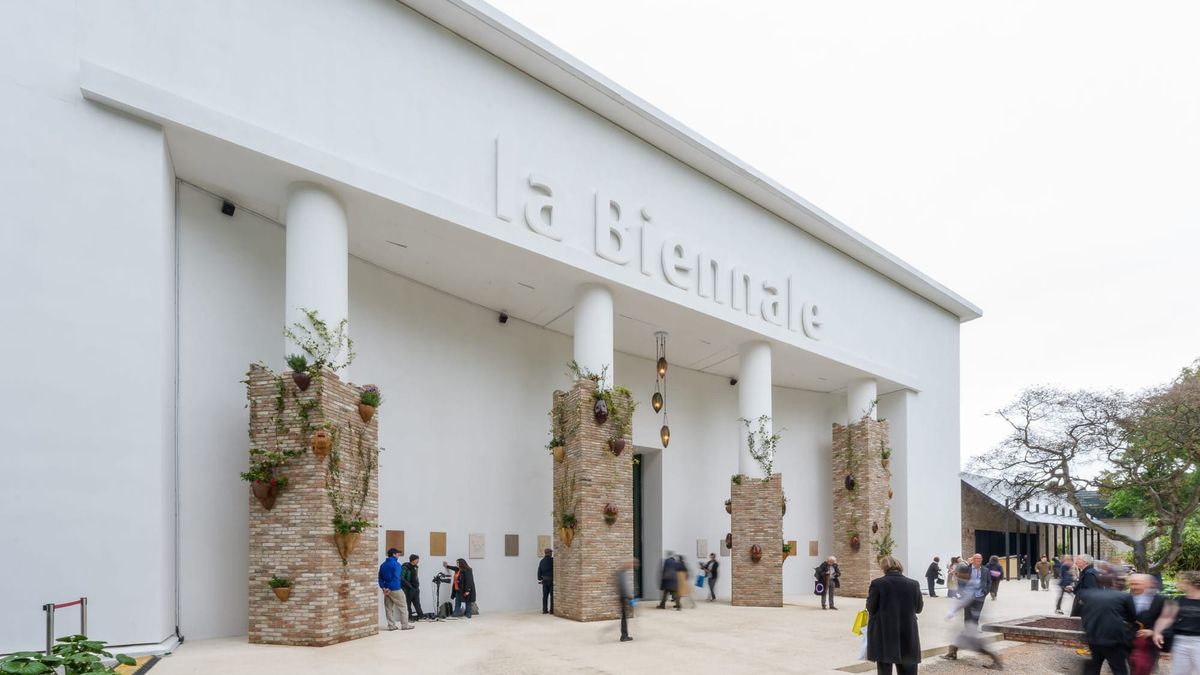
In her absence, an immense institutional strength was supposed to be projected through the execution of the Venice Biennale, with the physical thresholds, developed alongside Wolff Architects from Cape Town, acting as literal portals to alternative forms of spatial comprehension. However, it is only through reading the catalogue, rather than experiencing the exhibition itself, that one realises the artworks are organised according to her distinct typologies: Shrines, envisaged as tributes to two incandescent world-makers, Issa Samb (1945–2017) and Beverly Buchanan (1940–2015); processional assemblies; enchantments devised to counter cynicism about what art can do; places of rest such as isolated oases and islands; Schools; and the Applied Arts Pavilion.
Still, within this distributed curatorial structure, often understood in terms of delegated curating, certain constellations assume particular weight. The Council of the Mother Spirits of the Animals by Celia Vázquez Yui assumes a central position within the Central Pavilion, transforming the space into a parliament of more-than-human beings. Rooted in Shipibo cosmology, the assembly of ceramic animal spirits proposes an ecology grounded in reciprocity, care, and kinship, unsettling anthropocentric hierarchies and granting agency to the forest and its endangered worlds. Acting simultaneously as guardians, witnesses, and interlocutors, these figures open a space where art, healing, environmental justice, and Indigenous knowledge converge.
Extending beyond this gathering and unfolding deeper into the pavilion’s spatial horizon, María Magdalena Campos-Pons’s Anatomy of the Magnolia Tree for Koyo Kouoh and Toni Morrison (2026) inhabits a more intimate register of remembrance. The intertwined portraits of Koyo Kouoh and Toni Morrison emerge through a network of magnolia branches, weaving together personal memory and collective history into a living genealogy of Black women’s knowledge, care, and cultural resistance. Where the mango evokes fertility and sensuous abundance, the magnolia carries a quieter symbolic charge, one of dignity, inwardness, and a muted melancholy shaped by memory and loss. Together, the two installations articulate interconnected forms of resilience, proposing memory, kinship, and care as forces capable of sustaining both human and more-than-human futures. And this is an example of an effective juxtaposition.
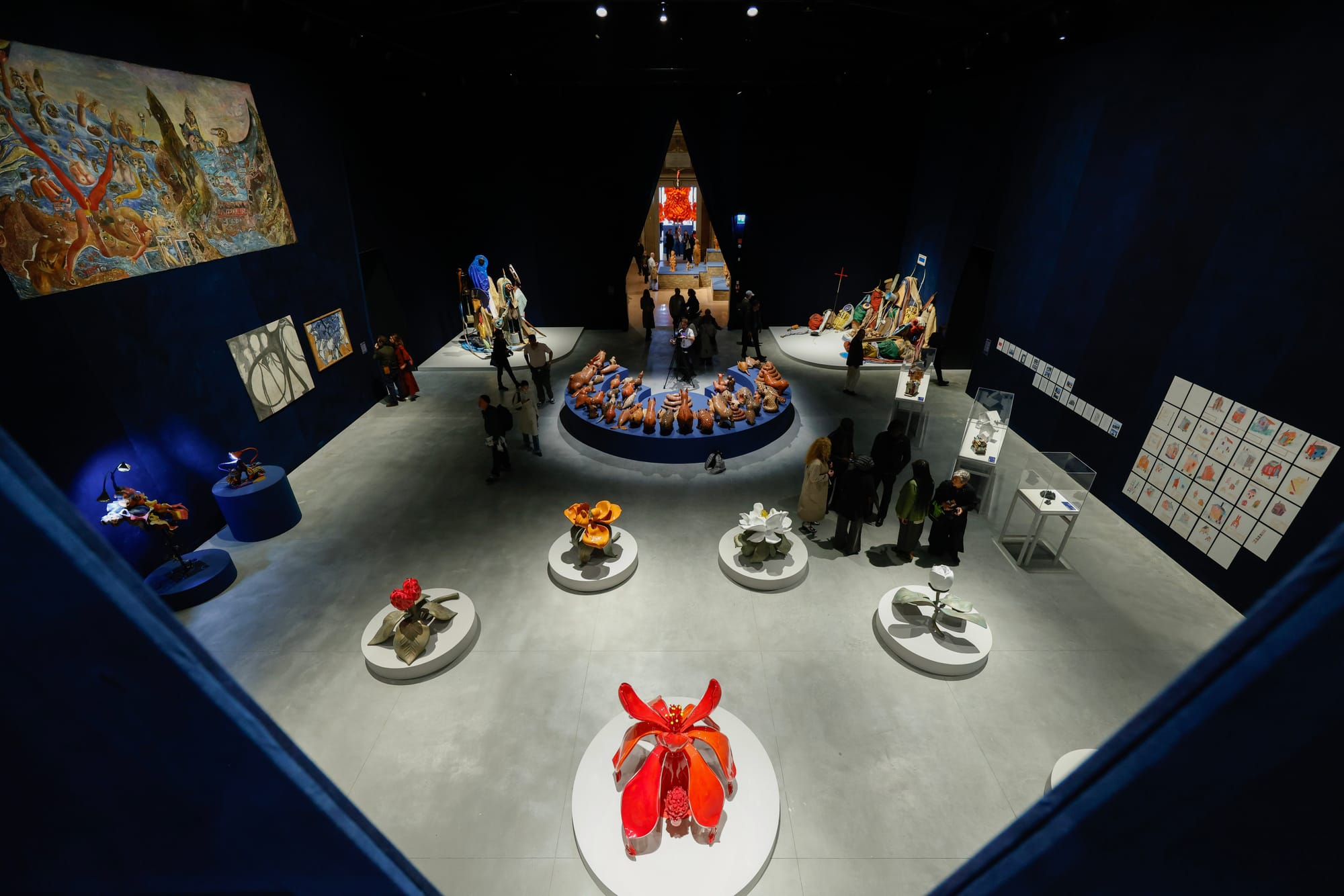
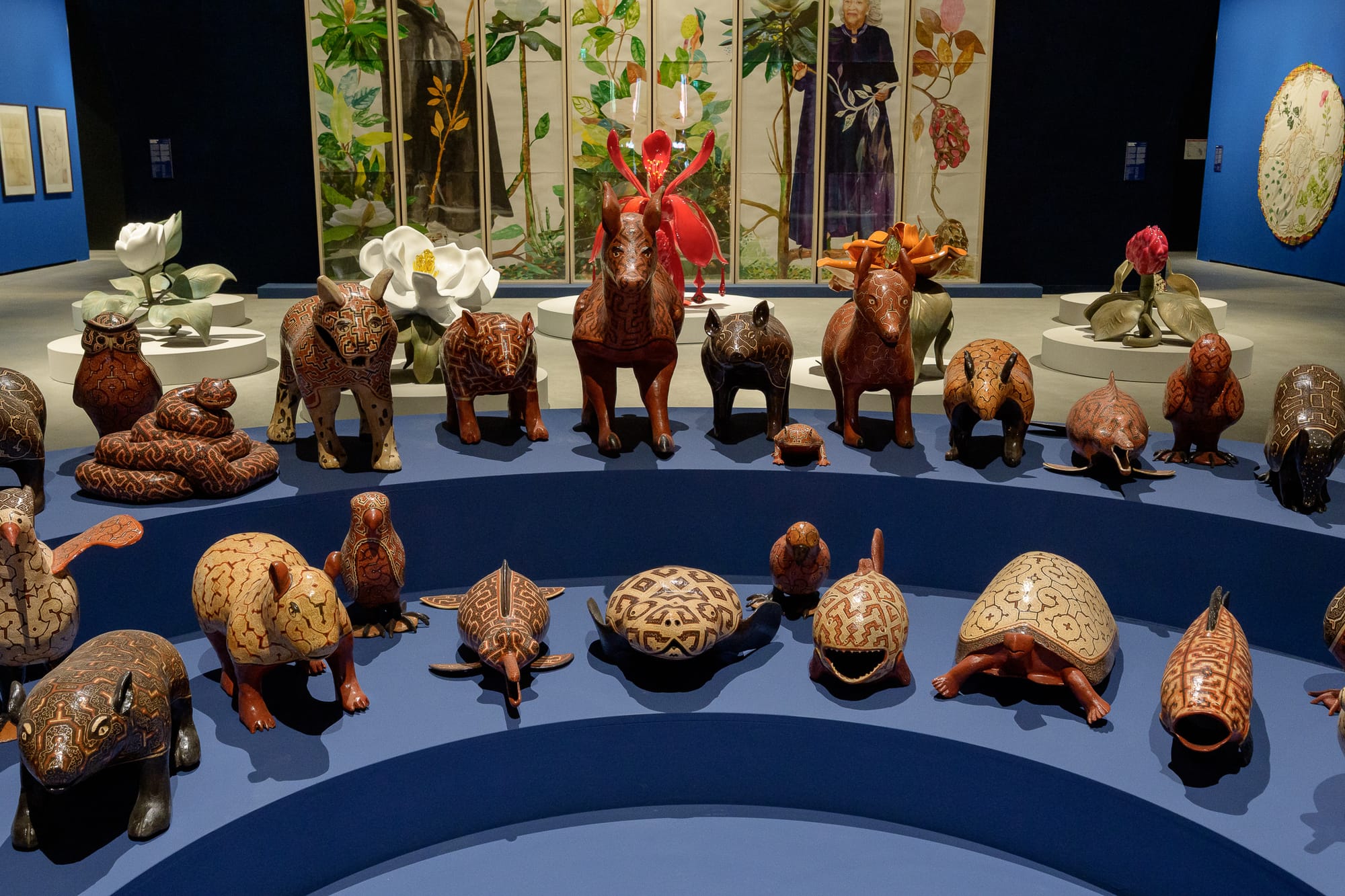
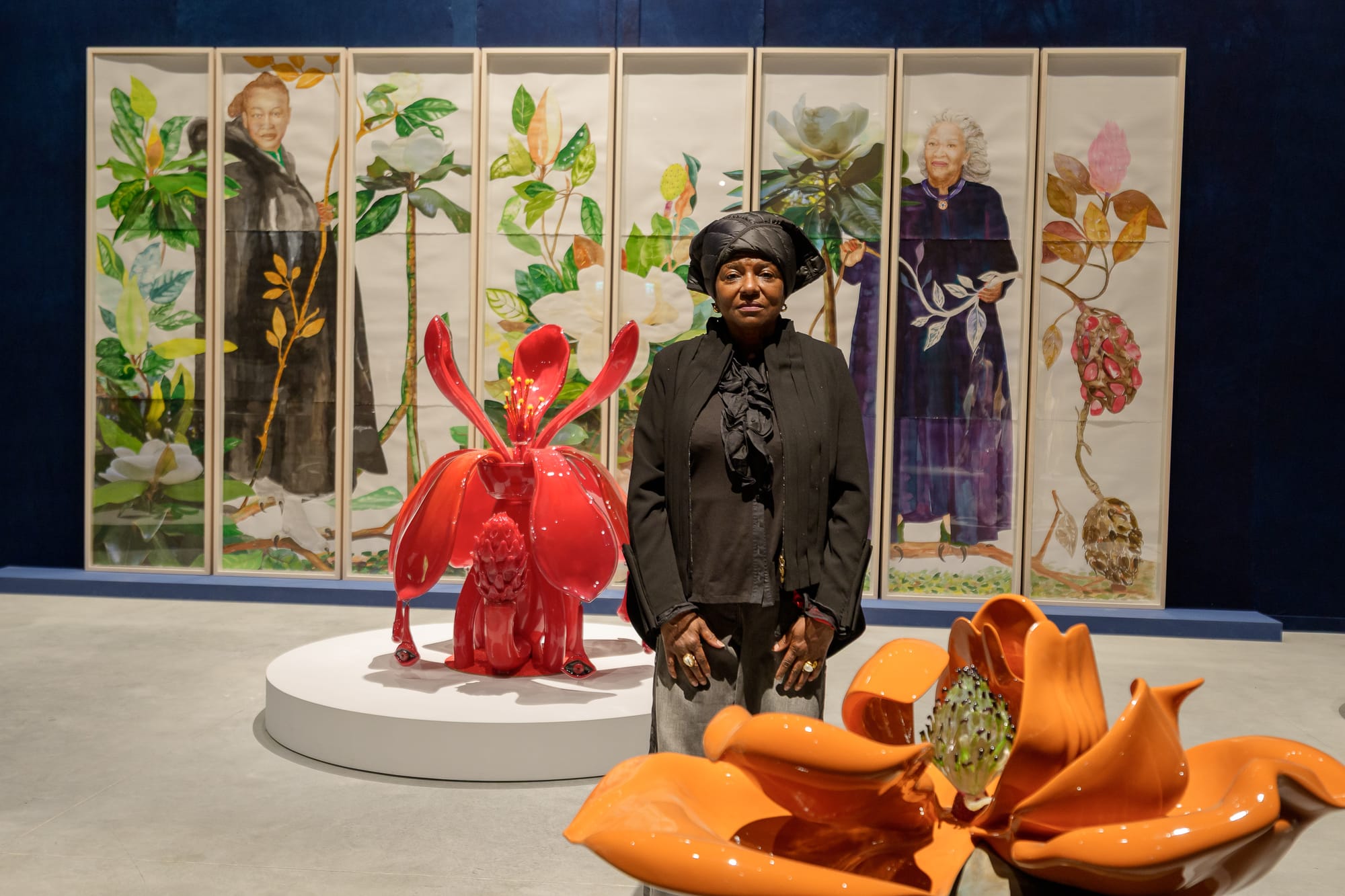
Installation views from the Central Pavilion section of Minor Keys, the 61st Venice Biennale, including Celia Vázquez Yui’s The Council of the Mother Spirits of the Animals and María Magdalena Campos-Pons & Kamaal Malak’s Anatomy of the Magnolia Tree for Koyo Kouoh and Toni Morrison. Photos: Jacopo Salvi and Andrea Avezzù. Courtesy of La Biennale di Venezia.
(Un)absorbed Loss
Beyond the above-mentioned categorisation, this tragic vacancy appears to fracture the main exhibition of the 61st Venice Biennale into two overlapping and sometimes conflicting modalities of mourning that extend across the Arsenale and the Central Pavilion.
In one, grief is worked through into conceptual form: it is metabolised into structure, language, or critical inquiry, where affect is not eliminated but organised into legible artistic and intellectual propositions.
At the entrance to the Arsenale, Refaat Alareer’s poem If I Must Die confronts visitors in a form that reads less as literary inscription than as epitaphic address, holding together public loss and the unfinished condition of a curatorial project never witnessed in its realised form. Yet, the poem also insists on persistence: “so that a child somewhere in Gaza sees the kite, my kite, the one you made, let it bring hope.”
Laurie Anderson’s Some Say Our Empire Is Passing (2026) operates as an intellectual black box, its white charcoal drawings charting the slow decay of global hegemony. By contrast, Guadalupe Maravilla’s Disease Throwers (2025) offers a visceral counterpoint to such structural collapse, combining large, totemic sculptures assembled from migration relics with a practice oriented toward cleansing and repairing personal and historical trauma. Theo Eshetu’s Garden of the Brokenhearted acts as a vital site of critical resistance within the Arsenale, where the literal unrooting of the olive tree materialises the trauma of displacement, transforming a space of profound historical loss into a temporary refuge that forces us to navigate the tension between ecological mourning and political survival.
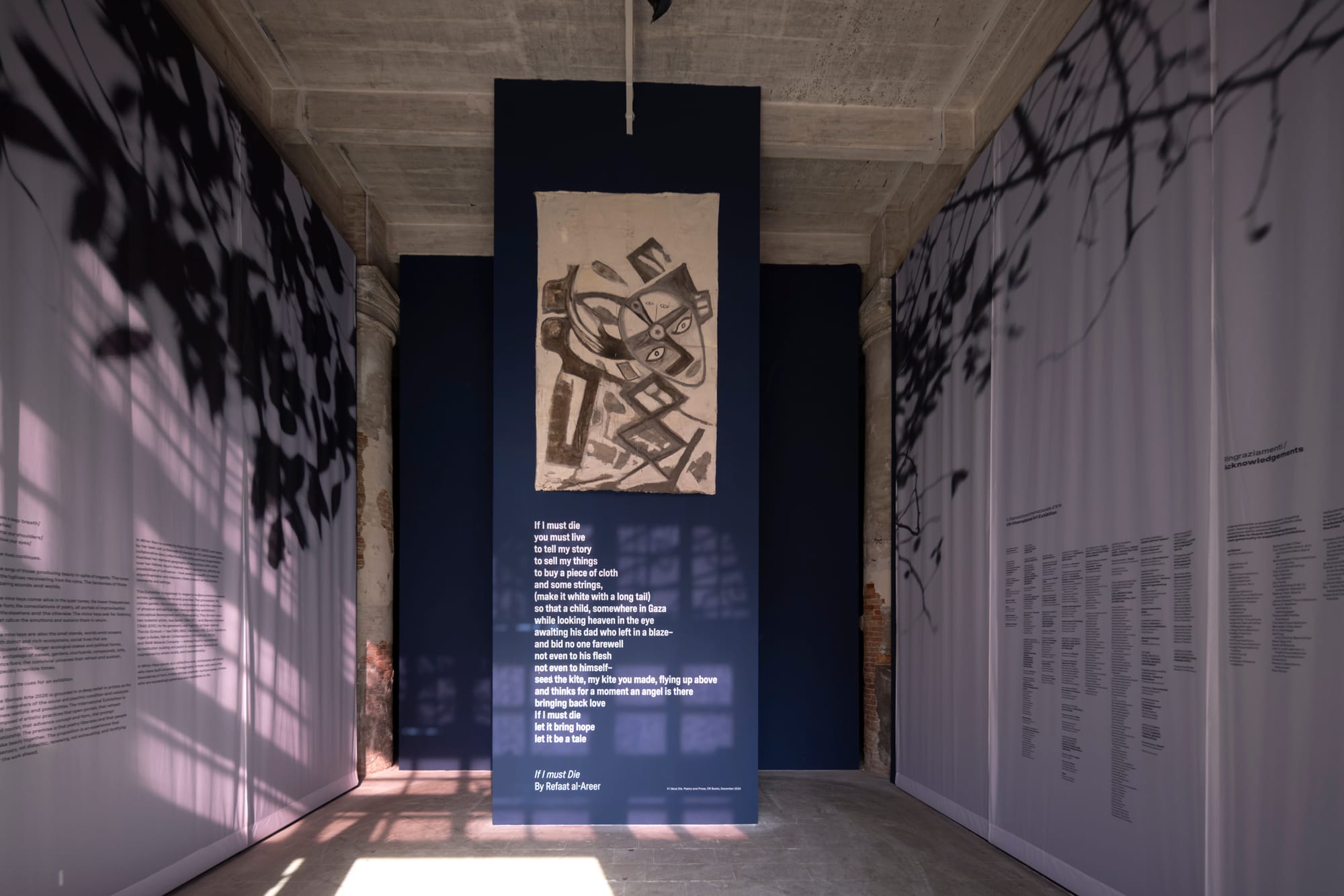
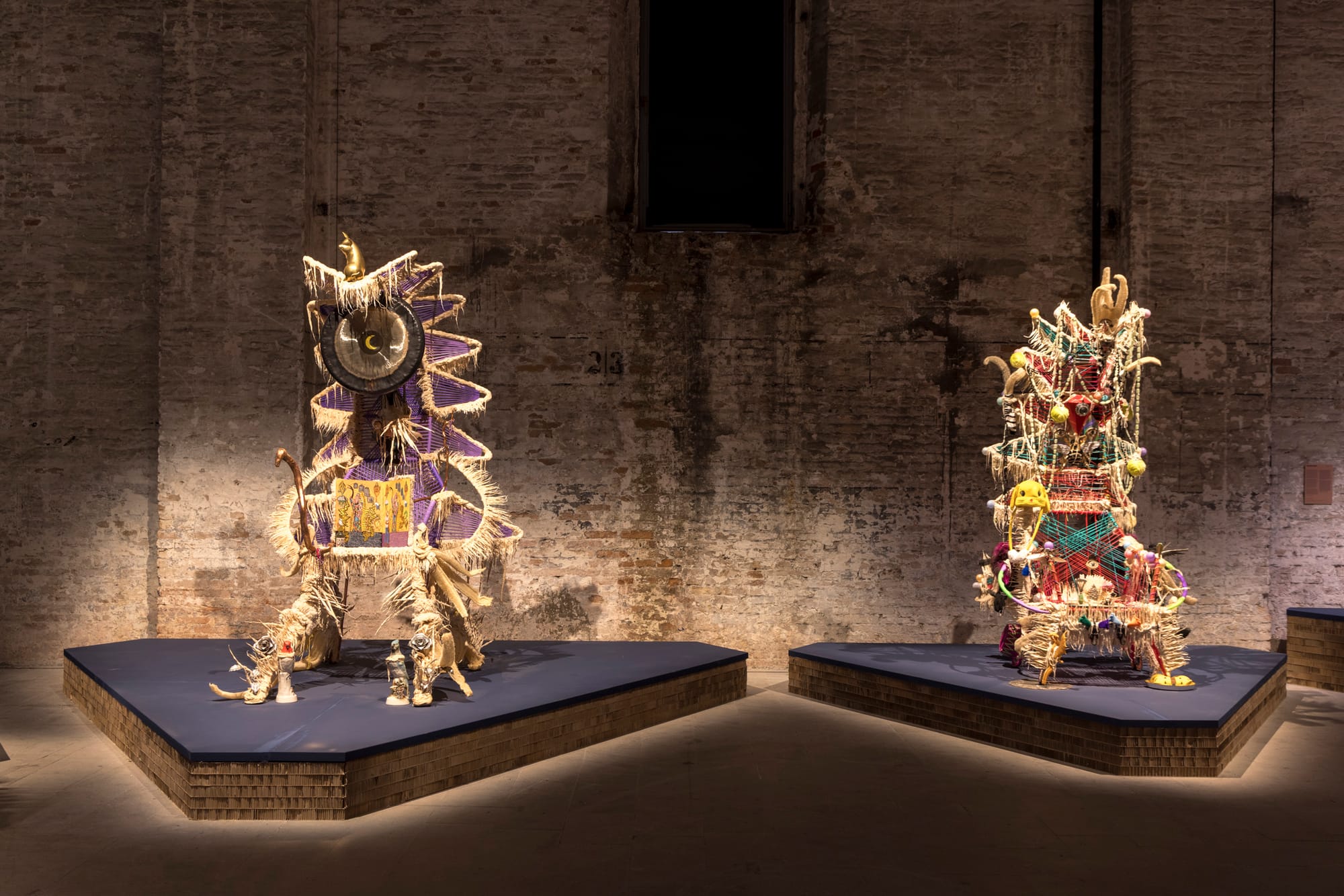
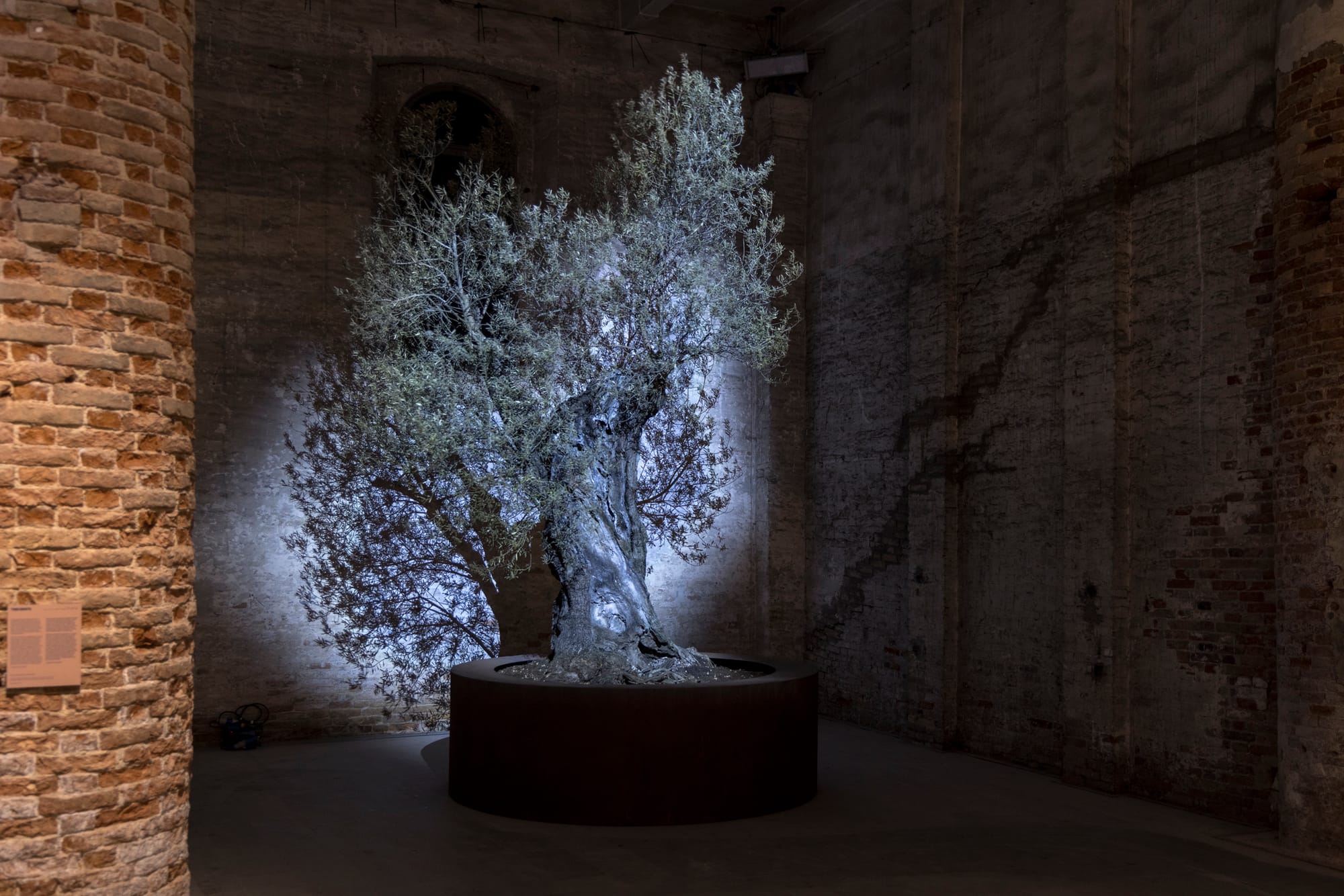
Installation views from the Arsenale section of Minor Keys, the 61st Venice Biennale, including Refaat Alareer’s If I Must Die, Guadalupe Maravilla’s Disease Throwers, and Theo Eshetu’s Garden of the Brokenhearted. Photo: Marco Zorzanello. Courtesy of La Biennale di Venezia.
In the other, grief remains closer to an immediate aesthetic register, circulating as atmosphere, motif, or surface intensity and producing a more decorative, visually legible affective field rather than a conceptual resolution. At times, however, this same register risks solidifying into a recognisable aesthetic code, in which mourning is reduced to surface effect, motif, and decorative repetition.
Large-scale black sculptures such as Nick Cave’s Amalgams and Graphts (2025) and Wangechi Mutu’s Simbi Siren (2026) test the threshold at which mourning is formalised into visual language. Here, black is no longer simply absence or withdrawal, but a charged material that oscillates between affect, symbolism, and the logics of corporate design.
Expulsive Generosity
The accompanying “collective score” suggests a limited degree of structural coherence. Some arrangements feel only loosely motivated; for instance, the visitor’s entry into the Central Pavilion strangely pairs Big Chief Demond Melancon’s Amistad Takeover (2026) with Marcel Duchamp’s Boîte-en-valise (1941–1966) in close proximity.
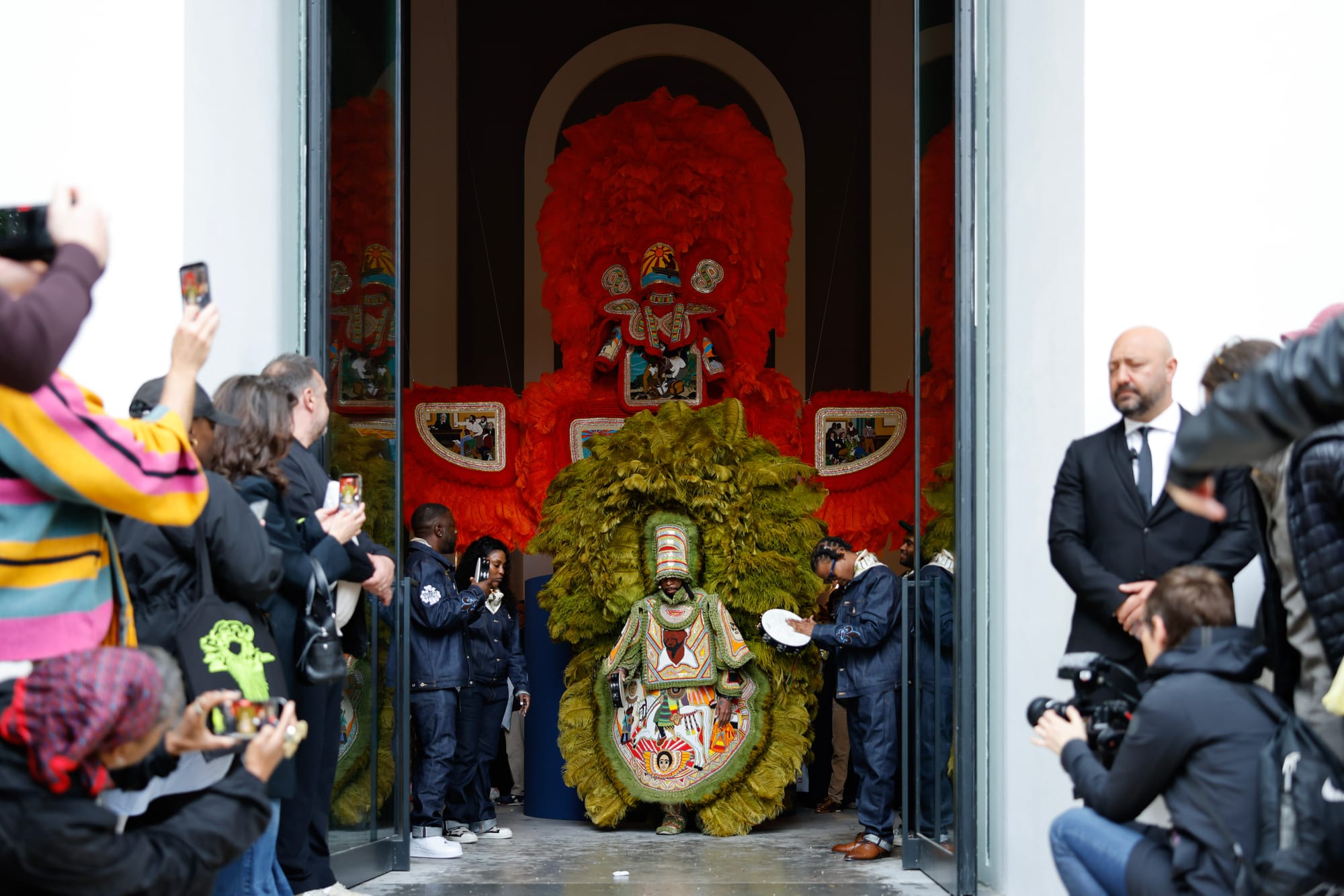
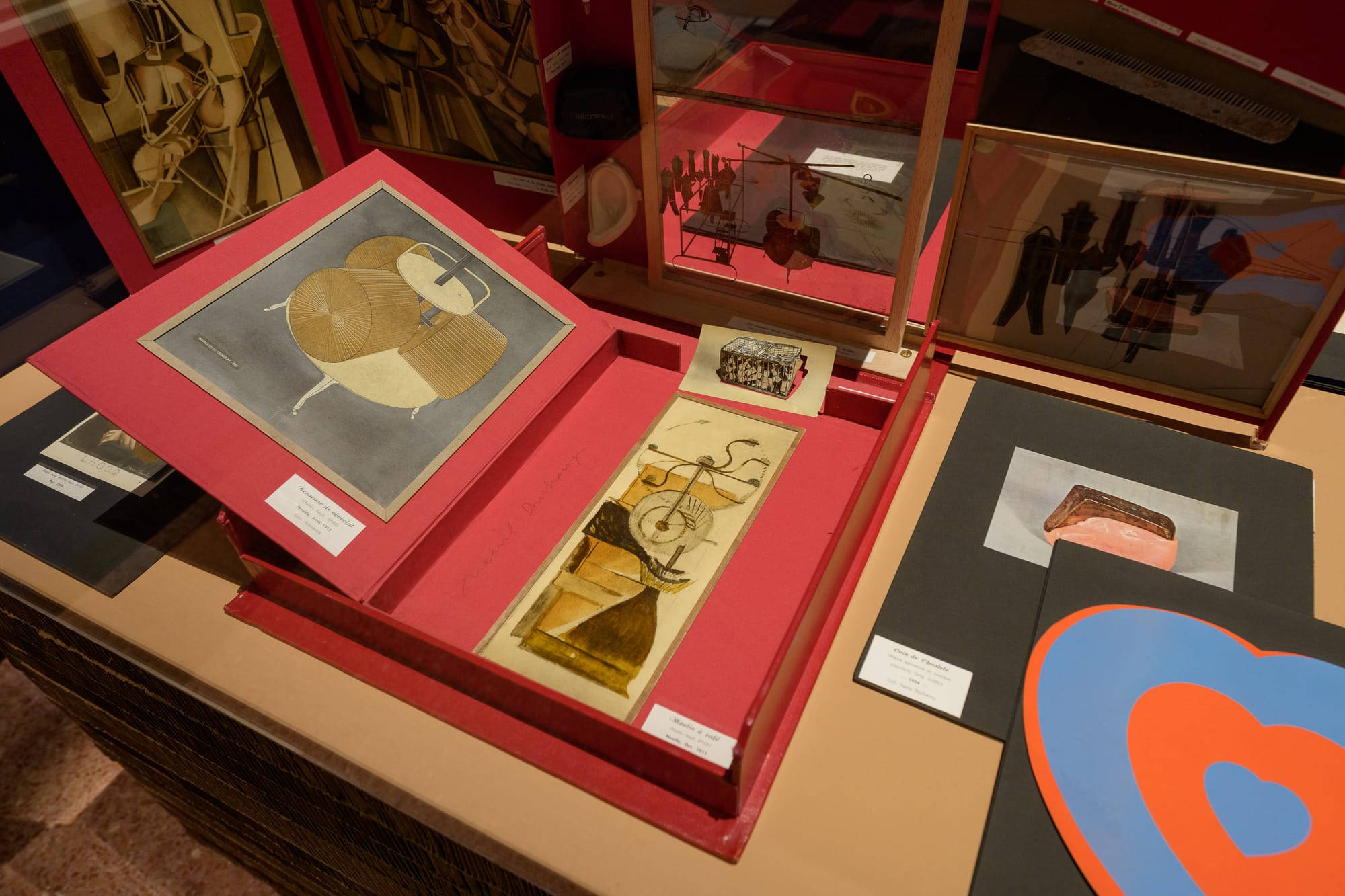
Performance and installation views from the Central Pavilion section of Minor Keys, the 61st Venice Biennale, including Big Chief Demond Melancon’s Amistad Takeover (2026), activated in Blessing the Ancestors (2026), and Marcel Duchamp’s La Boîte-en-valise: From or by Marcel Duchamp or Rrose Sélavy (1941–1966). Photos: Jacopo Salvi and Andrea Avezzù. Courtesy of La Biennale di Venezia.
The Central Pavilion unfolds as a densely populated, polyvocal field organised less by sequence than by accumulation and an expansive logic of inclusion. Works are placed side by side across diverse geographies, practices, and institutional contexts, though their relations are not always clearly articulated. While an overall continuity persists, the installation occasionally breaks into discontinuous clusters, at times recalling the logic of an art fair rather than a tightly structured biennial.
This fragmentation is most visible in the handling of smaller-scale works: ceramics, painting, textiles, and embroidery, which are often absorbed into the display without strong curatorial differentiation. The result is an expansive methodology that accommodates theatrical, ornamental, and opulent gestures, while not always fully framing their internal relations. In several cases, juxtapositions remain under-articulated, and co-presence tends to outweigh explicit articulation as a mode of meaning production.
A clear selection process is nevertheless evident, but the relatively light contextual framing between practices produces an effect of accumulation: positions appear primarily through proximity, generating density without consistently stabilising into coherent constellations.
Navigating Coherence
To move through the Biennale is therefore to oscillate between two registers: an affectively charged field of mourning on one hand, and a saturated environment shaped by accumulation on the other. Their tension sustains a perceptual pressure, as the exhibition repeatedly approaches coherence without fully settling into it.
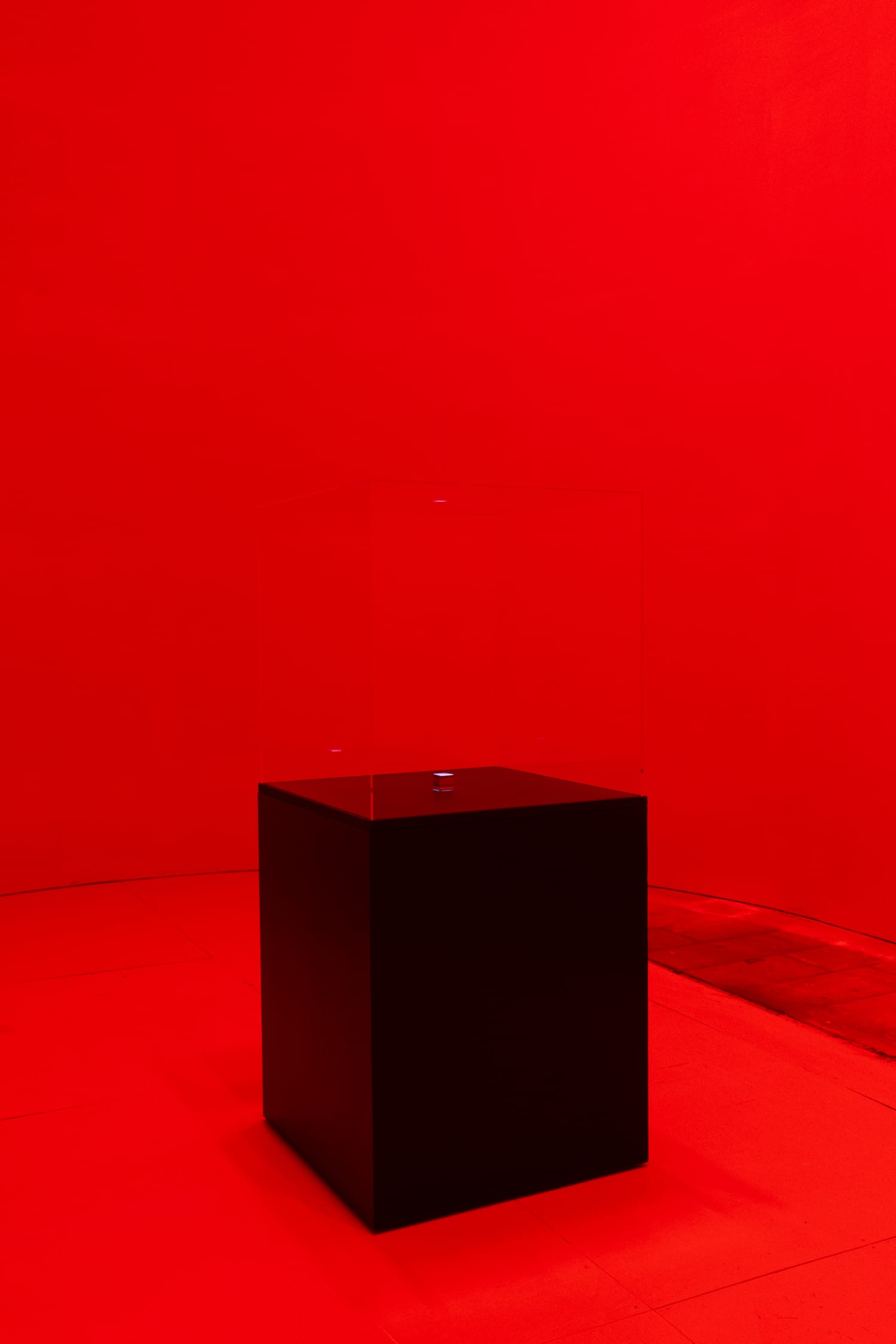
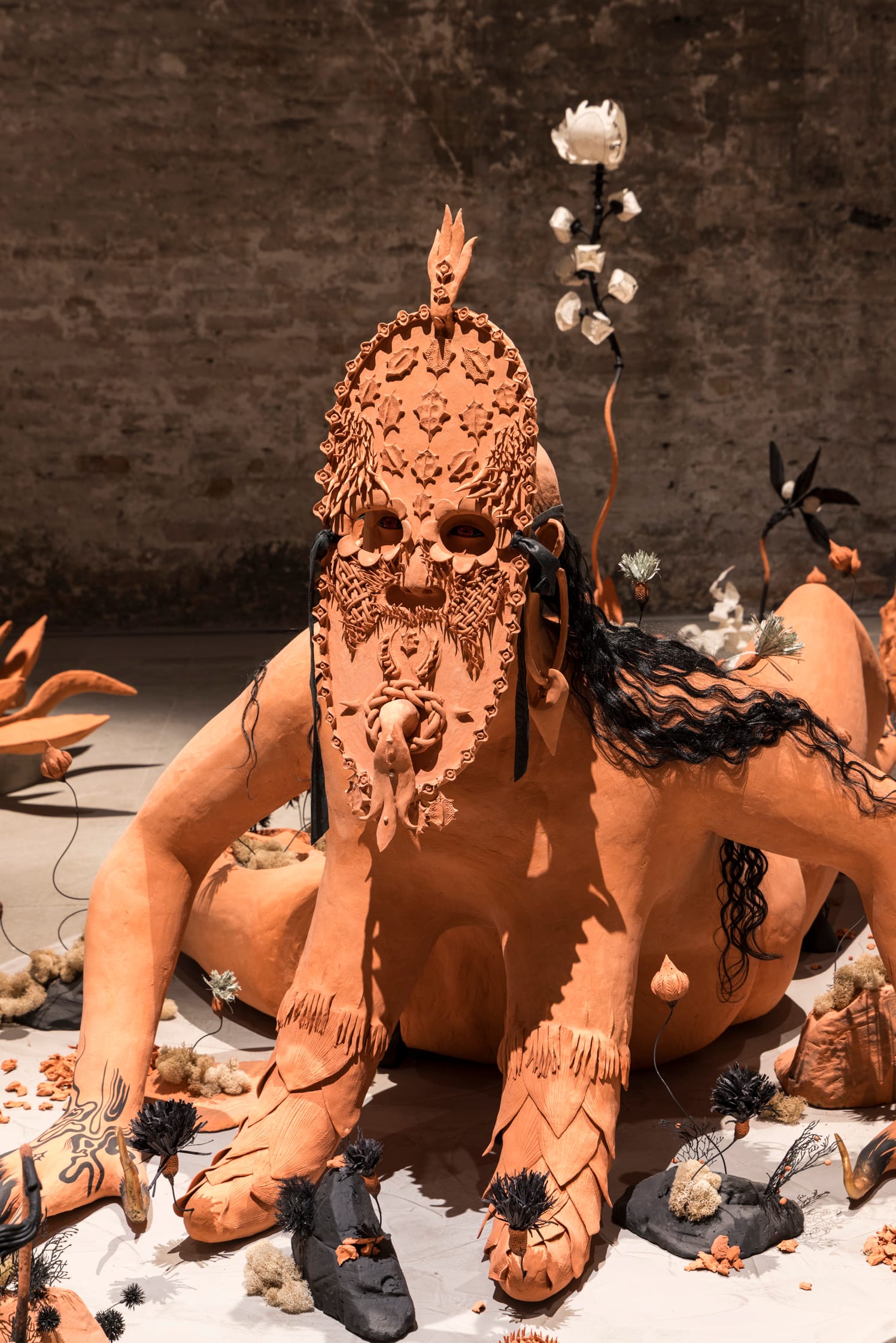
In the Arsenale, the most iconic artworks are those that hold the room, exhibiting a form of curatorial independence in which they generate their own spatial and perceptual logic rather than relying on juxtaposition. Take, for example, Alfredo Jaar’s The End of the World, a monumental room bathed in red light that houses a tiny four-centimetre cube made of compressed cobalt, rare earth elements, copper, tin, lithium, nickel, manganese, coltan, germanium, and platinum, some of the most critical minerals in the world today. Or Rajni Perera and Marigold Santos’s Efflorescence/The Way We Wake (2023) presents an uncanny female humanoid whose fragmented body merges with vegetal life. With her head concealed behind a mask, her legs detached and reversed, and plants emerging from her flesh, the figure evokes a state of metamorphosis in which the boundaries between the human, the natural, and the mythical become unstable.
Due to the absence of the curator as a central authorial figure, meaning does not collapse but instead disperses, operating not within political immediacy but rather in orientation toward eternity. Yet at certain moments, this organisational looseness must be read through the lens of profound tragedy: the mere fact that the committee successfully installed and presented these complex artworks, allowing them to stand in their own right, constitutes a significant achievement. At the same time, it leaves the viewer to navigate the fine line between a discernible curatorial vision and a series of unguided placements.
Rethinking Inclusion
Since Okwui Enwezor’s All the World’s Futures (2015), and now with Koyo Kouoh’s curatorial horizon in view, the Venice Biennale has increasingly treated Blackness and postcolonial discourse not as thematic supplements but as structuring epistemologies of contemporary art. Yet the institutional consolidation of these frameworks also raises questions about which other peripheral histories remain insufficiently legible within global exhibition-making, among them Eastern European and post-socialist narratives.
The Western art world and practices associated with the Global South continue to unfold within uneven and asymmetrical aesthetic and epistemic conditions. While contemporary institutions increasingly incorporate craft, ritual, and votive forms into contemporary art discourse, these practices do not simply enter a pre-existing system of meaning; they also unsettle and reconfigure it. At the same time, they remain caught within institutional frameworks that often oscillate between aestheticisation and ethnographic legibility, revealing the persistence of inherited modes of classification.
Rather than a lack of reciprocity, what emerges is a field of uneven translation, where influence is real but asymmetrical, and negotiation is ongoing but structurally constrained. Visibility alone is therefore insufficient. The question is not inclusion as such, but how interpretive and curatorial frameworks are continually produced and contested within the encounter itself. This raises a broader question that extends beyond the Venice Biennale: how can contemporary art institutions reconfigure the very conditions through which difference is made legible, valued, and transformed, rather than simply included and displayed.
Towards Polyphony
The absence of Koyo Kouoh in curating the 61st Venice Biennale has destabilised authorship, shifting attention from a singular curatorial voice toward the structures, gaps, and relations that remain visible in its withdrawal. Contrary to what the title suggests, Minor Keys offers no minor register; instead, it unfolds as an overflowing multitude of positions, visually dense and at times overwhelming, like a chorus that refuses to remain subdued. Yet beneath this abundance lingers a thin veil of sotto voce grief: absence does not merely wound, but, when confronted with courage, it can rearrange attention and reorder the world, opening space for unexpected turns, new rhythms, and emergent forms of relation. This produces a plural and polyvocal melancholic sensibility, a veil of sadness that, rather than diminishing the artworks, affirms and celebrates diversity in both content and form.
Review by Maja Ćirić | Curator & Art Writer
© ART Walkway. All Rights Reserved.
 Maja Ćirić