
Ai Weiwei and the Burden of Scale
At Aviva Studios, Button Up! turns Manchester’s Warehouse architecture into a theatre of empire, migration and censorship — while testing whether political monumentality can still accuse power without becoming spectacle itself.
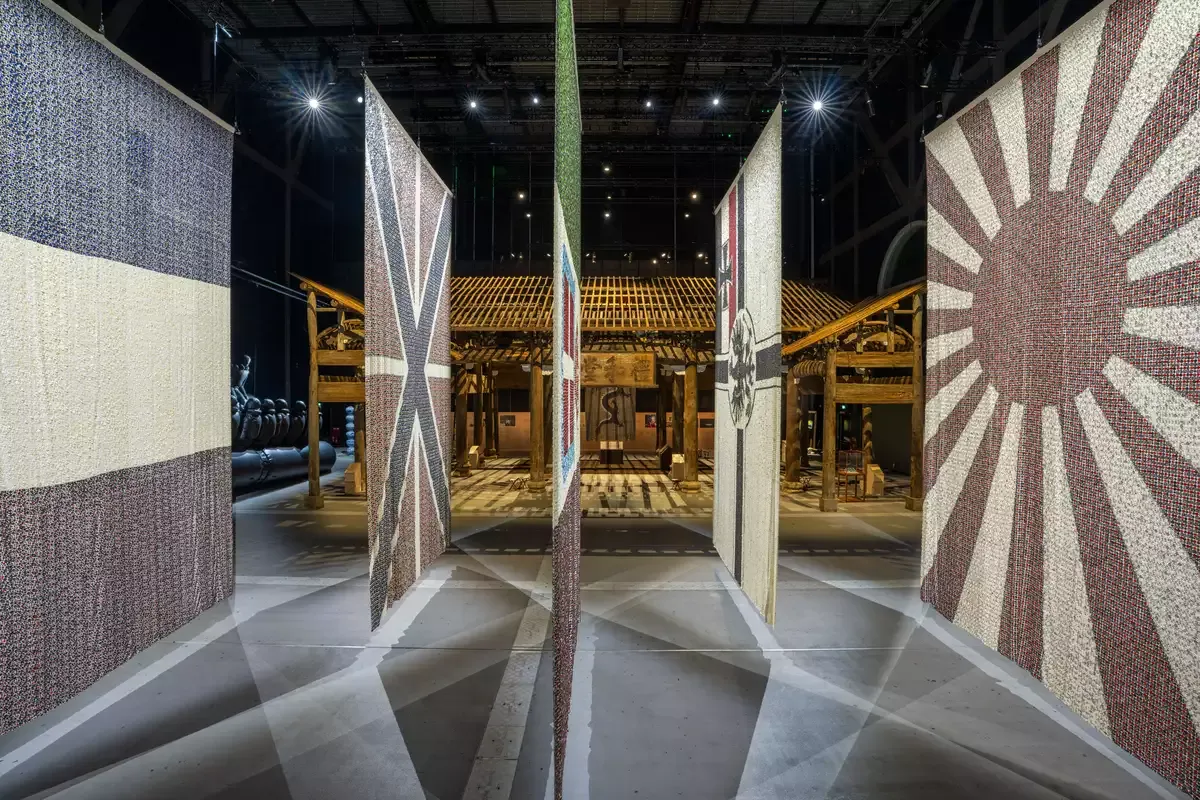
A migrant boat stretches across the Warehouse. Flags made from millions of buttons hang with the weight of national history. Bombs assembled from toy bricks cover a wall like a catalogue of human invention turned toward destruction. Around them, Aviva Studios does what it was built to do: make scale visible.
Ai Weiwei does not enter a neutral room.
At Aviva Studios, the Warehouse is already a demand. It asks for scale before any work has been installed. Its height, depth and industrial vastness do not simply receive art; they place pressure on it. Small gestures risk disappearing. Intimacy has to fight for air. A work can become monumental there almost by necessity, whether or not monumentality is what it needs.
Button Up! accepts that challenge directly.
Ai is not simply filling the Warehouse. He is using its appetite against itself. A venue built to host spectacle becomes, in his hands, a place where spectacle is made uneasy: the same scale that might ordinarily produce awe is redirected toward histories of extraction, displacement and control.
Ai has said that he is not interested in making large works only for the sake of size. In Manchester, however, the space calls for them. The statement matters because it identifies the exhibition’s central risk. Scale is both the condition that makes the show possible and the danger it must survive. A warehouse can turn history into evidence. It can also turn evidence into spectacle.
This is the burden Button Up! carries. The exhibition’s real question is not how large political art can become, but what happens to evidence once it is enlarged.
The exhibition gathers new and existing works across sculpture, installation, film, architecture and material accumulation. Its subject is vast: two centuries of Chinese and British relations, industrial capitalism, imperial violence, migration, censorship, surveillance and the present crises that continue to inherit those histories. Two new commissions, including Eight-Nation Alliance Flags and a new version of History of Bombs, sit beside major works shown in the UK for the first time. Manchester is not incidental to this framing. The city’s industrial past, its textile history and its place in the story of global production give the exhibition its local charge.
Ai’s question is not only what happened between Britain and China. It is how systems of trade, labour, force and consumption continue to pass through ordinary objects.
A button, in this exhibition, is never only a button.
Small Things, Vast Systems
The title Button Up! carries a joke, a command and a threat.
It refers to the millions of buttons used in Eight-Nation Alliance Flags, the new work made from the stock of a closed British button wholesaler. It also points toward censorship: the instruction to be quiet, to fasten speech shut, to make dissent presentable. The phrase sounds playful until it becomes disciplinary.
That movement from the ordinary to the political is one of Ai’s most durable methods. He takes materials that seem familiar, even harmless, and multiplies them until they begin to expose the systems behind them. Sunflower seeds, backpacks, bicycles, porcelain, toy bricks, life jackets, surveillance cameras, buttons. The object remains legible, but its innocence does not.
In Manchester, the buttons carry several histories at once. They belong to clothing, trade, domestic life and manufacture. They recall the textile economies that helped shape Britain’s industrial power. They also point toward China’s place in contemporary mass production. Salvaged from one closed commercial life, shipped, sorted, sewn and reorganized into flags, they become evidence of labour moving across time.
The Eight-Nation Alliance Flags hang with a physical heaviness that exceeds their material. They are banners, but they do not feel celebratory. They mark the imperial coalition that invaded China in 1900, turning national emblems into objects of historical weight. The buttons make the flags tactile and almost absurdly patient. Each small unit matters only because it has been repeated so many times.
That is Ai’s logic at its strongest: accumulation as accusation.
History of Bombs works through a related reversal. Made from millions of toy bricks, the work turns the grammar of childhood assembly toward the machinery of destruction. From a distance, the bombs can appear sleek, diagrammatic, almost clean. Up close, their construction becomes more troubling. The toy does not soften the weapon. It makes the weapon’s abstraction harder to avoid.
The child’s object and the military object meet inside the same system of manufacture.
When Scale Accuses
Button Up! is most convincing when scale does not simply enlarge the message, but reveals the system that made the message necessary.
Law of the Journey does this through unavoidable physical presence. The inflatable migrant boat stretches across the Warehouse with hundreds of human figures held inside it. Its force lies not in subtlety, but in refusal. The work does not permit the refugee crisis to remain a distant category. It makes displacement spatial. It turns the language of numbers into a body that cannot be easily looked around.
There is danger in that directness. Ai’s work often refuses ambiguity so insistently that the viewer can feel instructed rather than unsettled. But in Law of the Journey, the bluntness has a purpose. It recognizes that some realities are already over-explained and still ignored. The problem is not that audiences lack information. The problem is that information has become survivable.
Monumentality becomes a way of interrupting that survival.
Wang Family Ancestral Hall operates differently. Reassembled from more than a thousand wooden pieces, the Ming dynasty structure brings architecture into the exhibition as displaced memory. It does not accuse through volume alone. It creates a different tempo: slower, more architectural, closer to inheritance than emergency.
The work carries the weight of continuity under conditions of removal. It asks what happens when a building becomes movable, when ancestry is reconstructed inside a contemporary cultural venue, when an object that once organized social and ritual life is made to stand inside the warehouse logic of exhibition. It is less declarative than some of the surrounding works, and stronger for it.
La Commedia Umana, the black Murano glass chandelier of bones, skulls and organs, turns luxury against itself. A chandelier normally promises refinement, height, wealth and illumination. Here it becomes a hanging anatomy of death. Its beauty is inseparable from morbidity. It does not reject spectacle; it contaminates it.
That is where Ai’s use of scale becomes most effective. He does not pretend that spectacle is avoidable. He takes its seductions and makes them unstable.
When Meaning Arrives Too Quickly
Still, Button Up! raises a real question about political art.
What happens when every object is asked to stand for empire, war, migration, censorship or exploitation? At what point does clarity become flattening? When does a work stop opening thought and begin confirming what the viewer has already been told to feel?
Ai Weiwei has never been an artist of conventional nuance. This is often used against him, sometimes fairly. His images can be direct to the point of obviousness. A boat means migration. Bombs mean war. Flags mean empire. Bricks mean construction and destruction. Buttons mean manufacture, trade and censorship. The interpretive path is often unusually visible.
But subtlety is not always the measure political art should be judged by.
In a mass public venue, legibility is not automatically simplification. It can also be a way of refusing the comfort of specialist distance. Ai’s practice is not built around withholding. It is built around exposure. He works less like an artist hiding meaning inside objects than like an investigator assembling evidence until the pattern can no longer be denied. His materials often behave like witnesses. Their function is not to produce aesthetic uncertainty, but to insist that the viewer recognize connection: between industry and empire, commodity and coercion, private experience and public violence.
The weakness of this method is that it can become rhetorically closed.
The strength is that it understands something about power. Power is not always subtle either. It works through repetition, scale, administration, logistics, borders, categories, surveillance and force. Ai’s bluntness can feel heavy because the systems he addresses are heavy. The question is whether the heaviness remains active, or whether it settles into message.
Button Up! contains both outcomes.
Some works make history feel physically present. Others risk turning history into a symbol already explained. The exhibition is strongest when it allows materials to carry contradiction: buttons as labour and ornament, tea as culture and value, glass as luxury and death, architecture as memory and displacement. It becomes less persuasive when the object arrives as an illustration of a position rather than as a problem the viewer must stay with.
The Body Returns
This is why Sewing a Button matters, even as a related performance rather than the exhibition’s central installation.
After the flags, boats, bombs and architecture, Ai returns the question of power to a single body under observation. The performance re-enacts, in compressed form, the 81 days he spent in secret detention in China in 2011. Its scale is temporal rather than monumental: twenty-four hours, repeated actions, guards, interrogation, boredom, exposure, surveillance.
It changes the register of Button Up!.
The Warehouse allows history to become enormous. Sewing a Button reminds the viewer that power is also intimate, procedural and humiliating. It operates through waiting, watching, being watched, being denied privacy, being reduced to routines someone else controls. If the large installations show systems from outside, the performance returns to the body caught inside them.
That return is important because political monumentality can sometimes protect the viewer from vulnerability. A giant work can be overwhelming, but it can also keep suffering at a distance. One can admire its ambition, photograph its scale, agree with its message and still remain safely outside the condition being described.
A detained body is harder to convert into architecture.
Not impossible, but harder.
Live works also expose what monumentality can conceal. They depend on bodies, timing, translation, audience behaviour and institutional control. They can fail. They can become uncomfortable for the wrong reasons. They can reveal not only the violence they describe, but the fragility of staging violence as cultural experience.
That fragility is useful to remember when walking back into Button Up!.
The monumental works can look immovable. The performance suggests otherwise. Power may be systemic, but its consequences arrive through bodies. Art may build structures large enough to hold historical force, but it remains vulnerable to the room, the audience, the voice, the delay, the mistake.
Not Subtlety, But Pressure
The question Button Up! leaves is not whether Ai Weiwei is subtle.
Not in the conventional sense, and perhaps that has never been the point. His art rarely asks to be discovered quietly. It points, accumulates, enlarges, repeats, confronts. It wants the viewer to understand that the present is not separate from the histories that produced it.
The better question is whether monumentality can still create responsibility.
At Aviva Studios, the answer is uneven but serious. The exhibition sometimes explains what its strongest works have already made visible. It sometimes trusts scale more than complexity. Yet its best works understand that scale need not be spectacle alone. Scale can be a way of making systems visible when ordinary display would let them remain abstract.
Buttons become flags. Toys become bombs. A boat becomes a public body. A chandelier becomes an anatomy of death. An ancestral hall becomes a displaced architecture of memory.
None of these transformations are neutral. They ask what kind of world has made such conversions necessary.
That is where Button Up! belongs within Ai’s larger practice. It does not offer art as escape from history, or activism as a supplement to art. It treats making, witnessing and accusation as connected acts. The exhibition’s force lies in its refusal to separate material from politics, object from system, history from the present.
Its risk lies in the same refusal.
When everything is connected, the work must still make the connection felt rather than merely declared. At its strongest, Button Up! does that. It turns the Warehouse into more than a container for large objects. It becomes a pressure chamber for histories that remain unfinished.
The show does not ask whether art can change power directly.
It asks whether power can still be made visible once it has become the background of ordinary life.
Ai Weiwei: Button Up! is on view at Aviva Studios, Manchester, from 2 July through 6 September 2026.
© ART Walkway. All Rights Reserved.


