
Biennale Arte 2026: In the Absence of… 1/2
Maja Ćirić reviews Minor Keys, the 61st Venice Biennale, tracing absence through protest, authority, national pavilions, and institutional rupture.

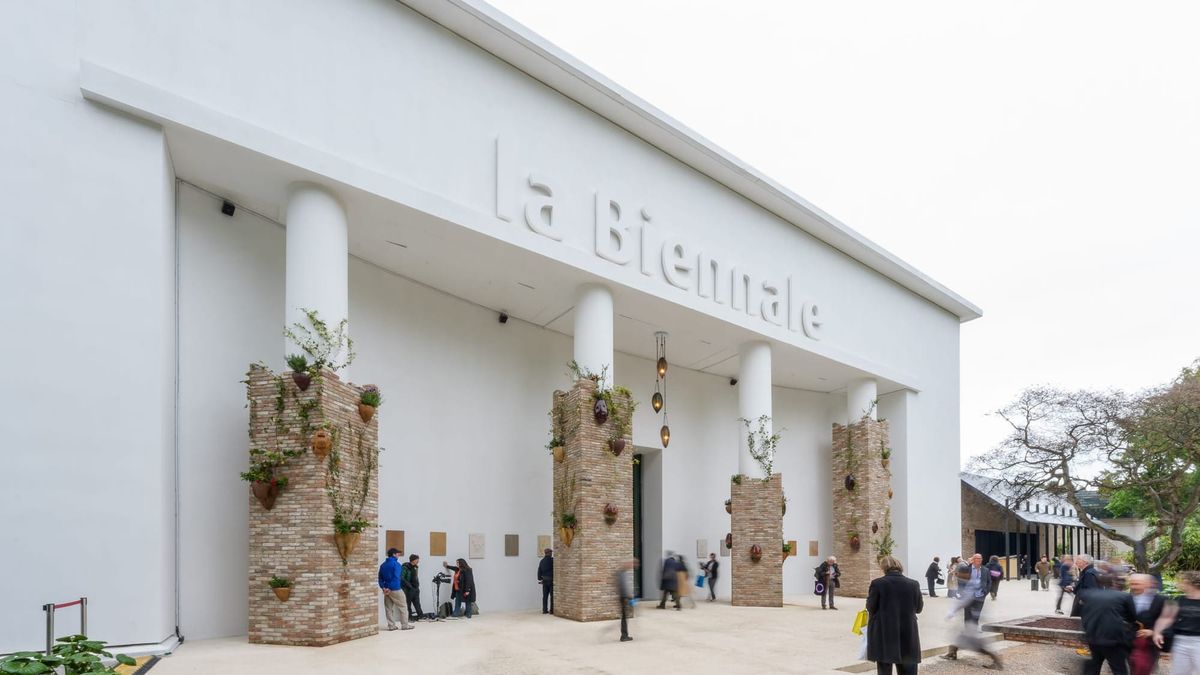
In absence, a field of tensions opens: emotional, structural, reflective, where meaning no longer arrives pre-sorted but must be carried in fragments. And at the 61st International Art Exhibition of La Biennale di Venezia, across the main exhibition Minor Keys, collateral events, and numerous ruptures, the absence of major chords does not erase; it repositions things.
Taxonomy of Absence
In the absence of Koyo Kouoh (1967–10 May 2025), curator of the 61st International Art Exhibition of La Biennale di Venezia; in the absence of the jury as an autonomous adjudicating body; in the absence of the prize as stabilised value; in the absence of justice as a binding horizon; in the absence of paternal state authority and its promise of protection, a range of tensions, emotions, and introspections emerge. African exhibiting bodies at the major show speak in tribute, in poems, in speeches that are at once address and rupture, asking why the universe could not wait for Koyo, why timing itself has become indifferent to presence, to loss, to recognition.
And the answer that returns is not an answer but a condition: the universe, it seems, does not wait for anyone anymore, neither for juries to convene, nor for prizes to settle value, nor for justice to align itself with institutions. Only the artworks, bodies on the ground, and lived experiences in the form of riots continue, exposed to time without protection, while thought is left to follow after them.
In the Absence of Justice
In the absence of justice, riot does not present itself as a form of evaluation but as refusal. Though far from the revolutionary intensity of the 1968 Venice Biennale protests in Piazza San Marco (St Mark’s Square), this year’s La Biennale di Venezia still carries traces of institutional disobedience and unresolved antagonism. It appears in sensory and bodily interruptions spread across the main nodes of Venice: the pink gunpowder haze marking Pussy Riot’s action against the Russian Federation; the mass mobilisations of ANGA (Art Not Genocide Alliance) bodies carrying Palestinian flags; and the counter-presence of heavily organised police formations performing their own choreography of force. Amid all this, the heavily guarded Russian Pavilion, saturated with floral arrangements and a staged DJ lineup, collapses under its own insistence on optimism, strength, and prosperity. Against the backdrop of an ongoing invasion, the invitation to dance acquires an almost grotesque dissonance.
Alongside these confrontations, Italian cultural workers intervened from within the institution itself by withdrawing cooperation from prize-based economies and prompting a partial 24-hour closure of pavilions during the last opening day. Framed as a strike against artwashing, the action called for an end to the “economy of genocide” and to exploitative labour conditions. Together, these acts do not simply contest judgement but suspend the conditions under which judgement claims authority.
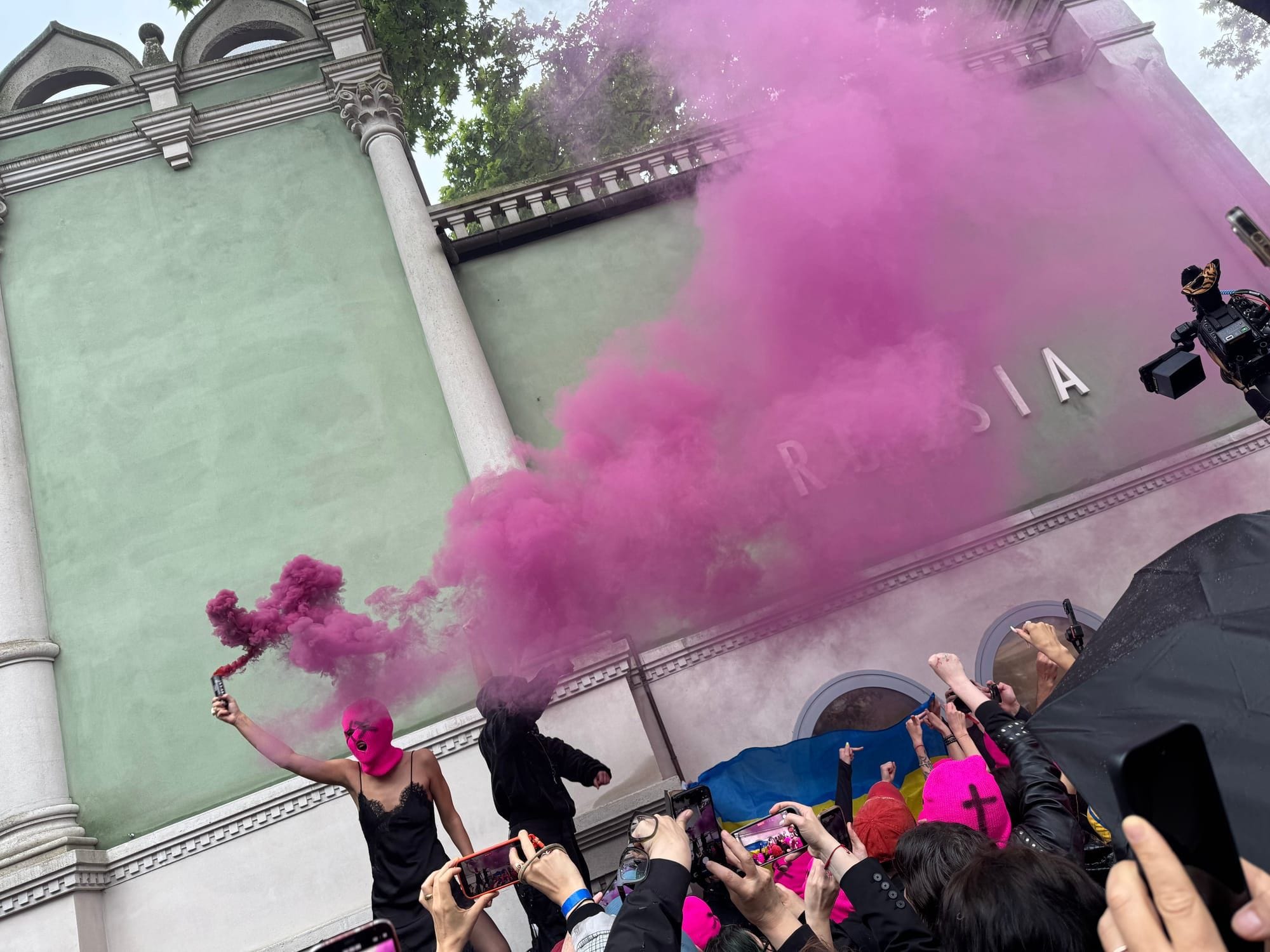
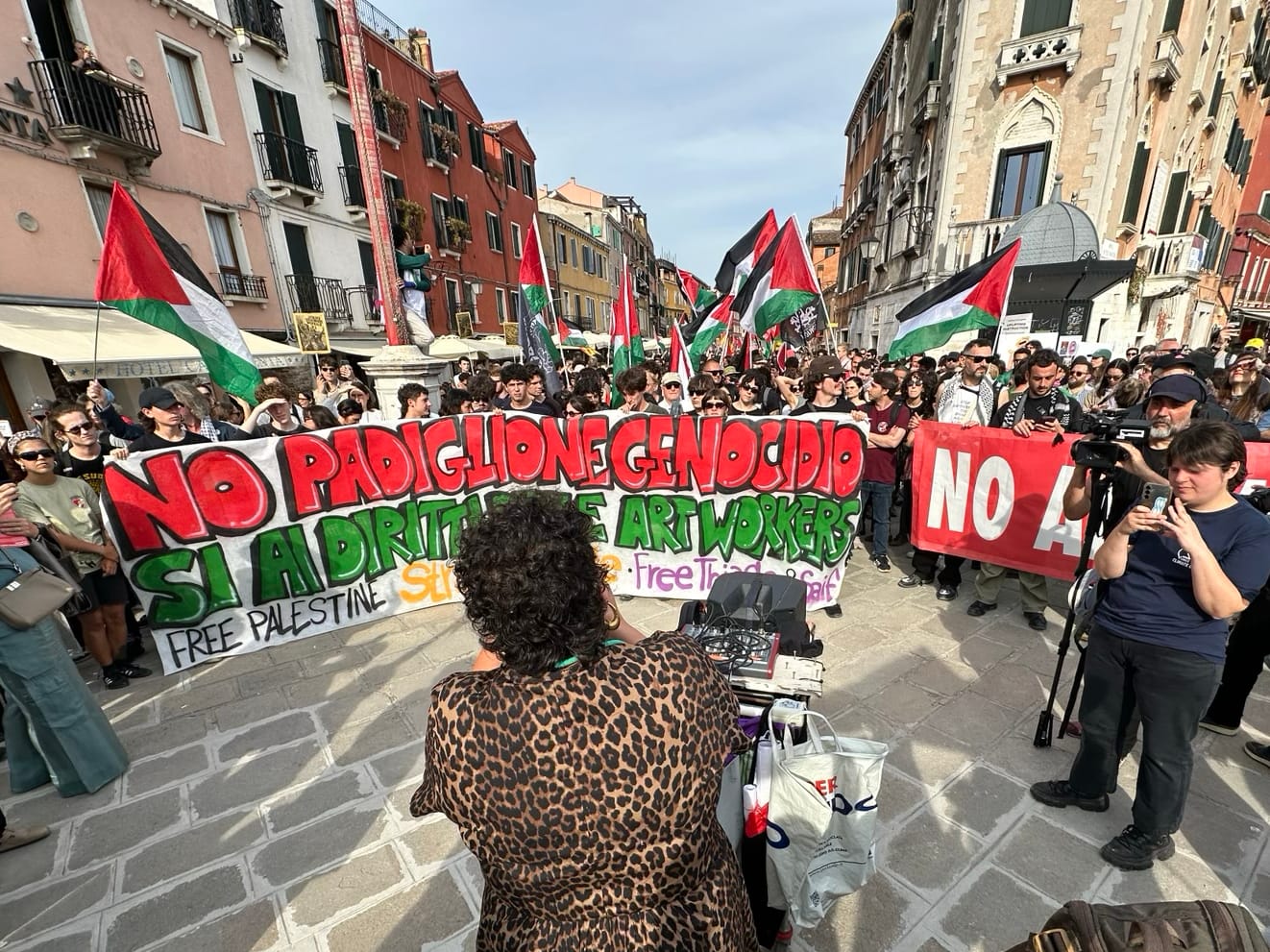
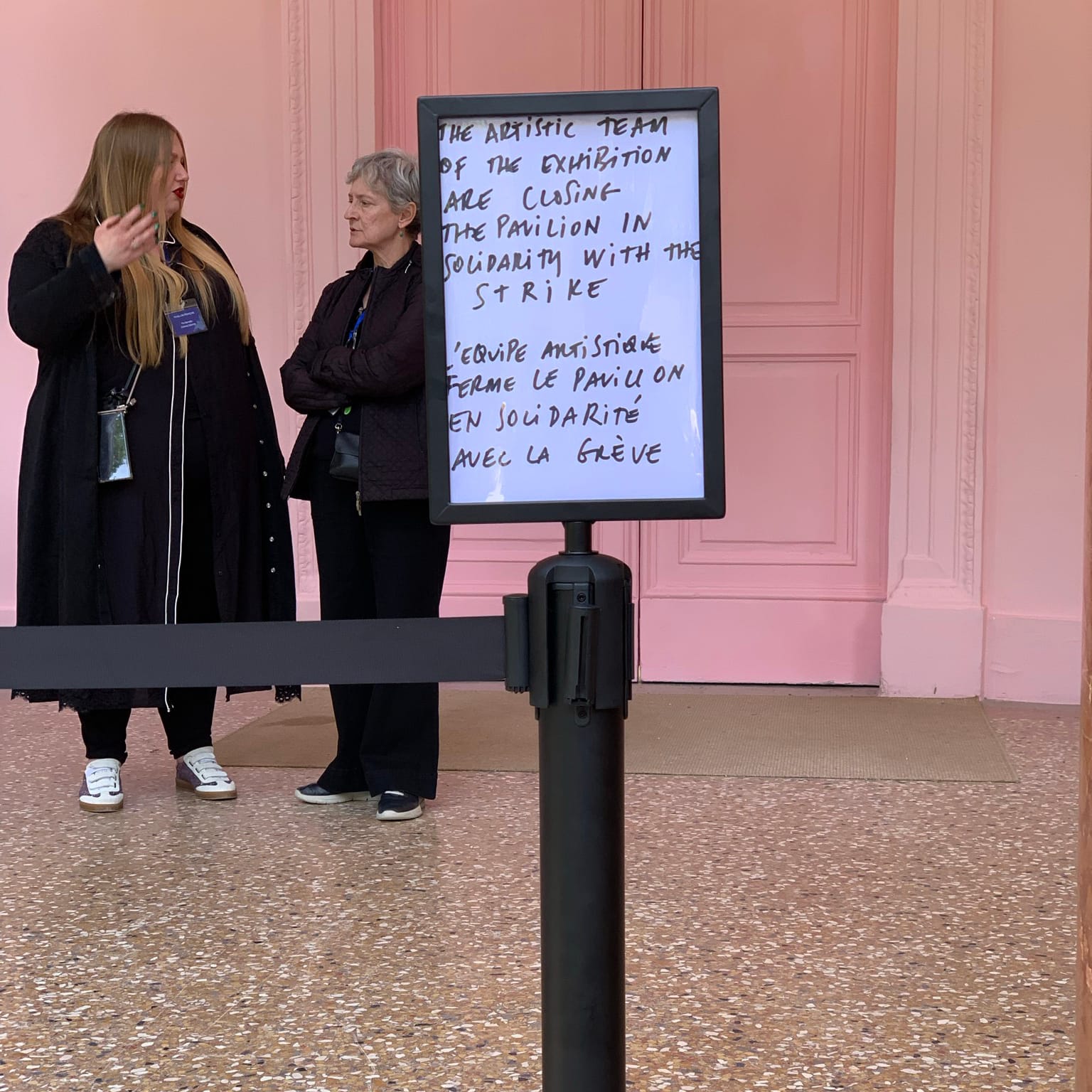
From left to right: Pussy Riot protesting outside the Russia Pavilion; Art Not Genocide Alliance (ANGA) mobilisations with Palestinian flags; and the closed French Pavilion with a strike notice. Image credits: Pussy Riot via Wikimedia Commons; ANGA; ANGA.
The strikes are not experienced only as rupture but as absence made audible. The exhibition begins to register through what is no longer present: unopened pavilions, suspended performances, interrupted flows of visitors. The machinery of the world in crisis becomes legible through the stage of the Venice Biennale. And in that withdrawal, another structure comes into view: the invisible contradictions that normally sustain the spectacle. The glamour of the institution reveals its dependencies at the moment those bodies step aside, producing noise the system cannot fully absorb. What links these dispersed actions is not a shared programme but a shared refusal of procedural silence. The Venice Biennale ceases to function as a stable architecture of judgement and becomes instead a field of interruptions: bodies that accumulate, wait, block, linger, and displace the authority of display. In this condition, presence is no longer representational; it becomes infrastructural pressure, the insistence of life against the grammar of institutional order.
In the Absence of Parental Authority
In the absence of a truth-seeking national authority, a legitimate symbolic father figure, or a nurturing motherland, loud, minor yet powerful deterritorialised bodies that refuse procedural silence take over this year’s national pavilions at the Venice Biennale.
At the Danish Pavilion, Maja Malou Lyse’s Things to Come turns the exhibition into a clinical-futurist fertility lab where reproduction is fully detached from the body and reorganised through image economies and sperm-banking infrastructures. Cryogenic sperm tanks embedded in the walls operate as biopolitical ready-mades, staging kinship as circulation without origin and biological continuity as administrative procedure rather than relation. In this system, the parent is structurally absent, replaced by technological and financial logics that render reproduction a matter of storage, transfer, and visual erotic stimulation, where desire and survival are increasingly routed through images rather than embodied connection.
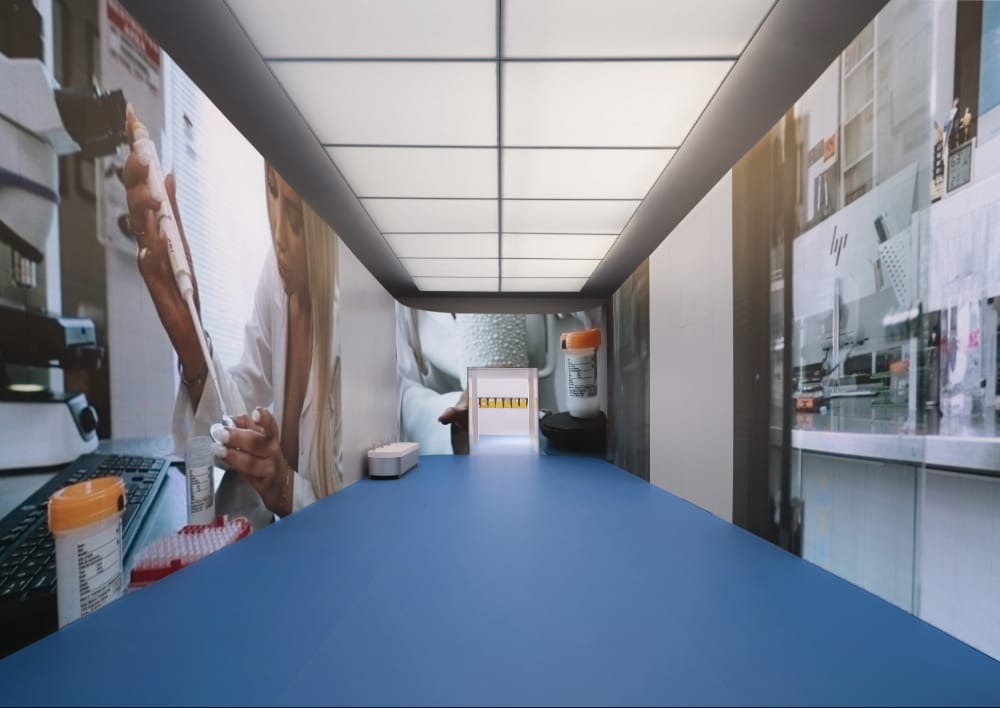
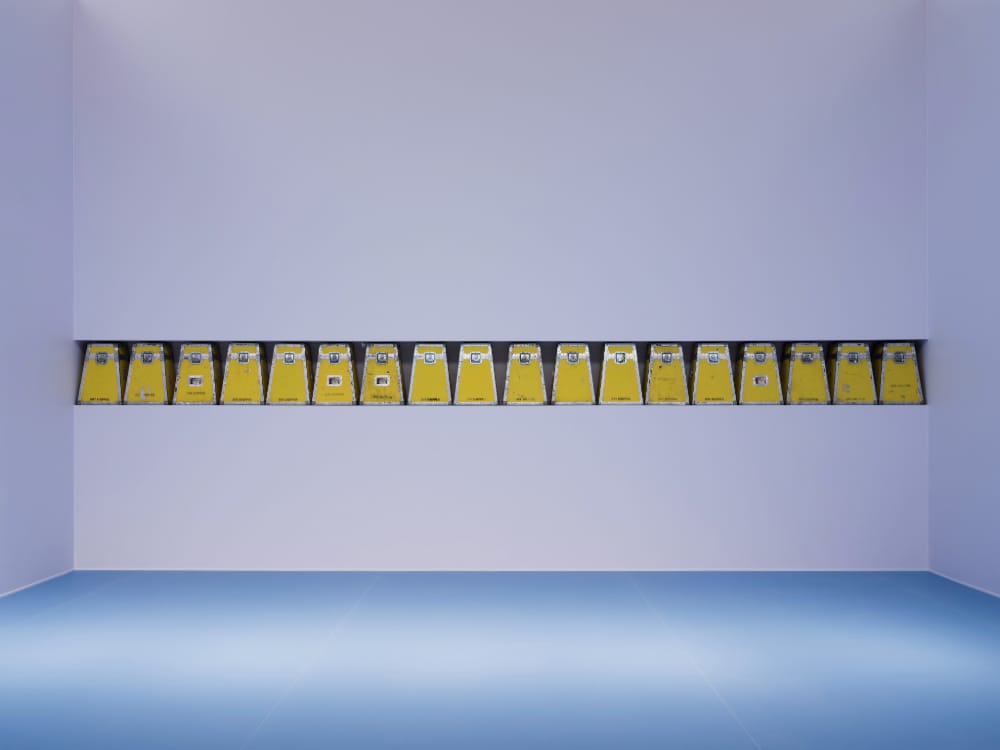
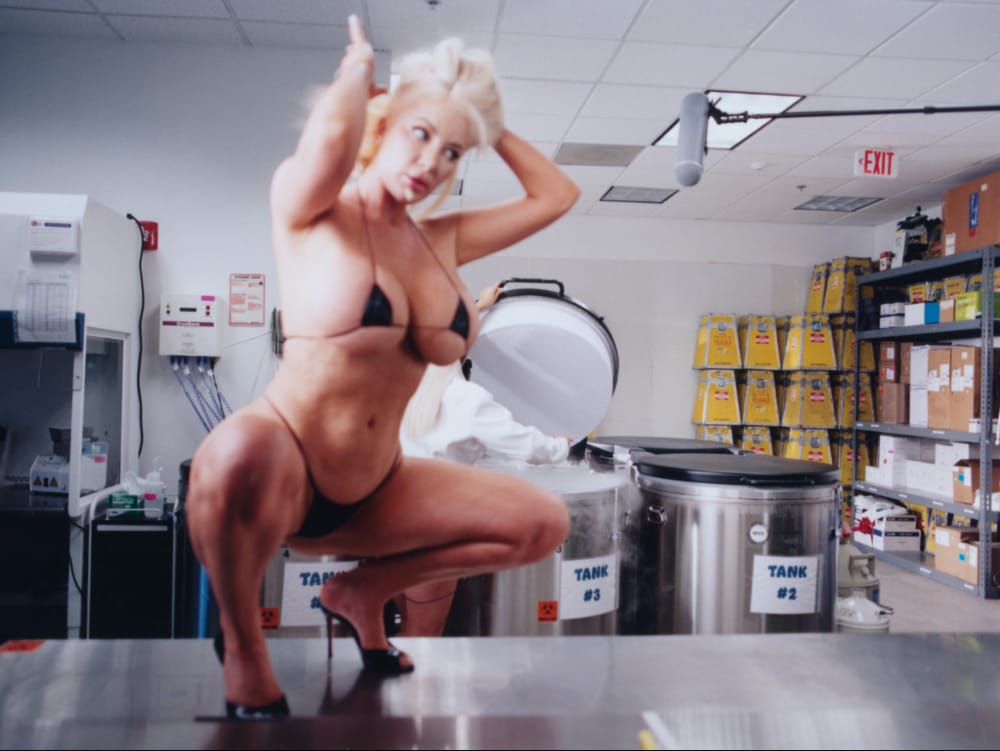
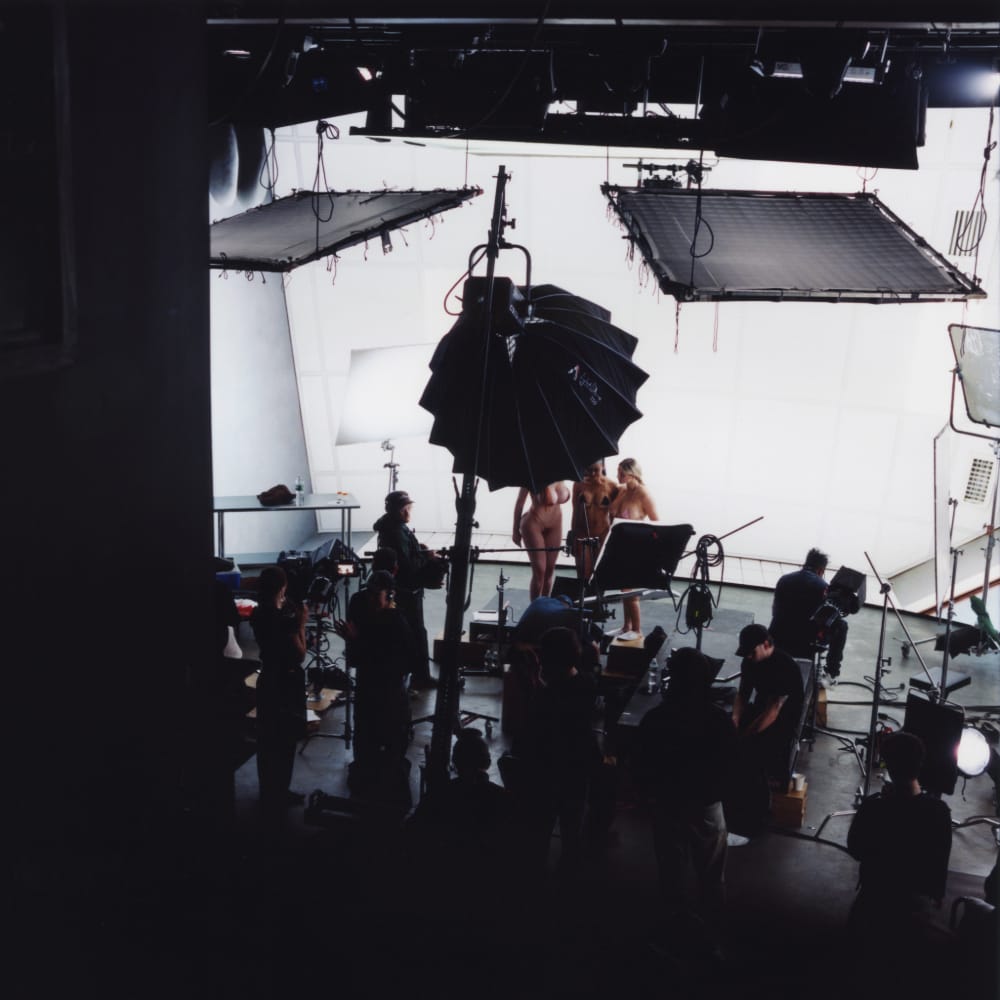
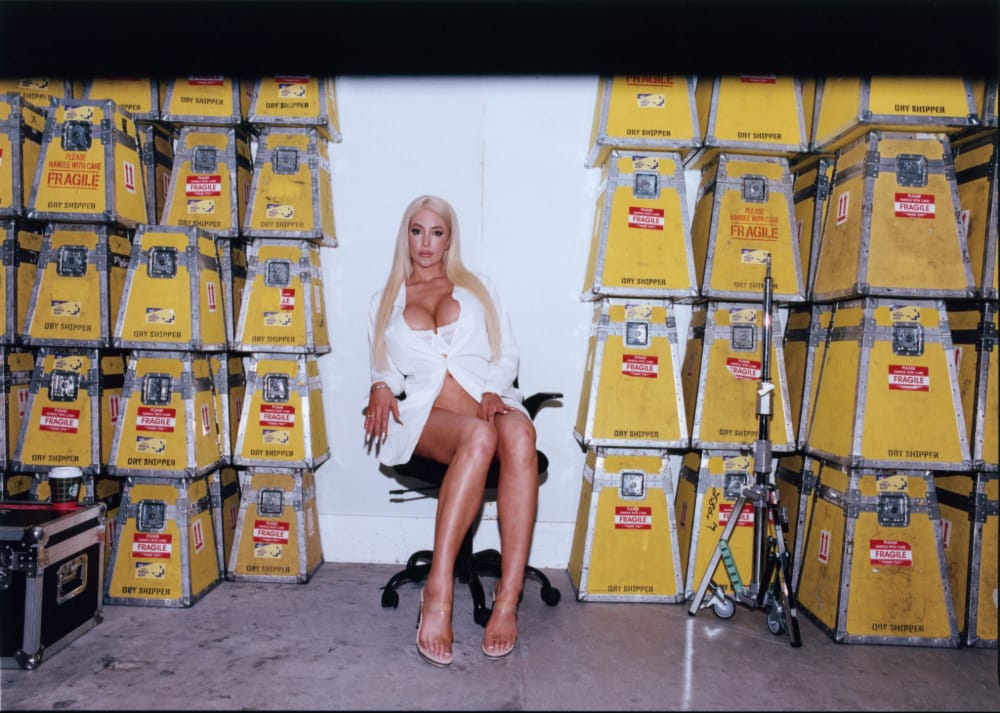
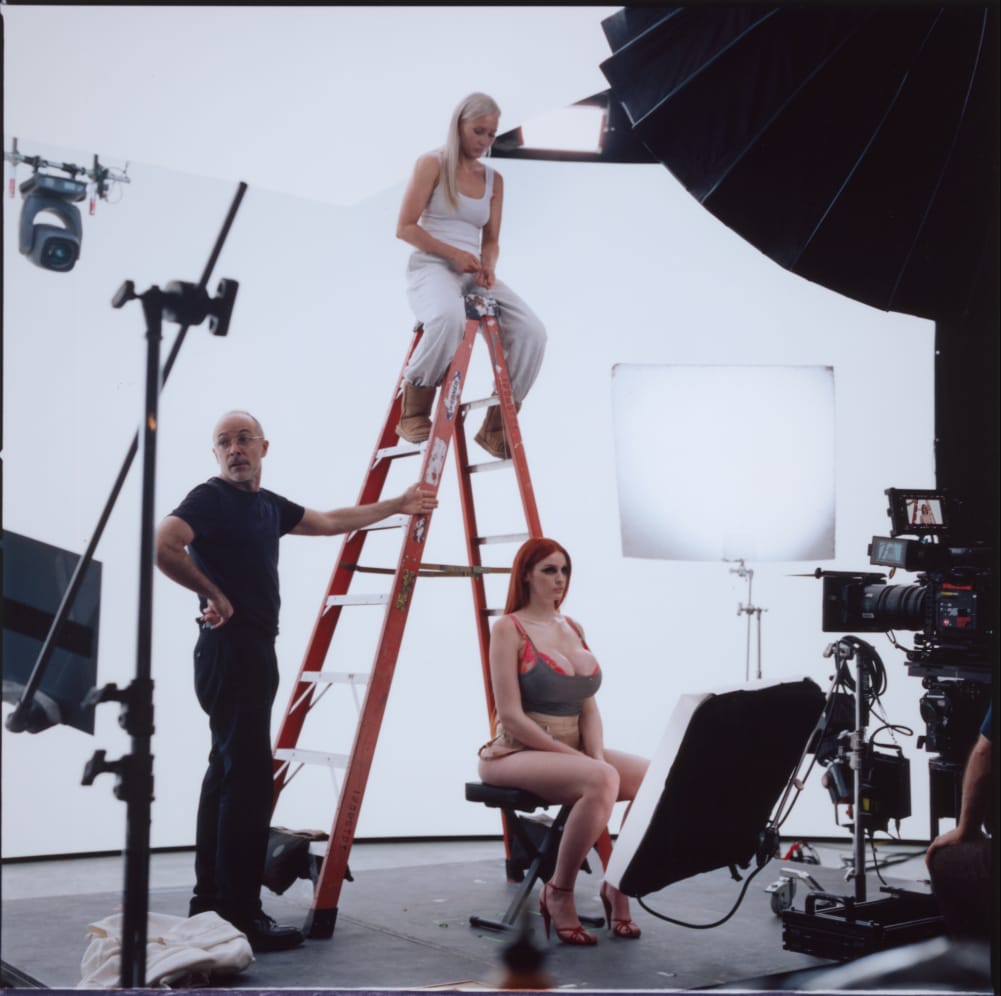
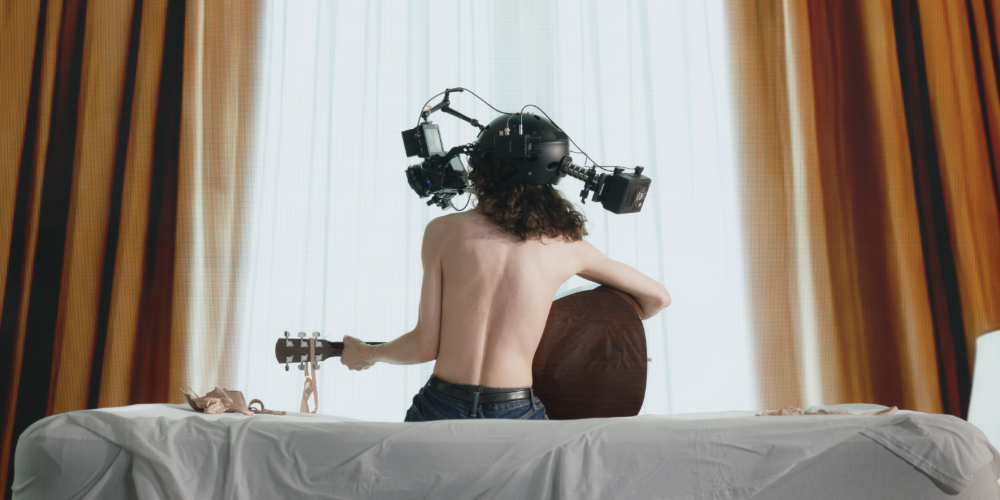
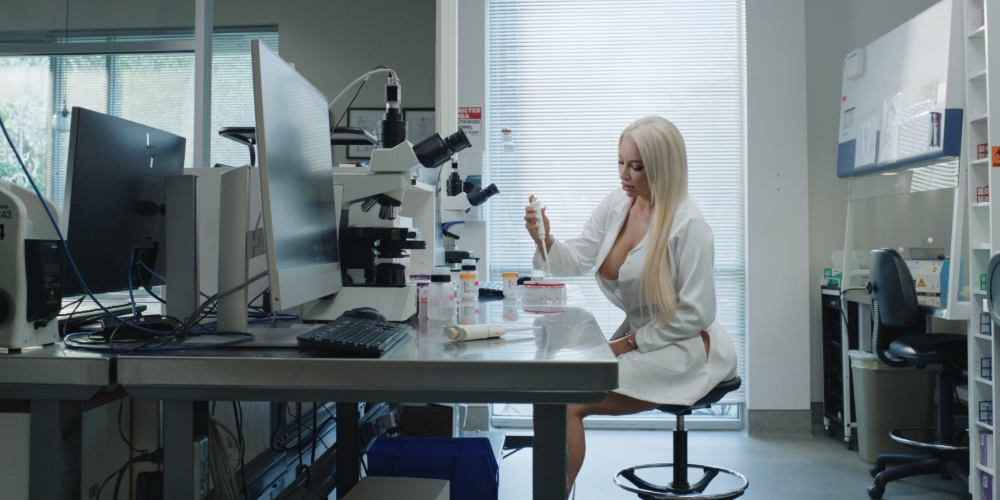
Maja Malou Lyse, Things to Come, 2026. Installation view, film stills and behind the scenes, Danish Pavilion. Photo: Zoe Chait. © Zoe Chait.
From cryogenic sperm, reproduction moves into its next register: exposed infant bodies. In softer but no less insistent gestures, Ei Arakawa-Nash’s Grass Babies, Moon Babies gathers “baby bodies” within a queer choreography of care, where baby dolls appear abandoned or without fixed guardianship, and the audience is invited to take them into their hands, temporarily assuming responsibility for their fragile presence.
Finally, moving toward enraged adolescence, some pavilions map a reproductive system in which absence does not interrupt kinship but produces it. Miet Warlop’s IT NEVER SSST, at the Belgian Pavilion, initially developed for the Dhaka Art Summit 2023, emerges from absence not as void but as trace: a condition in which language is never fully present, always deferred through repetition, fracture, and return. What appears as speech is already marked by prior silencing, where meaning persists only as residue.
Blurring manual labour, linguistic resistance, and communal ritual, the work functions not as a static pavilion but as a process of continual becoming. Performers, in a trance-like choreography, cast plaster words into moulds, staging language as something that can only be grasped through its own disappearance. Absence here is not opposed to presence but constitutive of it; every articulation carries what it cannot fully say. The exhibition space becomes a site of unstable signification. By activating the “minor key” of Bangla through bodily repetition, Warlop renders language as sonic remainder rather than stable system. The performance functions as a counter-linguistic apparatus in which absence ceases to signify loss and instead becomes the very condition of transmission.
Inside the Austrian Pavilion, among the Biennale’s most in-demand venues for its nudity and high-voltage intensity, a series of durational performances in Florentina Holzinger’s SEAWORLD VENICE revives the unresolved corporeal violence of Viennese Actionism, rerouting its masculine mythology through feminist excess, collective endurance, and deterritorialised embodiment. Choreography, scenography, and machinery operate as a single circulating system rather than discrete artistic elements. A monumental bell structure anchors the pavilion’s entrance, from which a performer is suspended, and gradually repositioned. The suspended body signals a shifting spatial and institutional logic, where gravity, tension, and support become compositional forces.
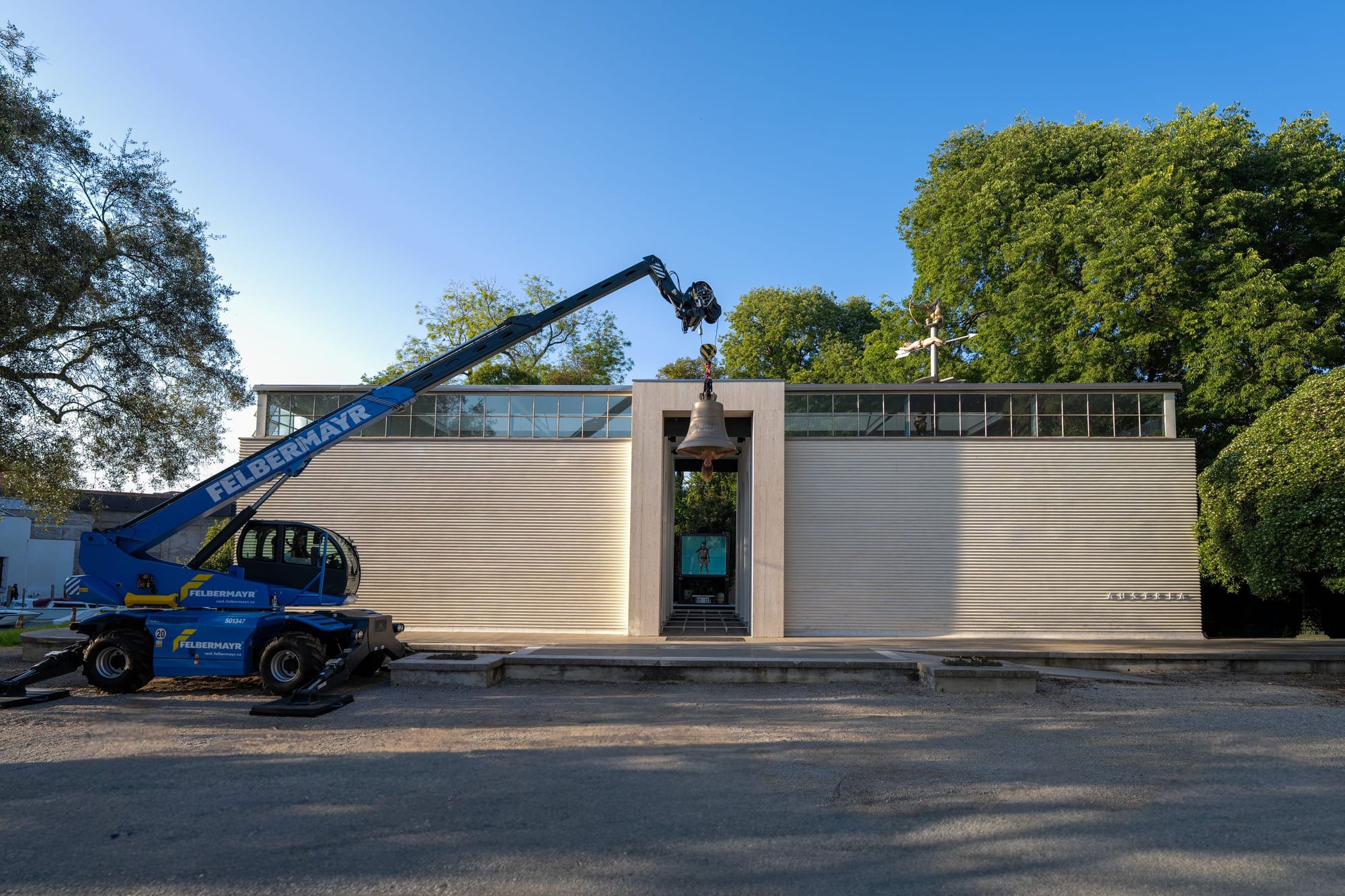
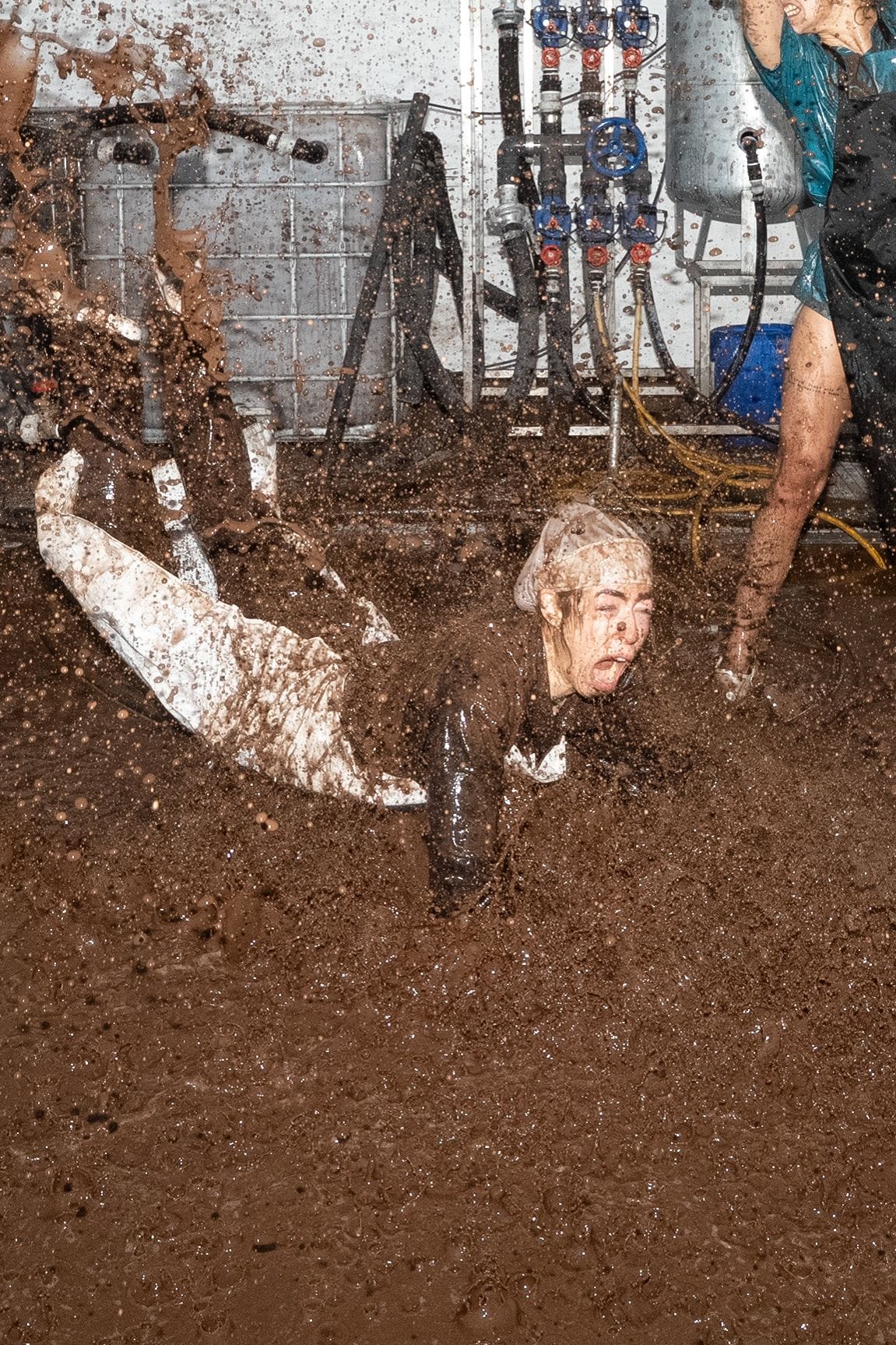
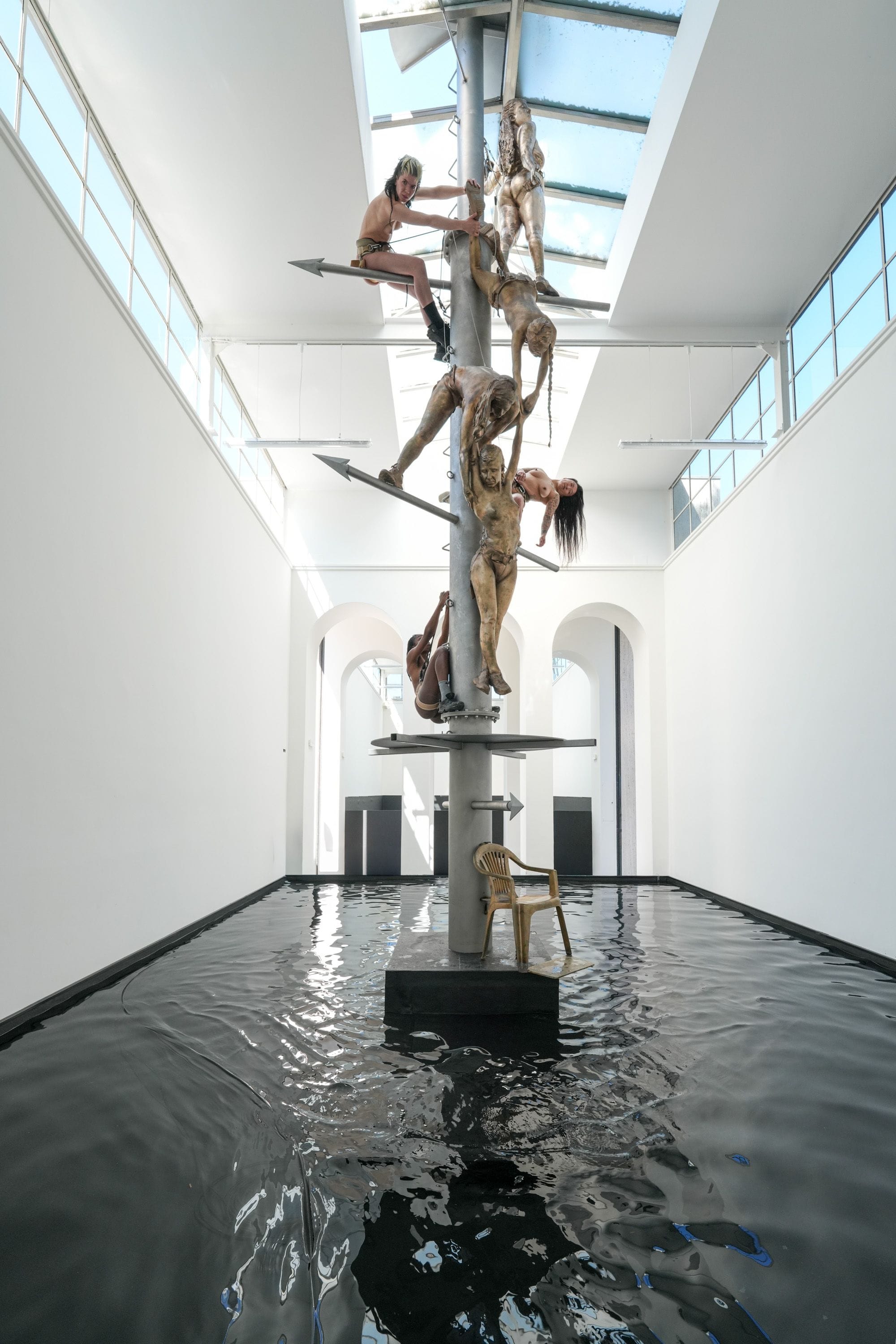
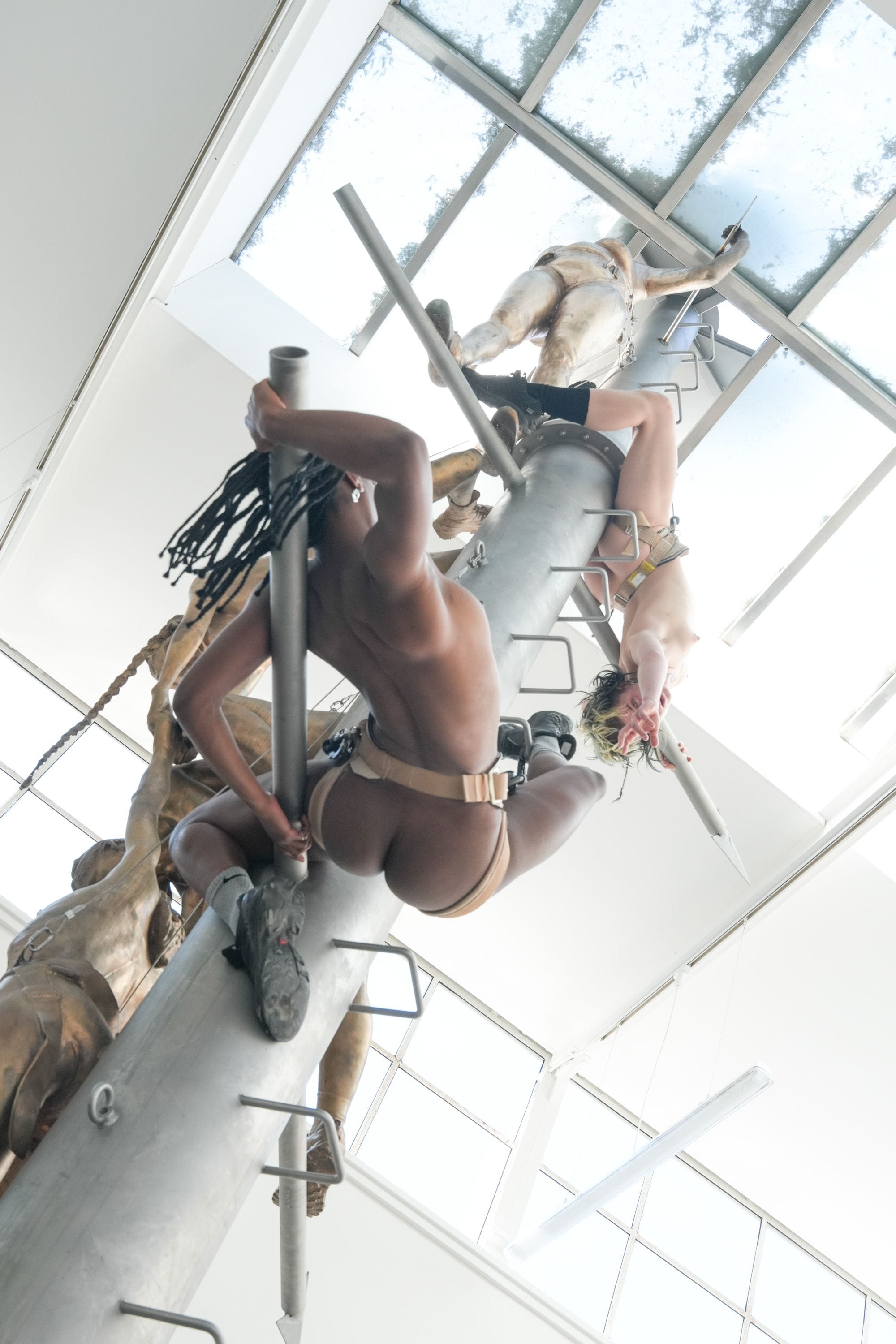
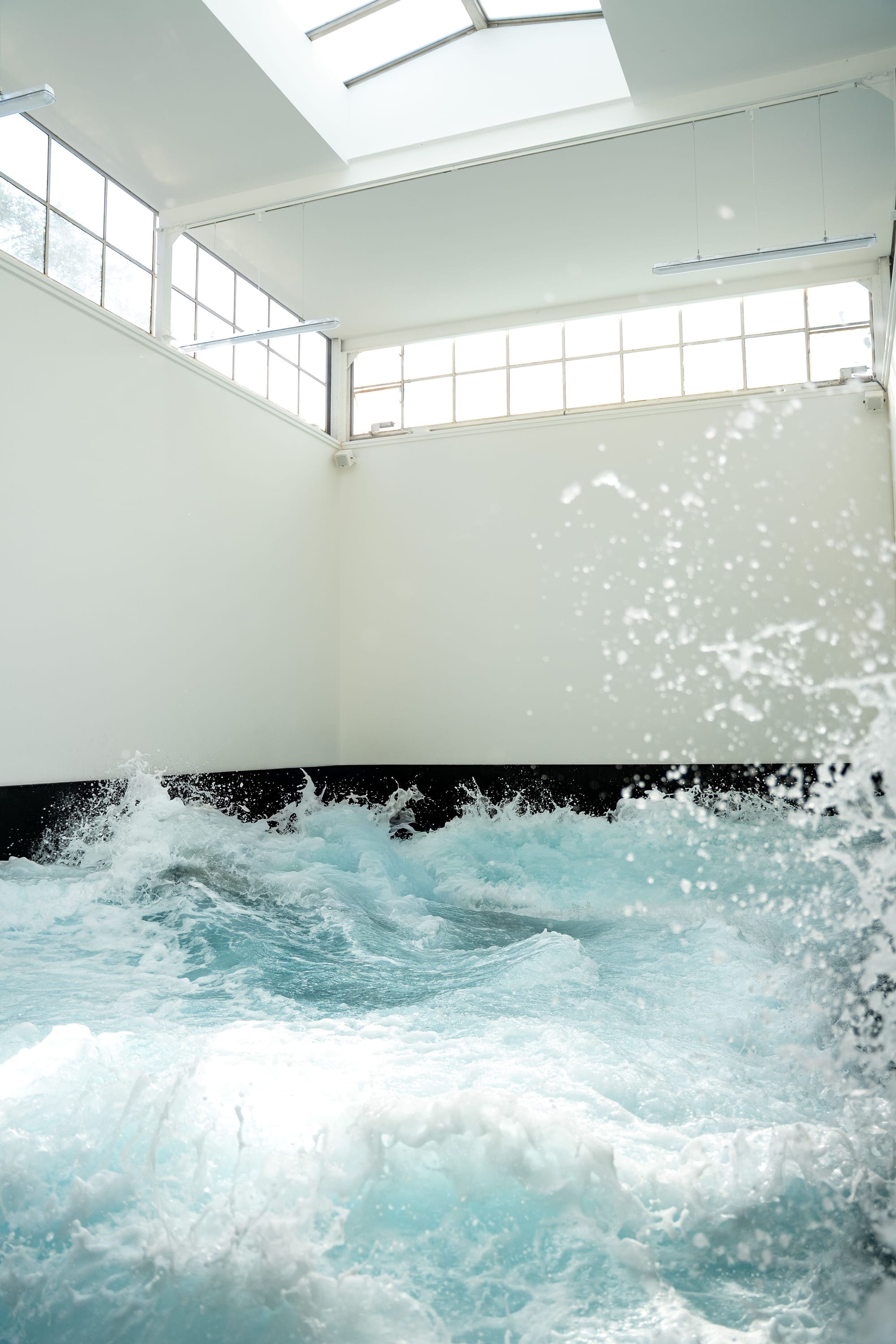
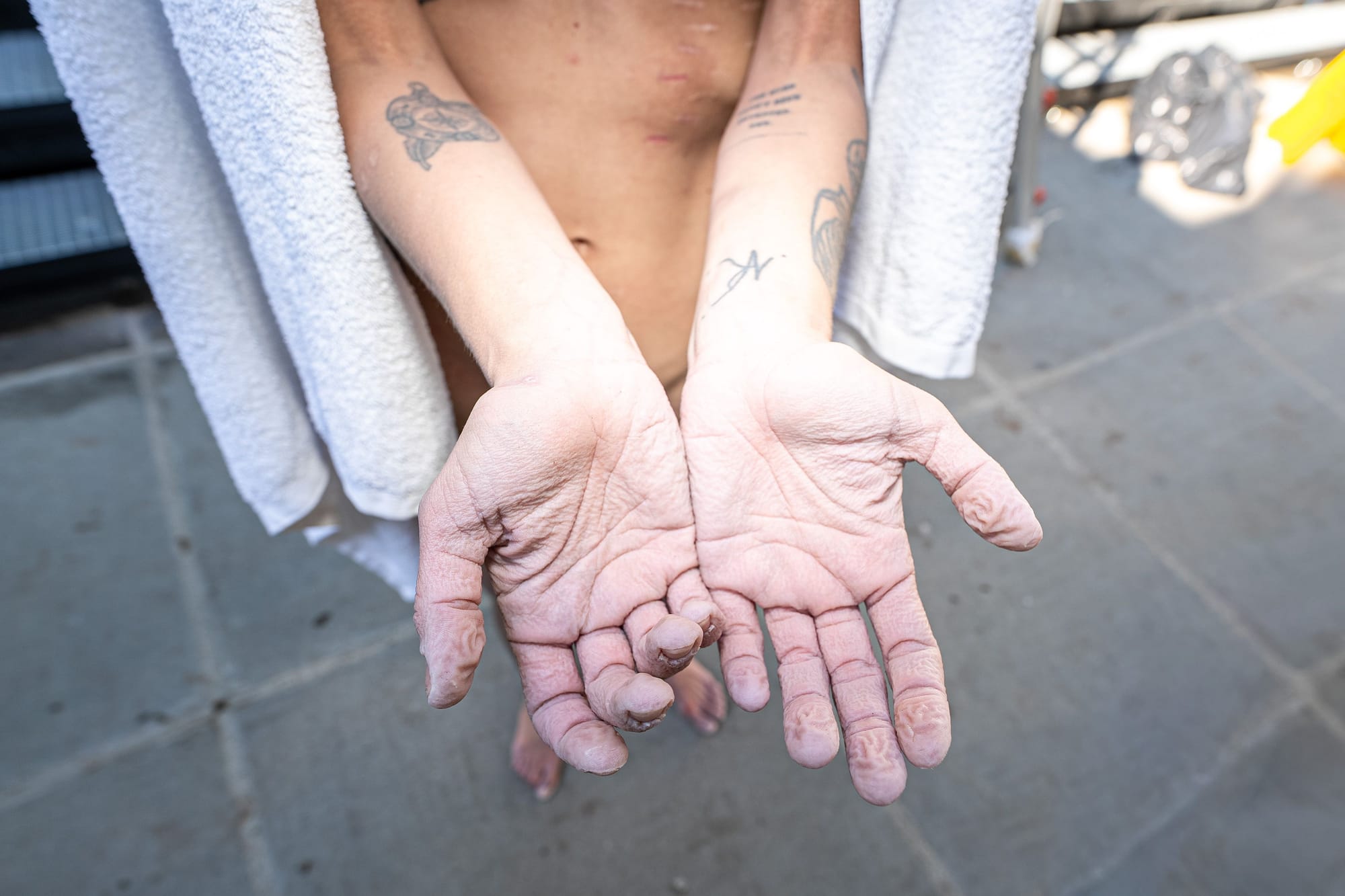
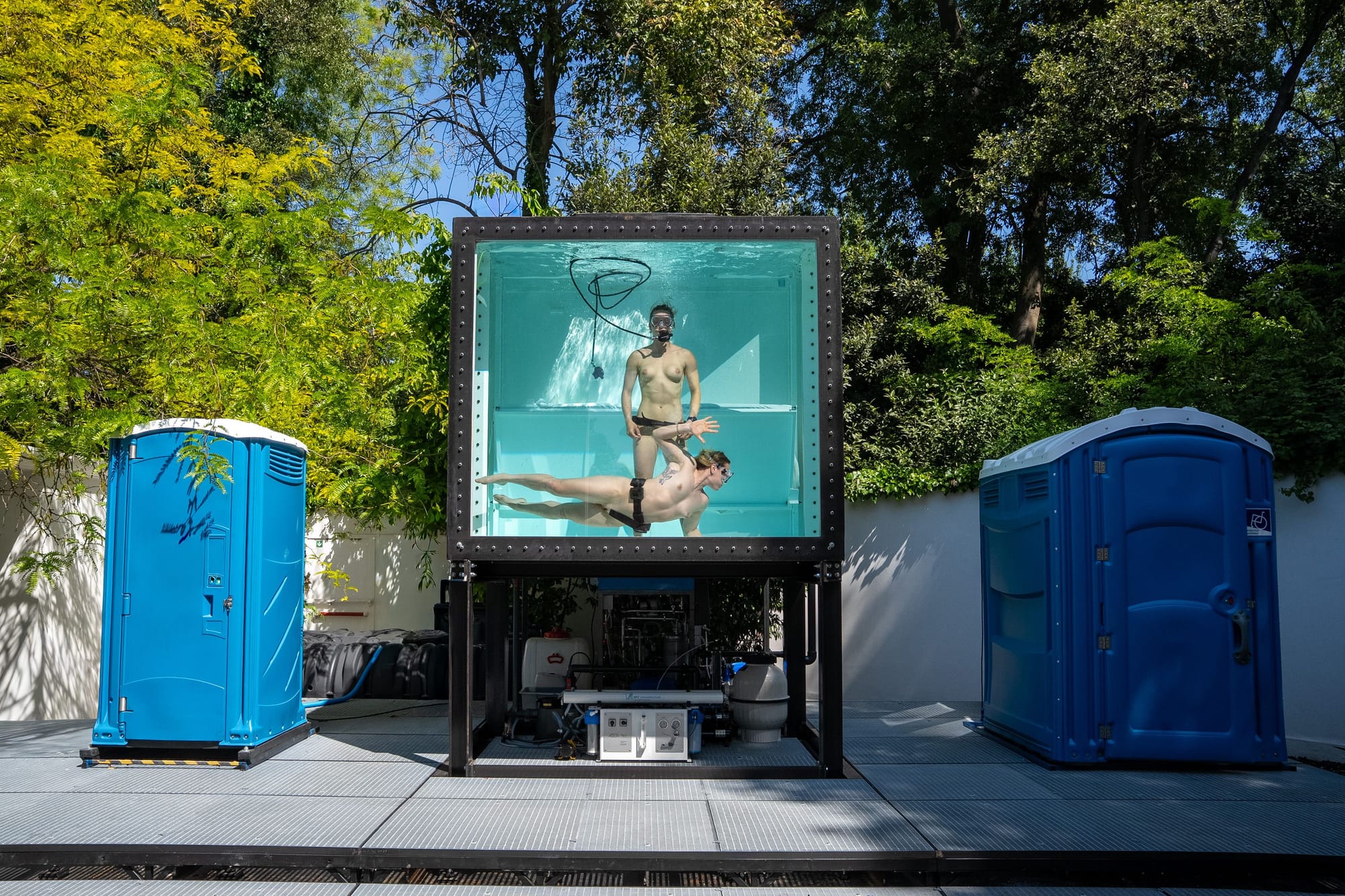
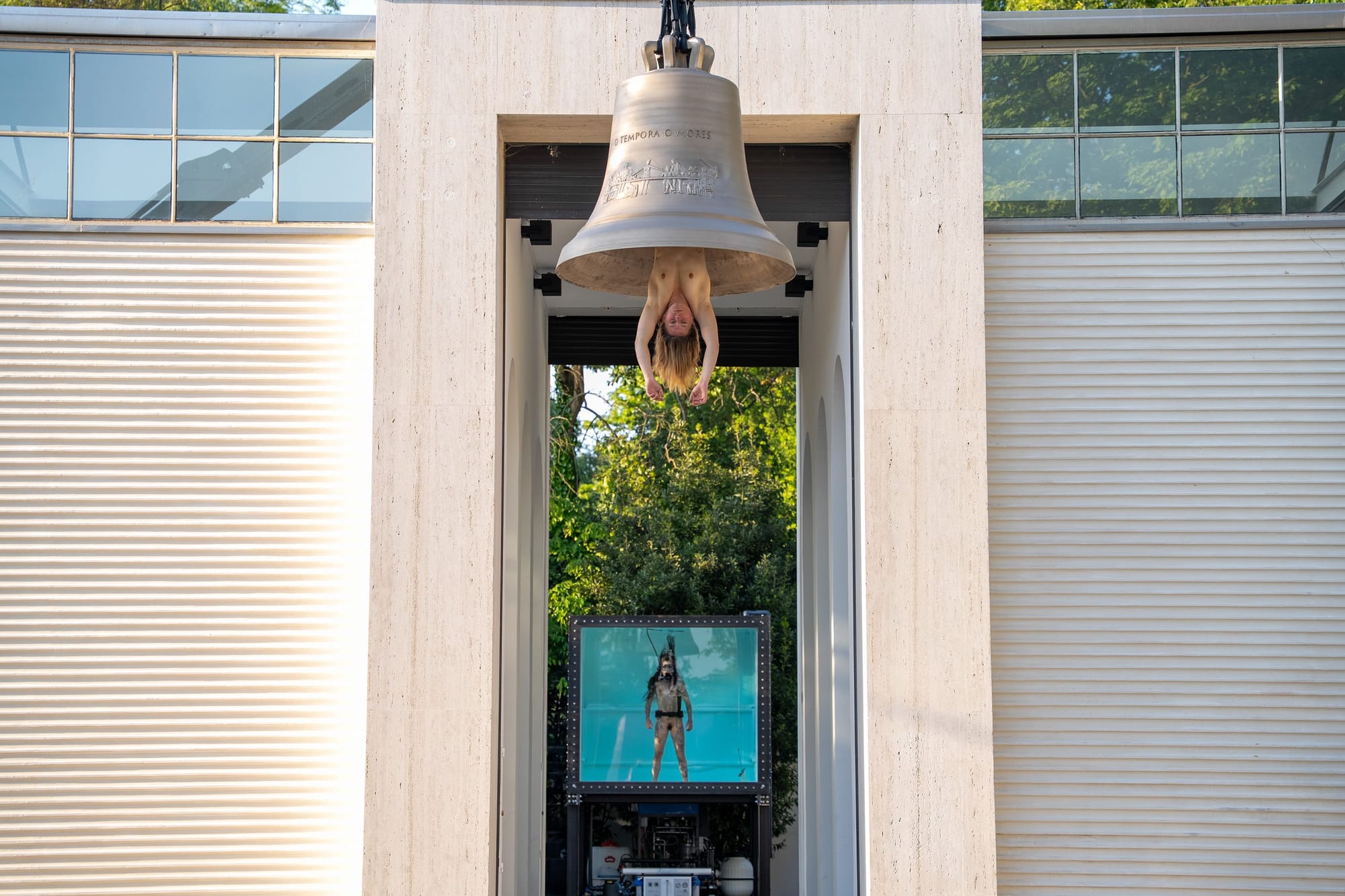
Florentina Holzinger, SEAWORLD VENICE, 2026. Installation view, Austrian Pavilion. Photo: Nicole Marianna Wytyczak. © Nicole Marianna Wytyczak.
One section of the pavilion remains waterlogged and is activated by a nude performer riding a jet ski with relentless, labour-intensive intensity. The continuous motion destabilises choreographic continuity and reasserts the volatility of the constructed environment. In parallel, bodily excess and abjection, urine, faeces, bodily fluids, are not staged as shock but absorbed into the material economy of the pavilion itself. What emerges is a dense operational field in which image, action, and infrastructure become indistinguishable, positioning the viewer within a constantly rearticulated economy of attention, discomfort, and physical immediacy. In this pavilion, the conditions that normally allow perception, meaning, and emotional distance to stabilise are systematically withdrawn.
From there, kinship does not stabilise but intensifies into exposure and pressure. In the Greek Pavilion, Andreas Angelidakis’s Escape Room renders absence architectural: an absence of orientation, of guaranteed exit, and of external spectatorship, where relations are produced under conditions of uncertainty and partial access, saturated by fluorescent, discothèque-like disorientation, funky props, and camera surveillance.
There is a cruel metric to the posthumous exhibition, a formal violence in which spatial logic must speak on behalf of a silenced artist. The untimely passing of Henrike Naumann in early 2026 casts The Home Front – Die Innere Front as a staggering architectural wake. In her physical absence, the pavilion organises itself around a calculated domestic void. Naumann’s signature furniture arrangements undergo a severe spatial flattening, compressed into vertical, wall-bound reliefs and severed chairs stripped of utility and presence. Coated in an institutional mint green reminiscent of abandoned Soviet barracks, this ghostly aesthetic frames a historical reckoning: the dissolution of East German identity after reunification in 1990.
By rendering socialist murals faceless and concealing gas masks behind banal denim curtains, Naumann sharpens a disquieting political clarity. The domestic interior emerges not as refuge but as the primary site in which radicalised fascisms are quietly accommodated, normalised through design, storage, and surface. In this final articulation, the private space is no longer intimate, it is infrastructural.
At the Dutch Pavilion, Dries Verhoeven’s intervention The Fortress pushes this logic further, enclosing the modernist structure in metal shutters and transforming it into a bunker-like condition in which absence becomes fully infrastructural. Each hour, visitors enter a darkened interior where a single performer moves among former Biennale catalogues, issuing self-help imperatives that sound instructional but collapse into distortion.
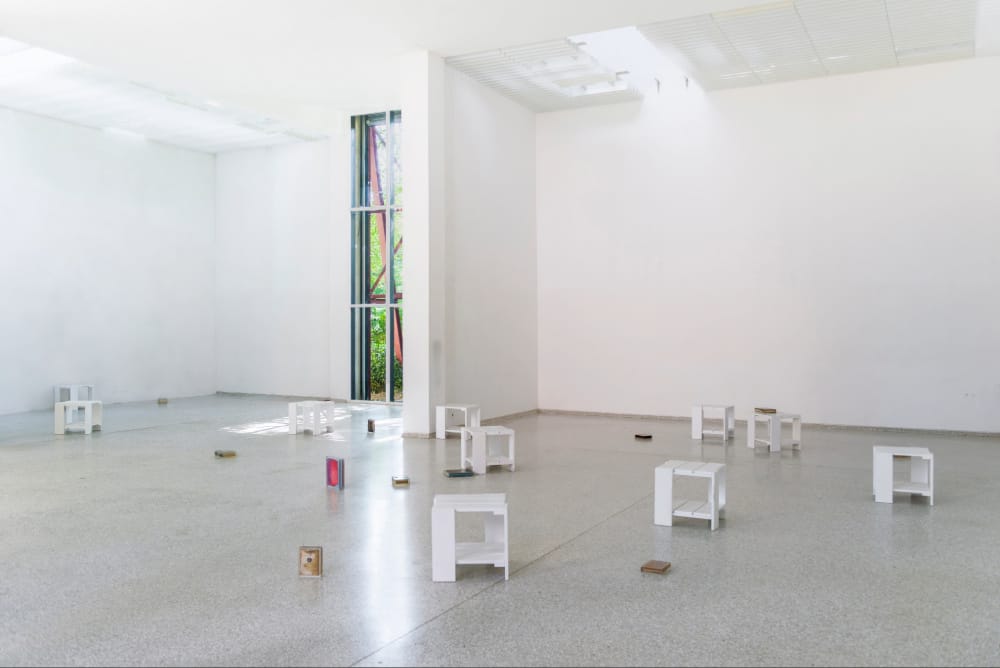
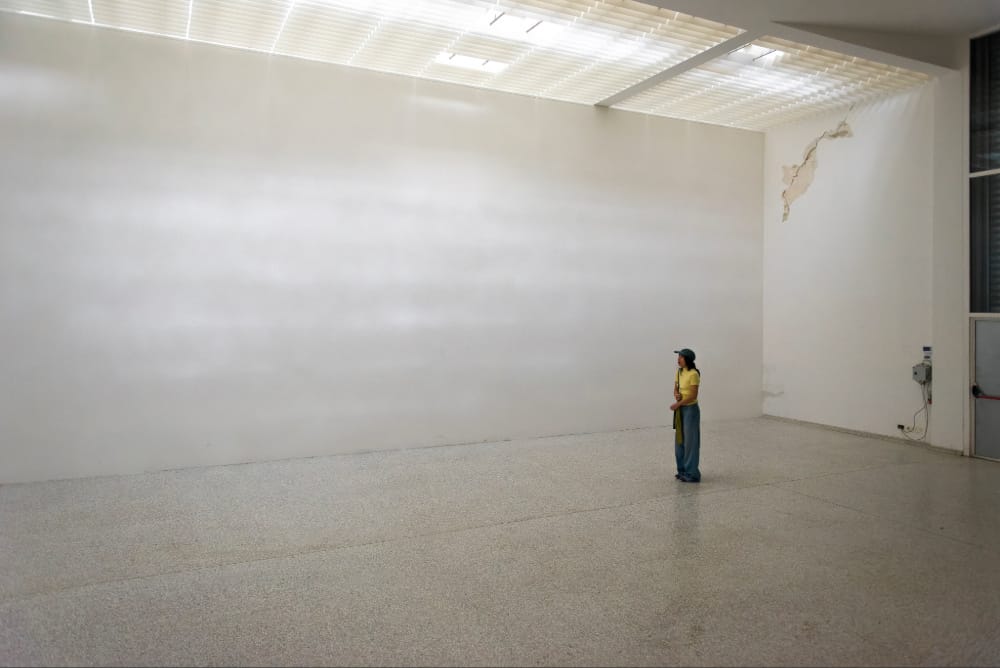
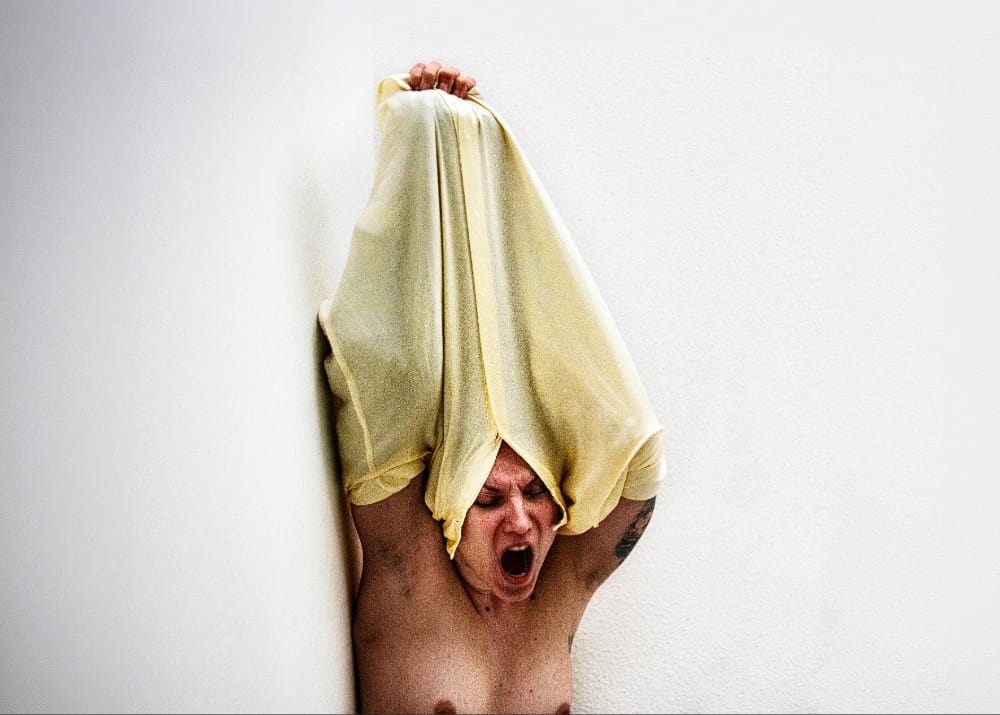
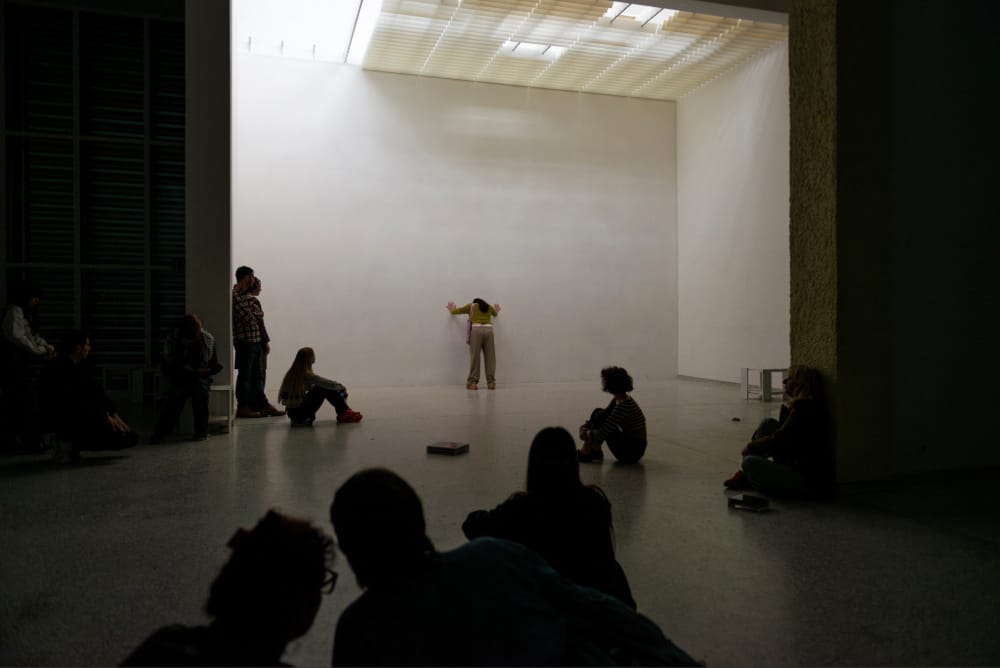
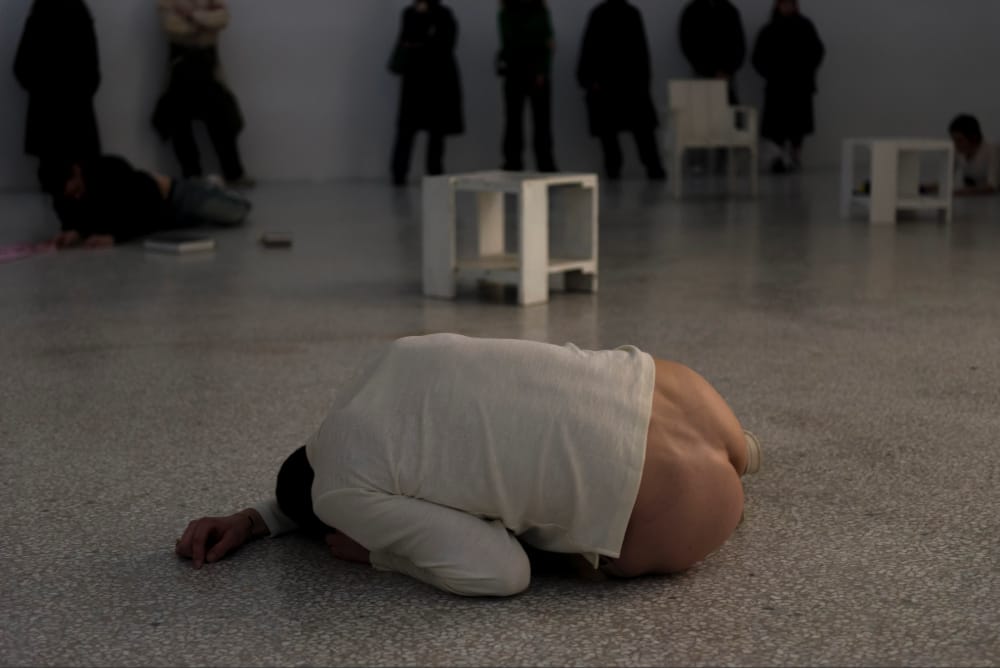
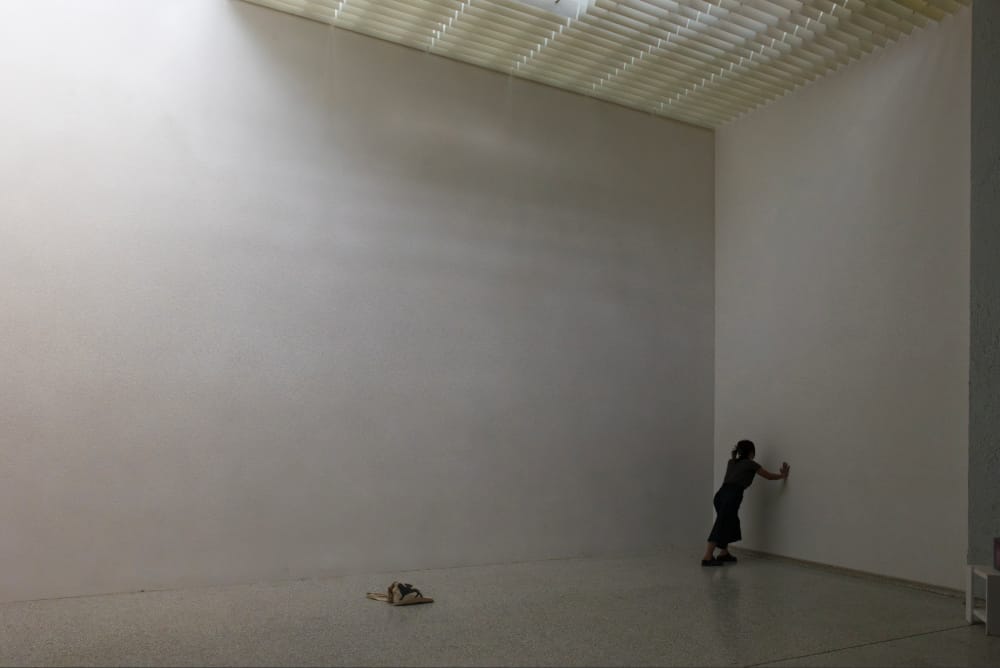
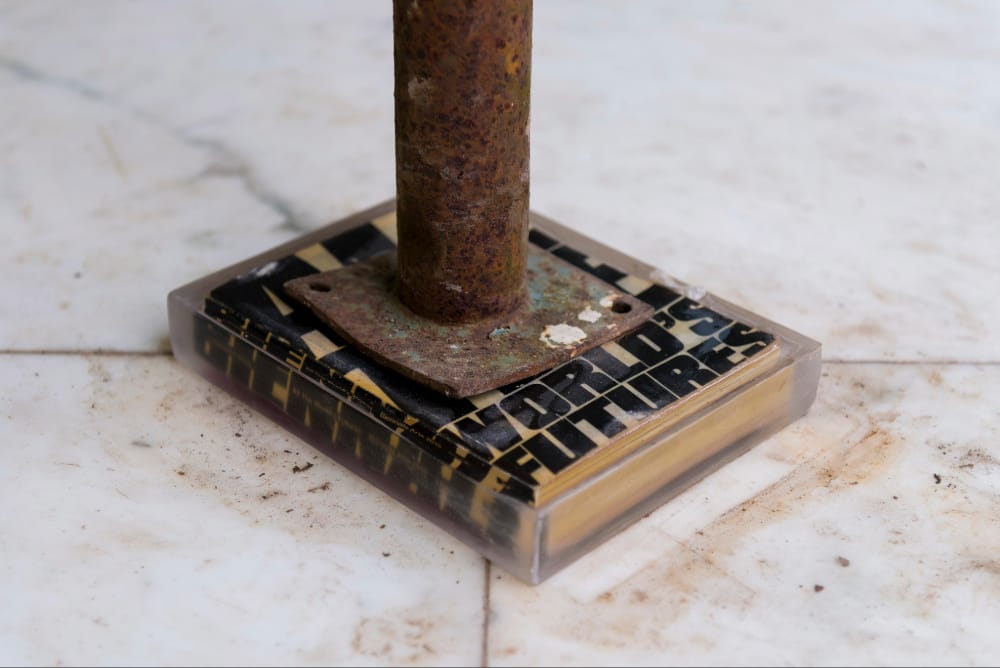
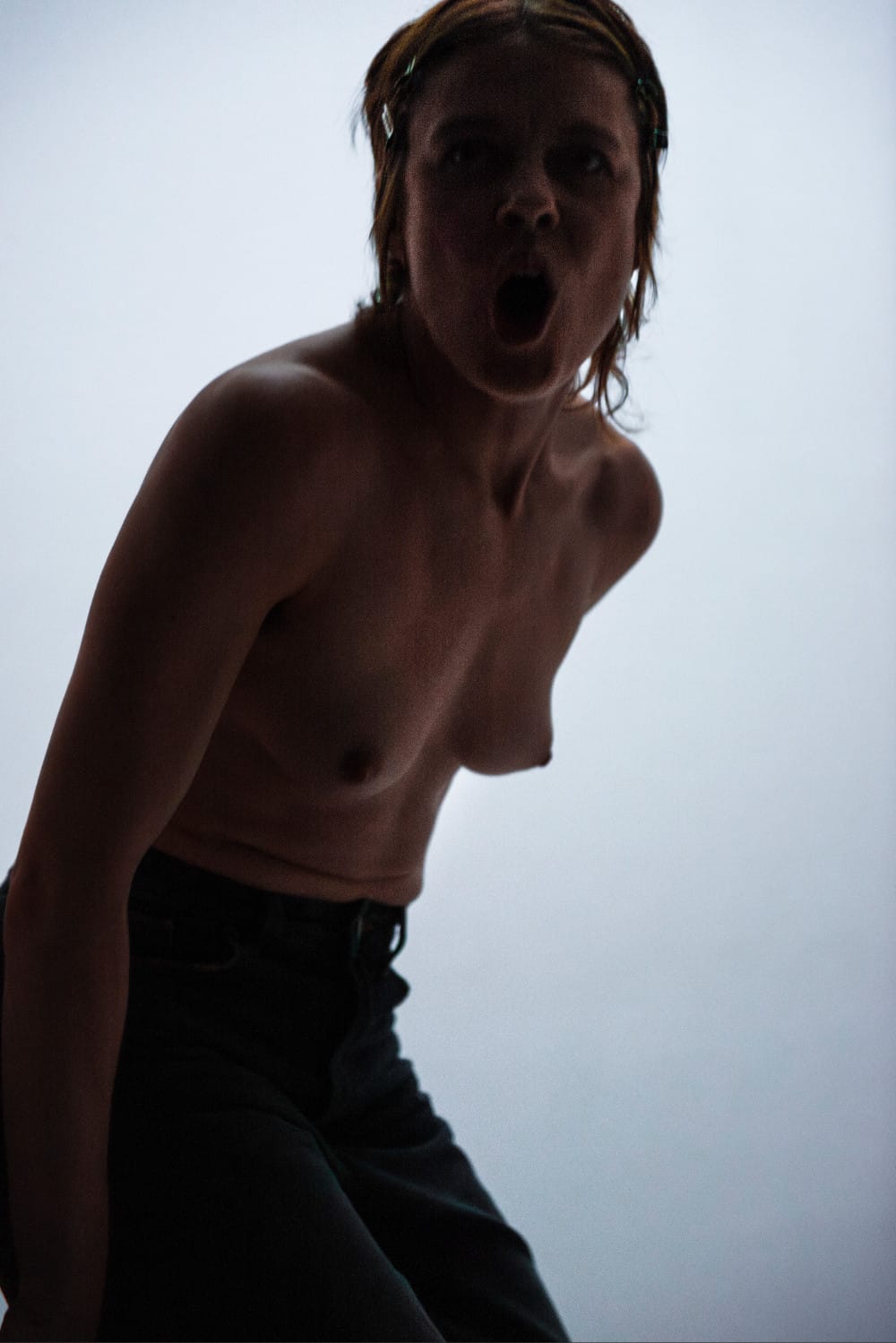
Dries Verhoeven, The Fortress, 2026. Performers from left to right: Dengling Levine, Jana Jacuka, Diane Mahin, Maarten Heijnens, Melyn Chow. Photo: Willem Popelier. © Willem Popelier.
Within this minimal yet destabilising performance, language loses stability and becomes guidance without grounding, speech without resolution. What is staged is not simply enclosure but a regulated absence: of transparency, external safety, and linguistic certainty. Entry and exit no longer function as spatial movement but as temporal thresholds in which absence and panic are actively produced, experienced, and carried beyond the pavilion as residue.
The British Pavilion presents Lubaina Himid’s Predicting History: Testing Translation as a space in which history is understood as a fragile act of reading, always shaped by drift, and the impossibility of complete translation. Vivid, saturated paintings animate the pavilion with theatrical intensity, where colour becomes both structure and interruption, guiding the viewer through layered scenes of figures, objects, and architectural fragments that resist linear narration. The artist groups her paintings into categories, Architects, Tailors, Chefs, Oars, Boatbuilders, and Gardeners, to explore different forms of making, care, and human connection. Across these artworks, absence plays an important role: unpainted or open areas suggest unfinished actions, time in progress, and processes still unfolding. In this register, history appears not as something to be preserved intact, but as something continuously reassembled through unstable perception and the gaps that inevitably remain.
Aeolian Suite at the Finnish Pavilion is an art-and-science project by the artist Jenna Sutela that transforms Venetian winds, Tramontana, Scirocco, Garbin, Bora Scura, and Bora Chiara, into an immersive sonic environment. Installed as five sonic-kinetic sculptures arranged in a circular formation resembling a wind rose, the work channels and amplifies the invisible presence of air and sound, giving form to what is otherwise intangible. The project translates one year of environmental data collected at the Acqua Alta Oceanographic Tower in the Gulf of Venice into a structured musical score, in which meteorological forces are rendered as traces, echoes, and resonant intervals rather than fixed phenomena, foregrounding perception as a site where absence becomes audible.
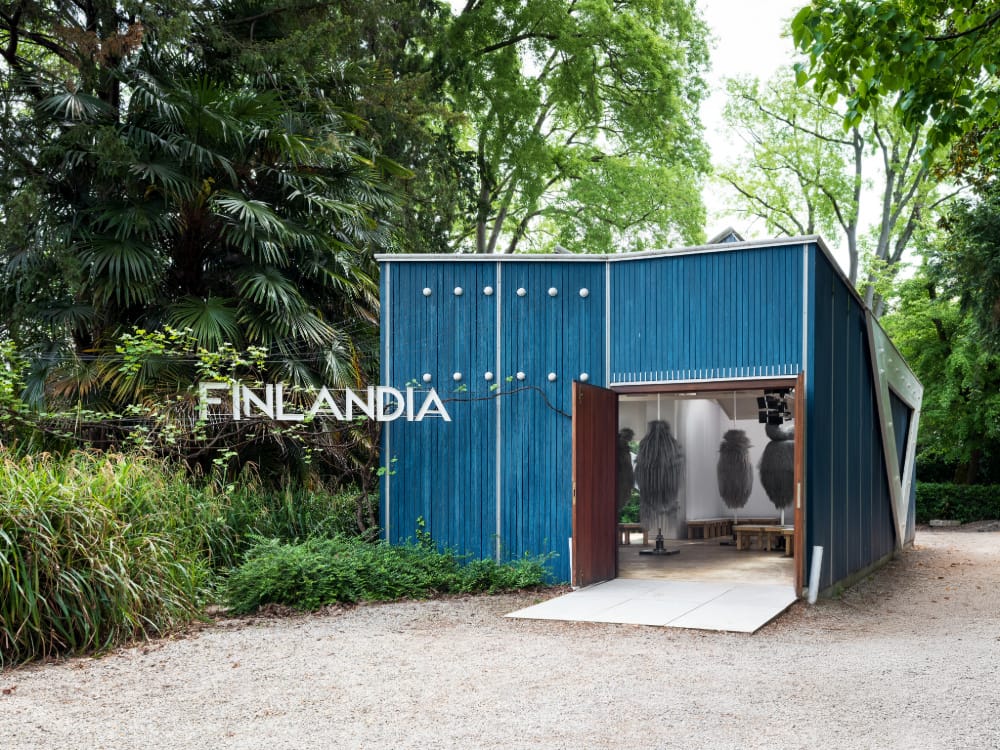
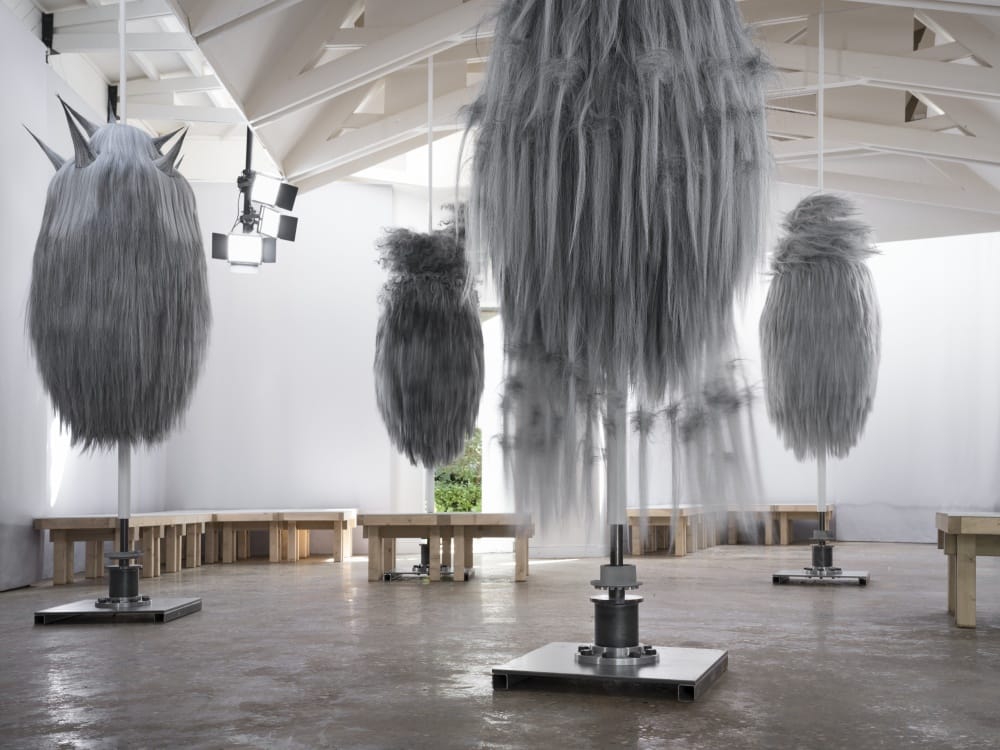
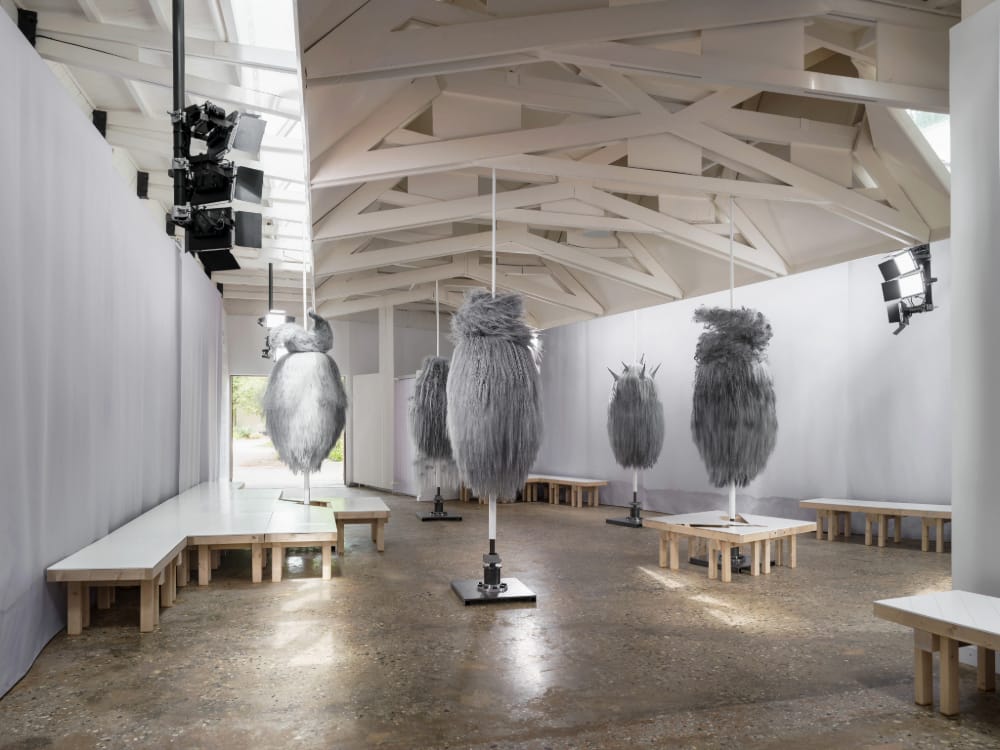
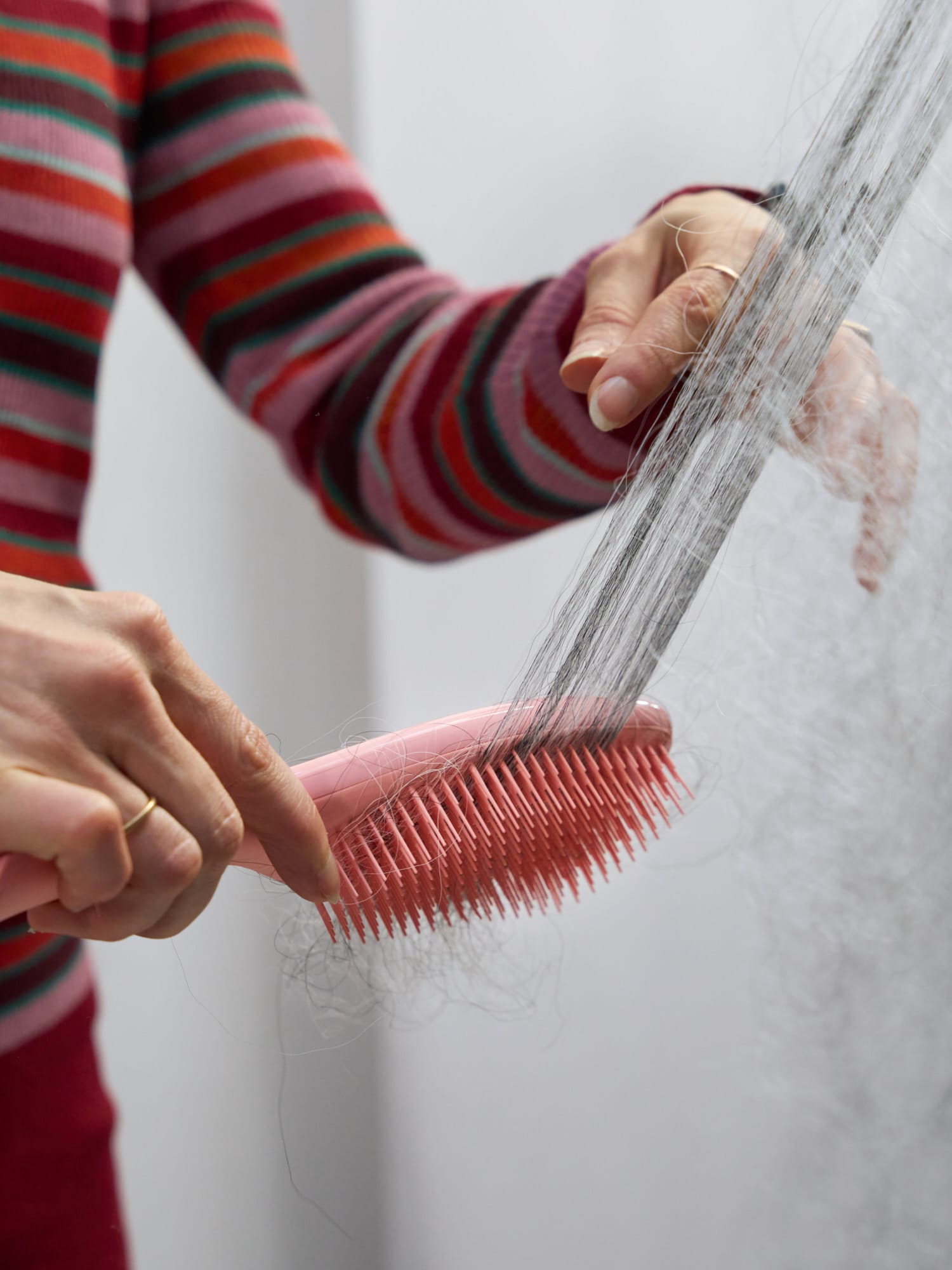
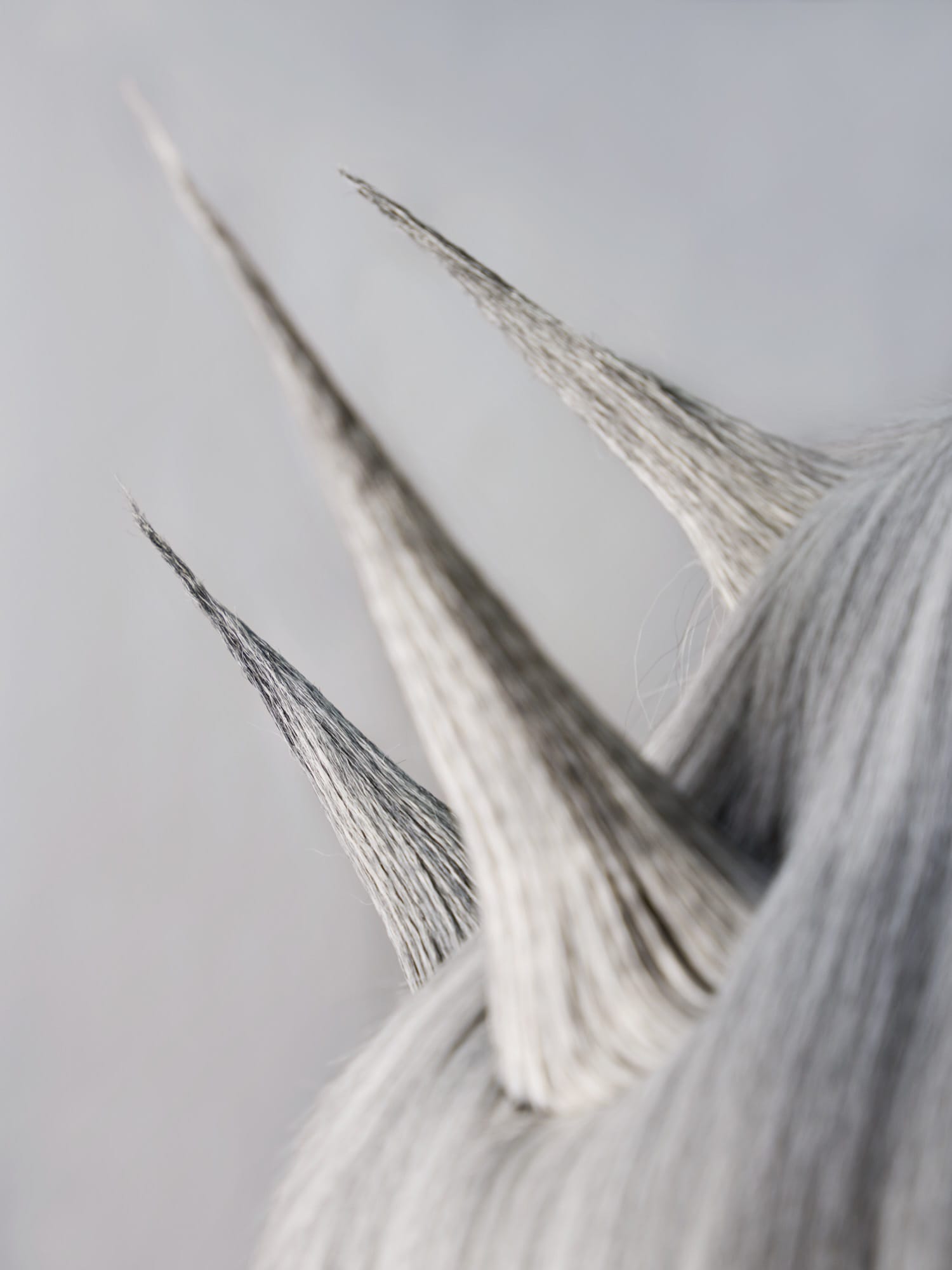
Jenna Sutela, Aeolian Suite, 2026. Installation views by Ugo Carmeni and detail images by Clelia Cadamuro, Finnish Pavilion. © Ugo Carmeni and Clelia Cadamuro.
The geopolitical void defining Taiwan’s global status finds its analogue in absence at the 61st Venice Biennale. Relegated to a collateral event at the Palazzo delle Prigioni, the historic prison complex linked to the Bridge of Sighs, Screen Melancholy by Li Yi-Fan weaponises structural invisibility. The stone detention rooms are transformed into a context-responsive environment for projection, with sculpted fragments of the body scattered throughout the space, doubling as informal seating. Using real-time game engines, Li captures the profound numbness emerging from the digital turn of 2021. The absence of the organic body is anchored by a wandering eyeball narrator, an uncanny avatar whose nerdy soliloquy traps the viewer inside the palace while an armada of police patrols outside. By haunting these ancient penal chambers with simulations, Li constructs a potent metaphor for Taiwan’s precarious nationhood, suggesting that under authoritarian pressure, lived presence is systematically replaced by synthetic substitutes.
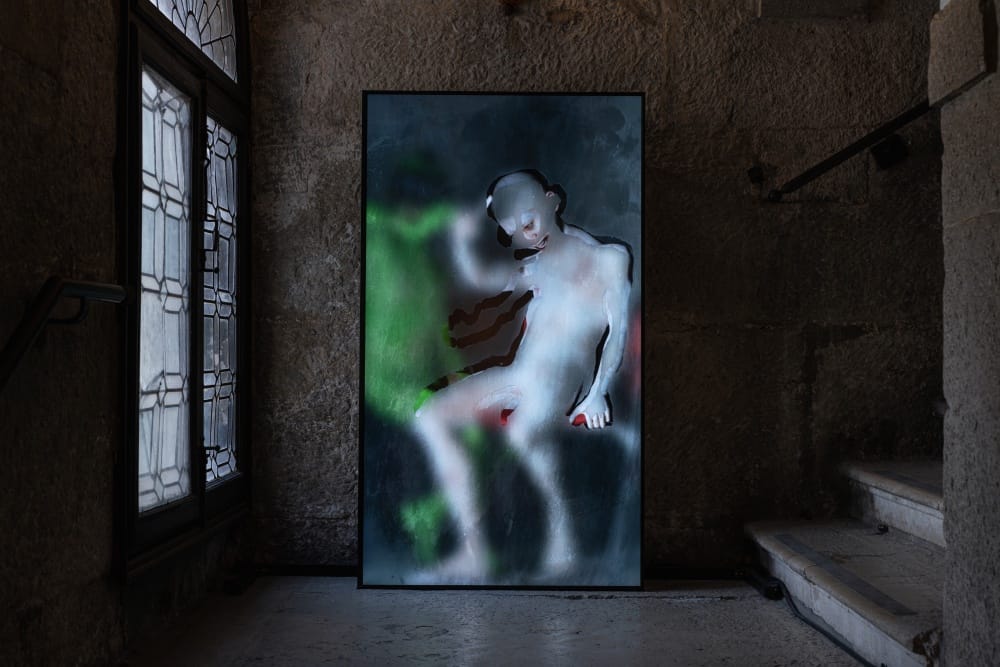
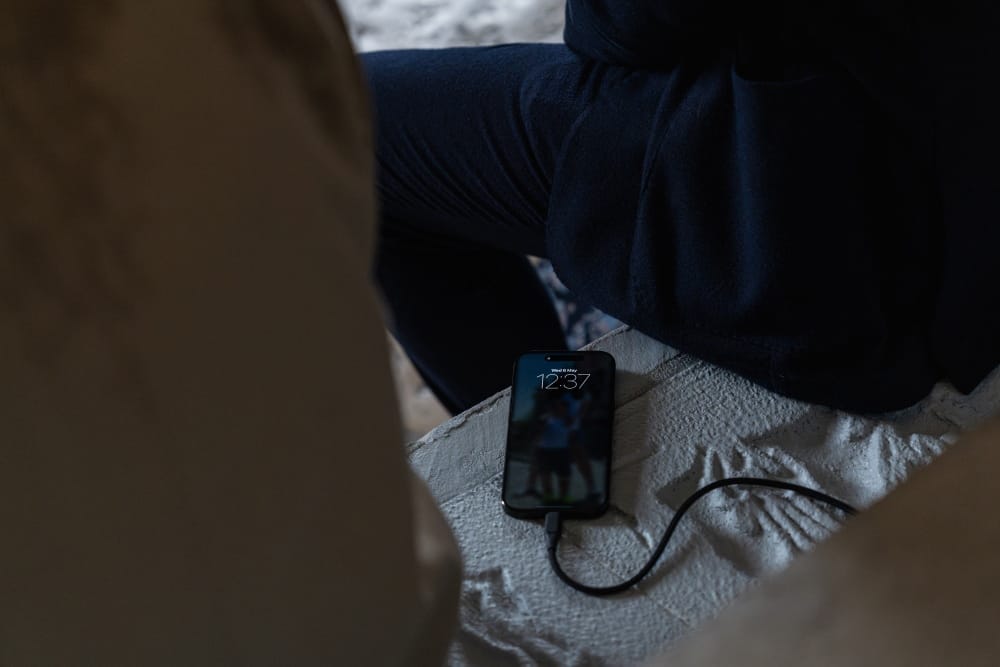
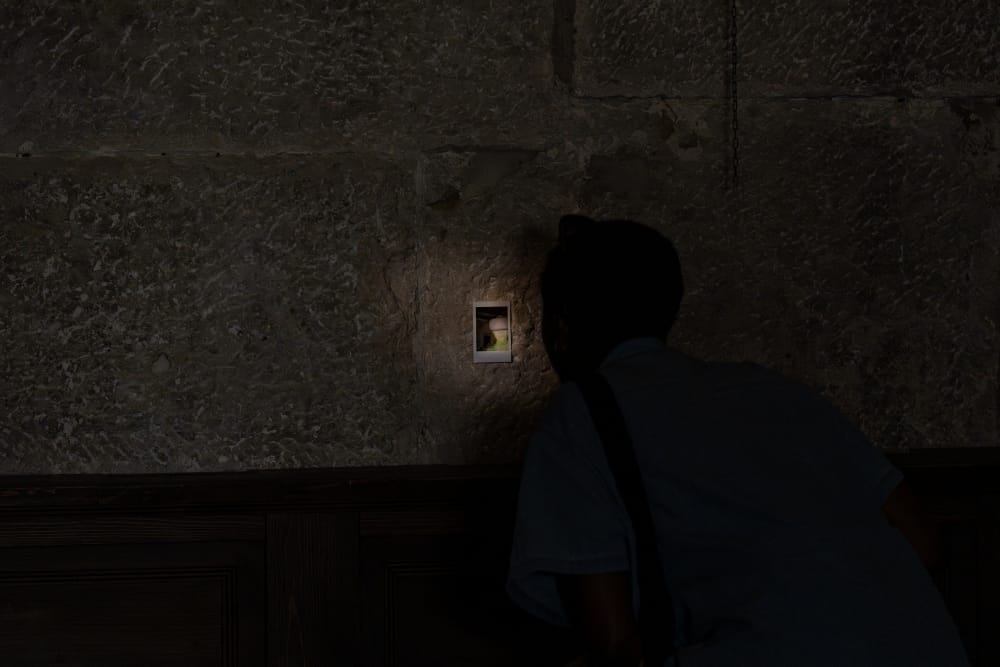
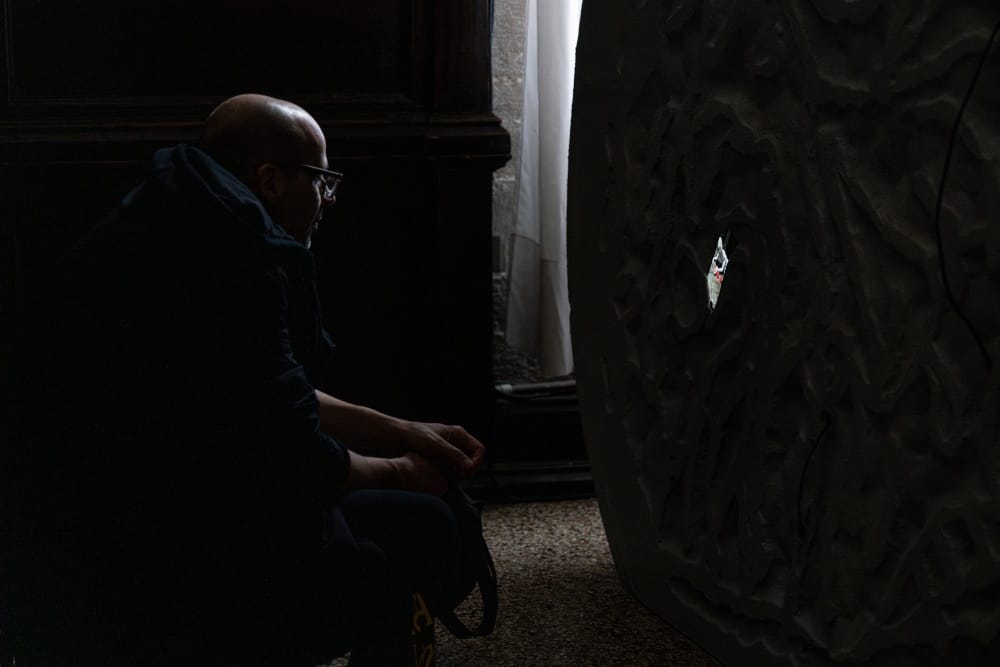
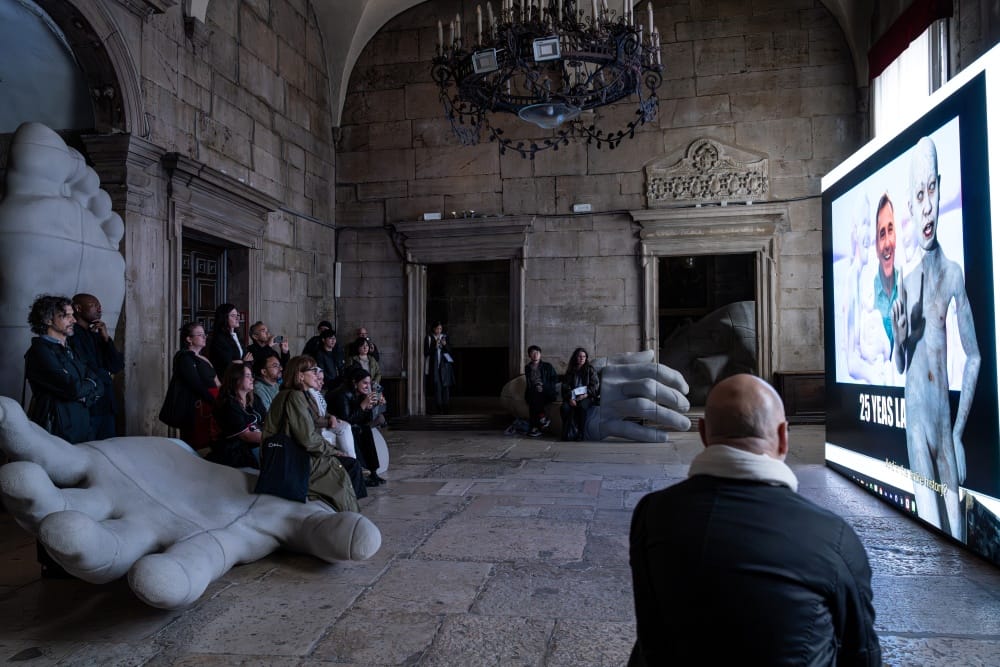
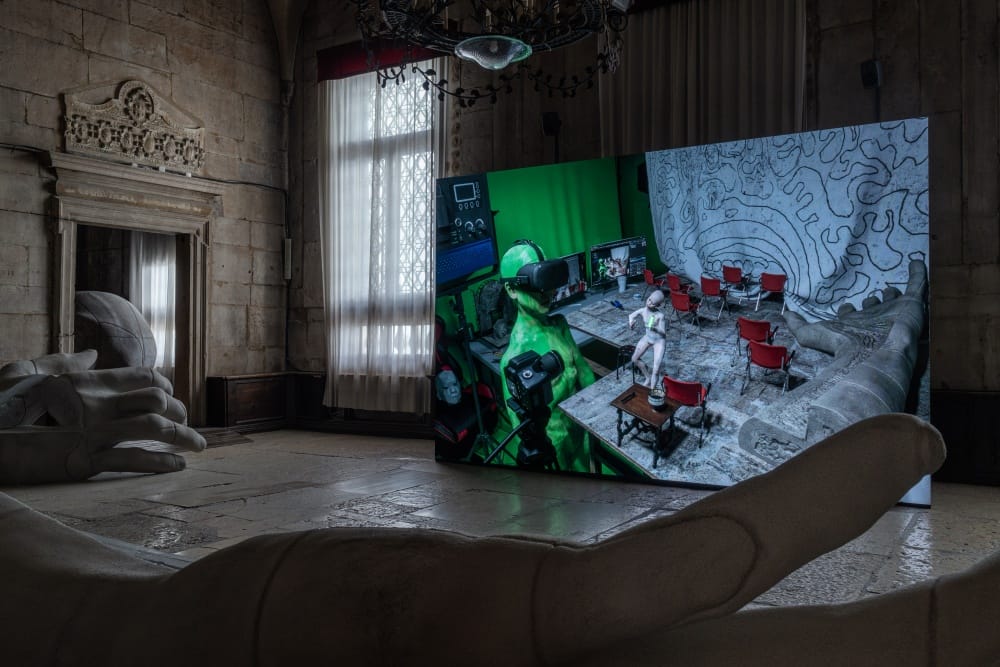
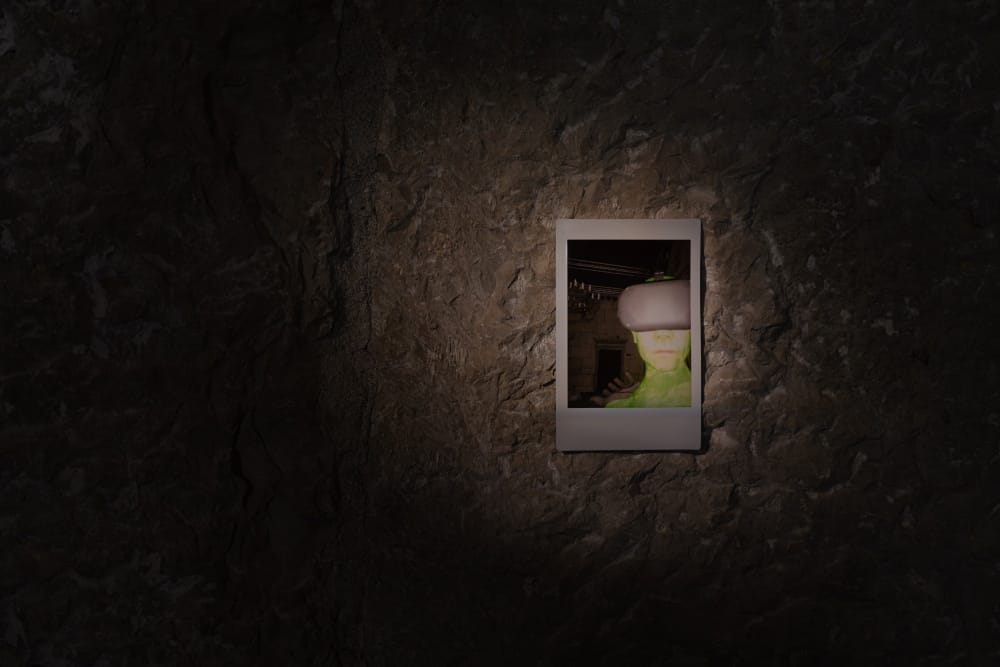
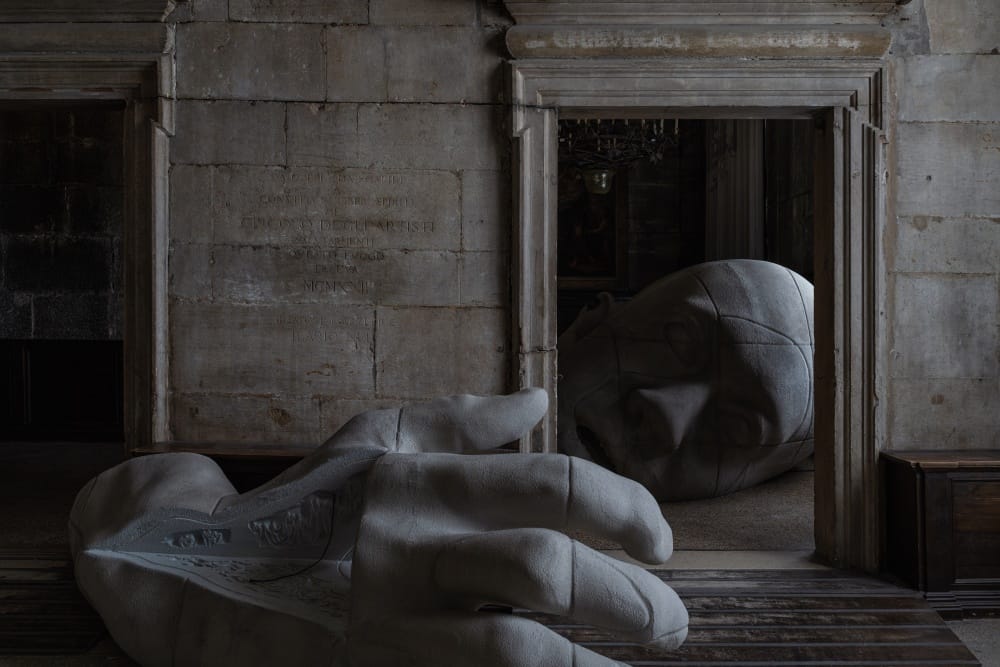
Li Yi-Fan, Screen Melancholy, 2026. Installation view and video installation screenshot. © Li Yi-Fan. Courtesy of the artist and Taipei Fine Arts Museum of Taiwan Collateral Event 2026.
Gabrielle Goliath’s Elegy (2015–ongoing) reappears at the 61st Venice Biennale as an uncontained gesture of institutional refusal, displaced from the cancelled South African Pavilion into the independent space of the Chiesa di Sant’Antonin. Supported by transnational cultural networks, the work unfolds as a durational sonic field: a chorus of Black and brown femme opera singers sustaining a single continuous tone, exchanging breath as endurance and collective refusal. What is staged is not representation but persistence, an accumulative architecture of listening shaped by gendered, racialised, and colonial violence, from South African femicide to the genocidal histories of the Nama and Herero, and the ongoing devastation in Gaza. In its relocation, Elegy becomes less an object than a pressure: a work that persists precisely through its withdrawal.
The 61st Venice Biennale can be read as a field shaped by the absence of stable authority, often resembling a child without functioning parental figures, trying with exhausting intensity not to become them. Visibility is increasingly produced through self-assertion. Many positions arrive overcoded: borrowed languages twisted into a so-called teenager’s bedroom of references, defences, compulsions, and acts of refusal. Hyper-vigilant and often self-explaining, many exhibitions mistake nervous energy for conviction, to the point of becoming symptomatic of the very condition they seek to escape. Still, in scattered moments, something slips through the performance: a stubborn vitality that might yet survive the damage.
Beneath this self-consciousness runs a distinctly antifascist anxiety, the fear of coherence, of seduction, of any unified language that might harden into authority. The Biennale, as a condition, behaves like someone raised among ruins who has learned to distrust beauty whenever it arrives too intact. Every gesture must therefore interrupt itself, disclaim itself, expose its own mechanisms before anyone else can accuse it of certainty. At its weakest, this condition becomes pathological noise; at its strongest, it persists with intense, unsettled energy.
Review by Maja Ćirić | Curator & Art Writer
© ART Walkway. All Rights Reserved.


