The Louvre’s Renewal Begins With Managing Arrival
With STUDIOS Architecture Paris and Selldorf Architects selected for the Louvre’s Nouvelle Renaissance project, the museum is trying to turn a year of institutional strain into a new public approach: entrances, routes, visitor flow and a separate path for the Mona Lisa.


The Louvre has named STUDIOS Architecture Paris and Selldorf Architects as the winning team for a major stage of its Nouvelle Renaissance project, giving one of Europe’s most closely watched museum renovations its first clear architectural form.
The announcement is not only about design. It is about what happens before the art begins.
At the Louvre, the museum experience starts outside the galleries: in the approach across stone, in the queue, in the security line, in the descent, in the compression of bodies beneath a monument that became the modern image of museum arrival. The Pyramid is not only an entrance. It is where the scale of the Louvre first becomes physical.
That physical pressure has become part of the institution’s problem.
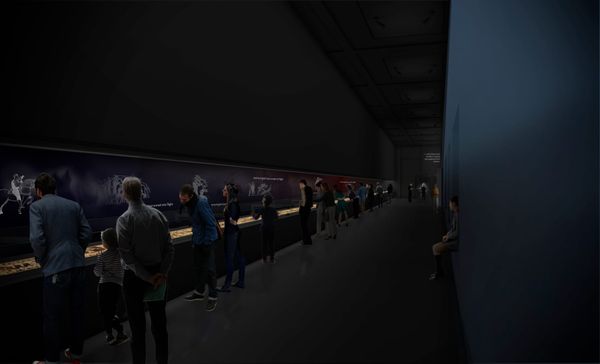
The project centres on the Grande Colonnade, the eastern façade of the palace, where the winning proposal introduces a new public approach, underground entrances, clearer circulation, green space, visitor facilities, exhibition areas and a dedicated route for the Mona Lisa. It shifts attention toward the eastern side of the Louvre, away from the Pyramid as the single dominant point of arrival.
The official language is one of reconnection: city, palace, museum, clearer pathways, green space and improved visitor conditions. But the deeper problem is simpler and harder.
The Louvre has to receive more people than its inherited systems can comfortably hold.
That is felt before a visitor reaches a painting. It is felt in how long arrival takes, how movement narrows, where groups pause, how attention is spent before it can be given, and how staff are asked to manage a load that architecture has not fully absorbed. A museum can lose part of its public experience before the collection even comes into view.
This is why the new entrance matters.
The Grande Colonnade is not just another door. It is an attempt to redistribute the first encounter with the Louvre. If the Pyramid concentrated the modern museum into one unforgettable image of arrival, the Colonnade proposal suggests a different need: not one image, but a system of entry able to separate, slow, direct and release visitors before congestion becomes the museum’s dominant condition.
The Mona Lisa makes that condition sharper.
The painting pulls people through the Louvre with a force that behaves almost independently of the collection around it. Visitors cross rooms not always to look, but to reach. They move toward the painting as toward proof: proof of presence, proof of encounter, proof that the visit has touched the image they already knew before entering the building.
That is not a failure of the public. It is the reality of a work whose fame has outgrown ordinary display.
A dedicated space and route for the Mona Lisa may ease congestion. It also admits that the Louvre contains more than one kind of visitor. Some come for the museum. Some come for a single painting. Some come for the palace, the queue, the photograph, the confirmation that they have passed through one of the world’s cultural thresholds.
The renovation has to hold those publics without letting one exhaust the others.
After a year of security failures, maintenance problems, staff unrest and public debate over renovation costs, the architecture announcement is not a decorative next step. It is a move to turn breakdown back into sequence.
First arrival. Then screening. Then movement. Then looking.
That order matters because the Louvre is not only a palace of collections. It is a working institution that has to make millions of bodies, expectations, risks and routes pass through a historic structure without letting the mechanism become the experience.
This is the burden now carried by major museums at global scale.
Success produces visibility. Visibility produces demand. Demand produces queues, bottlenecks, security exposure, staff pressure, climate needs, revenue arguments and public impatience. Eventually, the museum has to redesign the conditions under which its own success is received.
The Louvre’s Nouvelle Renaissance project is therefore not simply an expansion.
It is an attempt to rebuild confidence through the choreography of arrival: to show that the museum can still organise the public experience before queues, bottlenecks and single-image pilgrimage become the strongest forces shaping how the museum is understood.
© ART Walkway. All Rights Reserved.