When Everything Must Change: Radical Intelligence at the Thessaloniki Biennale
Maja Ćirić reviews Nadja Argyropoulou’s 9th Thessaloniki Biennale, reading Everything Must Change. RI.S9 through radical intelligence, mêtis, metamorphosis, and the politics of adaptive survival.
When, in her curatorial text, Nadja Argyropoulou, independent curator of the 9th Thessaloniki Biennale of Contemporary Art, organised by MOMus – Metropolitan Organisation of Museums of Visual Arts of Thessaloniki, describes the city as peripheral despite its location within the European Union, it becomes clear that conditions in regions even further removed from Europe’s cultural and economic centres can scarcely be assumed to be more favourable.
By naming the 9th Thessaloniki Biennale Everything Must Change. RI.S9, Argyropoulou places the exhibition’s ideological and political charge on a single modal verb: must. Embedded in the Biennale’s central dictum, “everything must change,” the verb shifts change from possibility to necessity, framing it not as an option but as an imperative. Grammatically, must is a defective powerhouse: it resists conjugation, bypasses temporal succession, and allows no conditional alternative. By rejecting the softer diplomacy of should and the speculative openness of might, the curatorial framework casts transformation as an ontological prerequisite rather than a curatorial proposition.
This linguistic absolutism permeates the exhibition’s spatial dramaturgy. Artworks cease to be objects of leisurely aesthetic consumption and become urgent interlocutors demanding cognitive recalibration. The stripped syntax, the bare infinitive change without the particle to, performs a symbolic decolonisation of institutional language, shedding procedural politeness in favour of direct insistence. Here lies the Biennale’s critical force: must is not a fulfilled prophecy but a fraught performative cry, a linguistic mirror held up to a civilisation attempting to will itself into a future its own grammar cannot yet contain.
Beyond the imperative implied by “must,” the title also contains the acronym RI.S9, standing for Radical Intelligence Saloniki 9, with Saloniki referring to an eastern, oral name of Thessaloniki. This review reads the exhibition through Catherine Malabou’s Morphing Intelligence: From IQ Measurement to Artificial Brains, translated by Carolyn Shread and published by Columbia University Press in 2019, where intelligence emerges as an ontological paradox: it possesses no stable being of its own and cannot properly belong to anyone. Rather than grounding itself in essence or identity, it exists through continuous transformation.
Malabou recalls that the Greeks recognised the priority of metamorphosis over being, naming intelligence mêtis before calling it logos, thus granting cunning precedence over reason. It is perhaps fitting that this reflection unfolds in Greece itself: where else might one revisit metamorphosis through Malabou’s lens than in the cultural landscape from which mêtis first emerged as a figure of transformative intelligence?
In this sense, intelligence is not a fixed faculty but a capacity for adaptation, displacement, and invention. For Malabou, metamorphosis can substitute for being; what something is cannot be separated from what it becomes. Viewed from this perspective, intelligence appears as a circulation of energy, defined by its mutations, displacements, and ongoing transformations.
Radical mêtis is a form of intelligence that no longer merely navigates appearances, but actively generates metamorphic states of identity, strategy, and perception. Traditionally embodied by the fox and the octopus, it manifests through four characteristic capacities: turning the adversary’s game against itself, sensing and seizing the opportune moment of kairos, deploying multiple stratagems, and hiding behind masks. What unites these capacities is the power of metamorphosis, the ability to alter form, position, and relation in response to shifting circumstances.
The main venues of RI.S9 are the Thessaloniki International Fair, TIF-HELEXPO Pavilions 2 and 3, and MOMus. However, during the opening weekend of the 9th Thessaloniki Biennale, Dimitris Ameladiotis debuted his performance the ha(l)lophyte at the Kalochori Lagoon, embodying Malabou’s concept of biological, adaptive mêtis. Immersing his body in the salty wetland, he drew structural parallels between the resilient plants of the Axios Delta and his own physical experiences with Stickler syndrome. Eschewing a fixed logos, Ameladiotis used raw, sensory-driven improvisation to showcase a cunning intelligence born from genetic mutation and constraint. The performance stood as a powerful meditation on survival, bodily vulnerability, and the organic capacity to intelligently navigate a hostile environment.
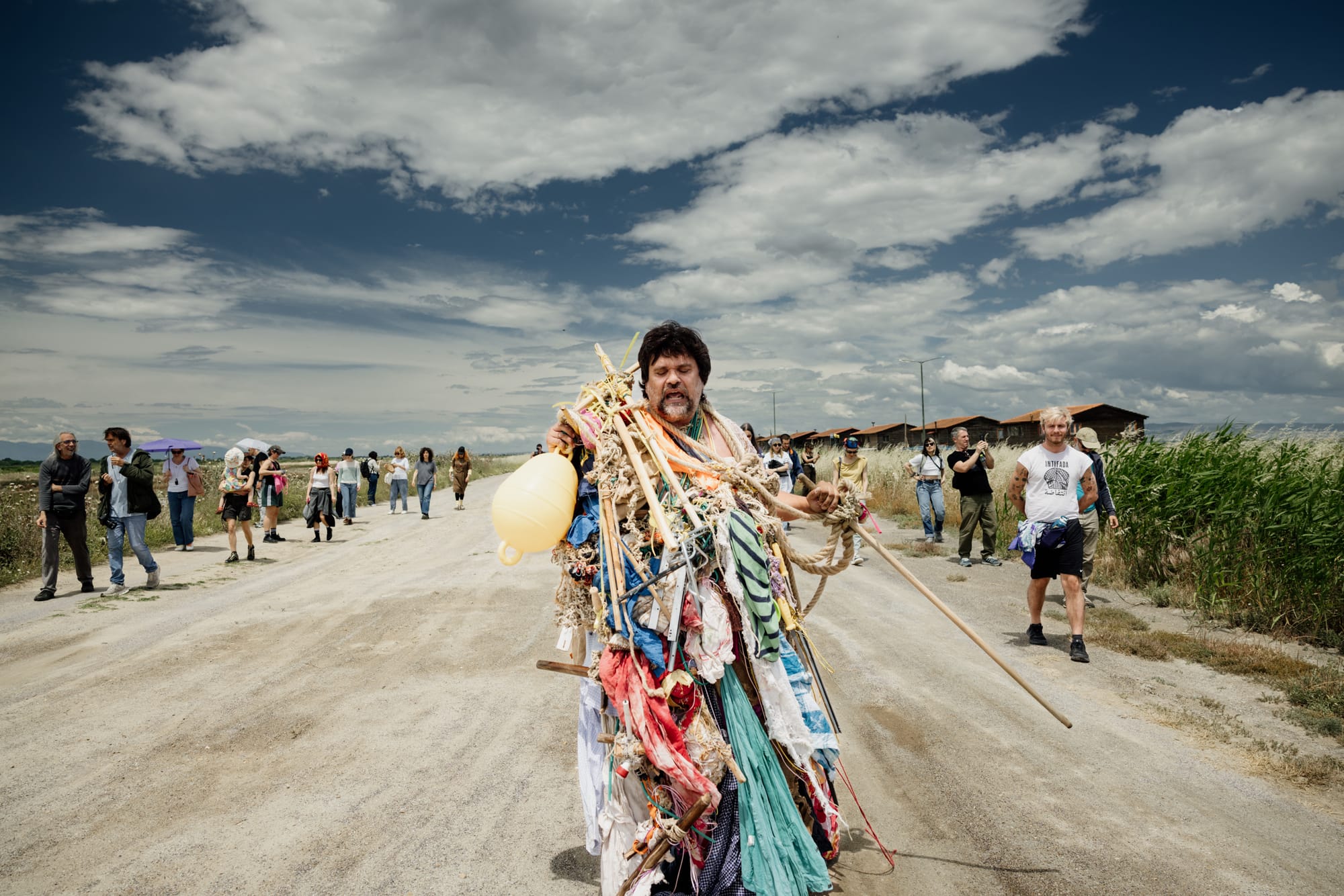
If RI.S9 invokes “radical intelligence” in Malabou’s sense, then its artworks can be approached not as representations of intelligence but as enactments of mêtis: cunning, adaptive, transformative. Recognising this resonance between Malabou’s thought and RI.S9, this review proposes four movements of mêtis — reversal, kairos, mask / disguise, and metamorphosis — as a critical framework developed here to interpret how the Biennale’s artworks articulate intelligence as a set of transformative, situational, and relational operations rather than a fixed curatorial principle.
Reversal
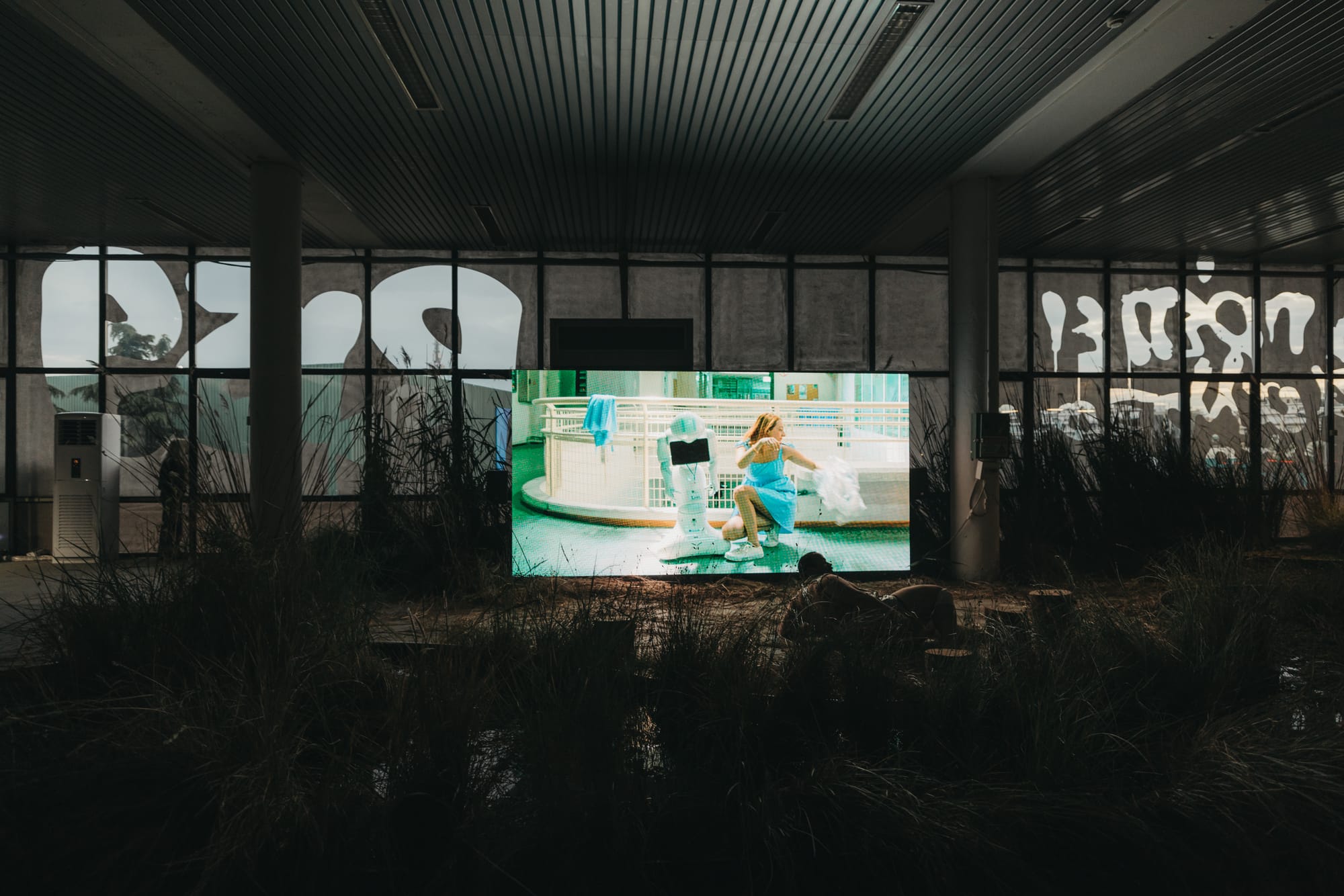
Antigoni Tsagkaropoulou’s In the Wild operates within the logic of metamorphosis, where intelligence appears not as a fixed faculty but as a continuous process of becoming. Through its entanglement of wetlands, film, archival material, and robotic vision, the work dissolves stable boundaries between human, machine, and environment. Intelligence emerges here as a distributed ecological condition, slow, adaptive, and constantly reconfigured through relations of care, fragility, and coexistence.
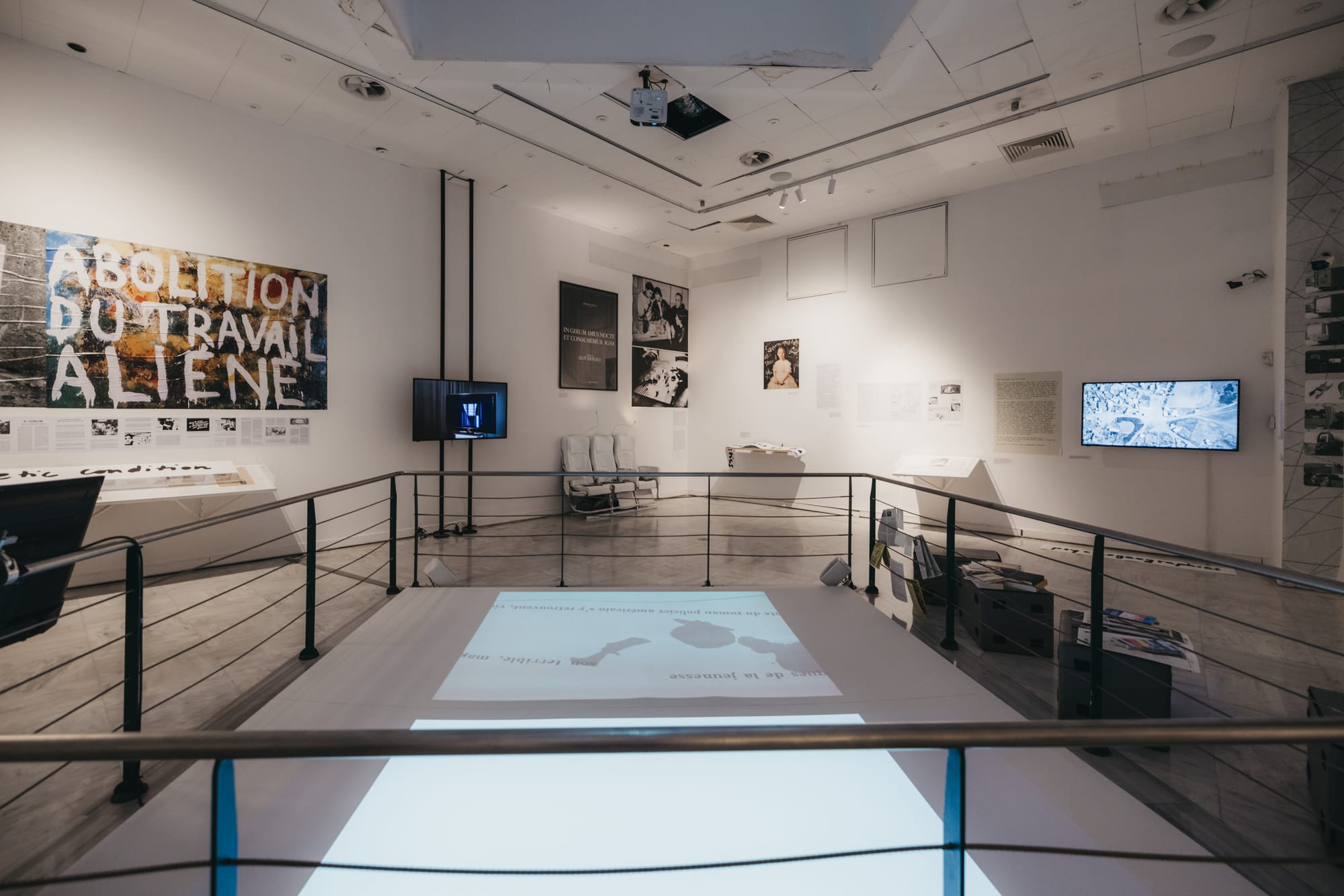
At MOMus, the area of the Biennale called Flipper Zone: Playing Against the Spectacle, co-curated with researcher-curator Vanessa Theodoropoulou, draws on the legacy of the Situationist International and Guy Debord. It explicitly proposes the détournement of dominant images and narratives, exemplifying mêtis as the capacity to turn the enemy’s game against itself.
In the vicinity, Marco Scotini presented Disobedience Archive (The Loudspeaker) in collaboration with artists Zafos Xagoraris and Katerina Stefanidaki, whose spatial design structured the installation’s open circulation and visual rhythm. The archive assembled over thirty international artists and collectives alongside historical material by avant-garde artist Gustav Klutsis, bringing together imagery across gender disobedience, insurgent communities, and radical ecologies.
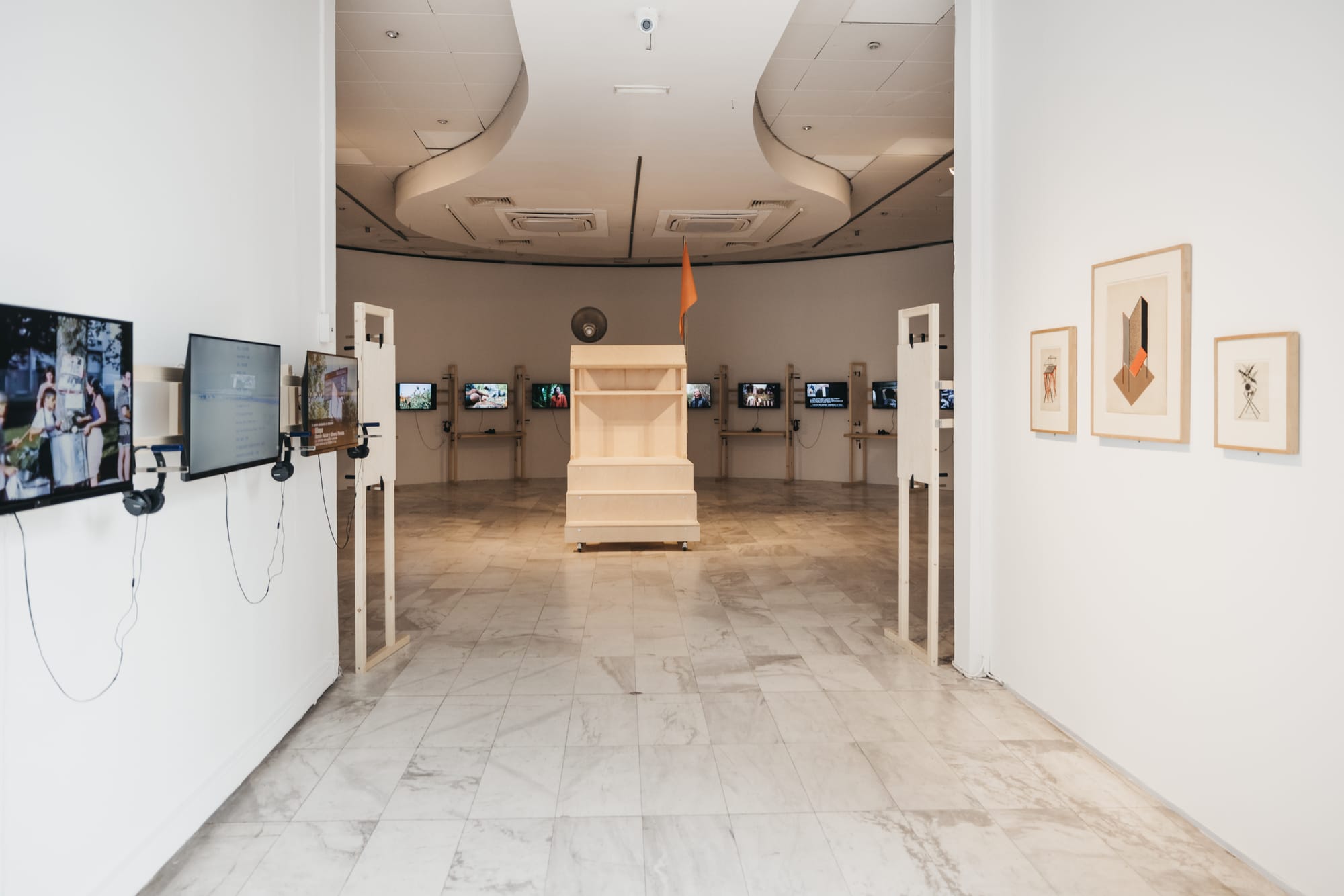
Read through the lens of mêtis, the project operates as a second-order intelligence that reorganises dispersed tactical knowledges into a structured field of relations, producing legibility through curatorial selection, sequencing, and juxtaposition. This also generates a structural inversion of institutional logic, where mechanisms of classification and visibility are repurposed to circulate what those mechanisms normally suppress, producing a tension between insurgent content and curatorial order.
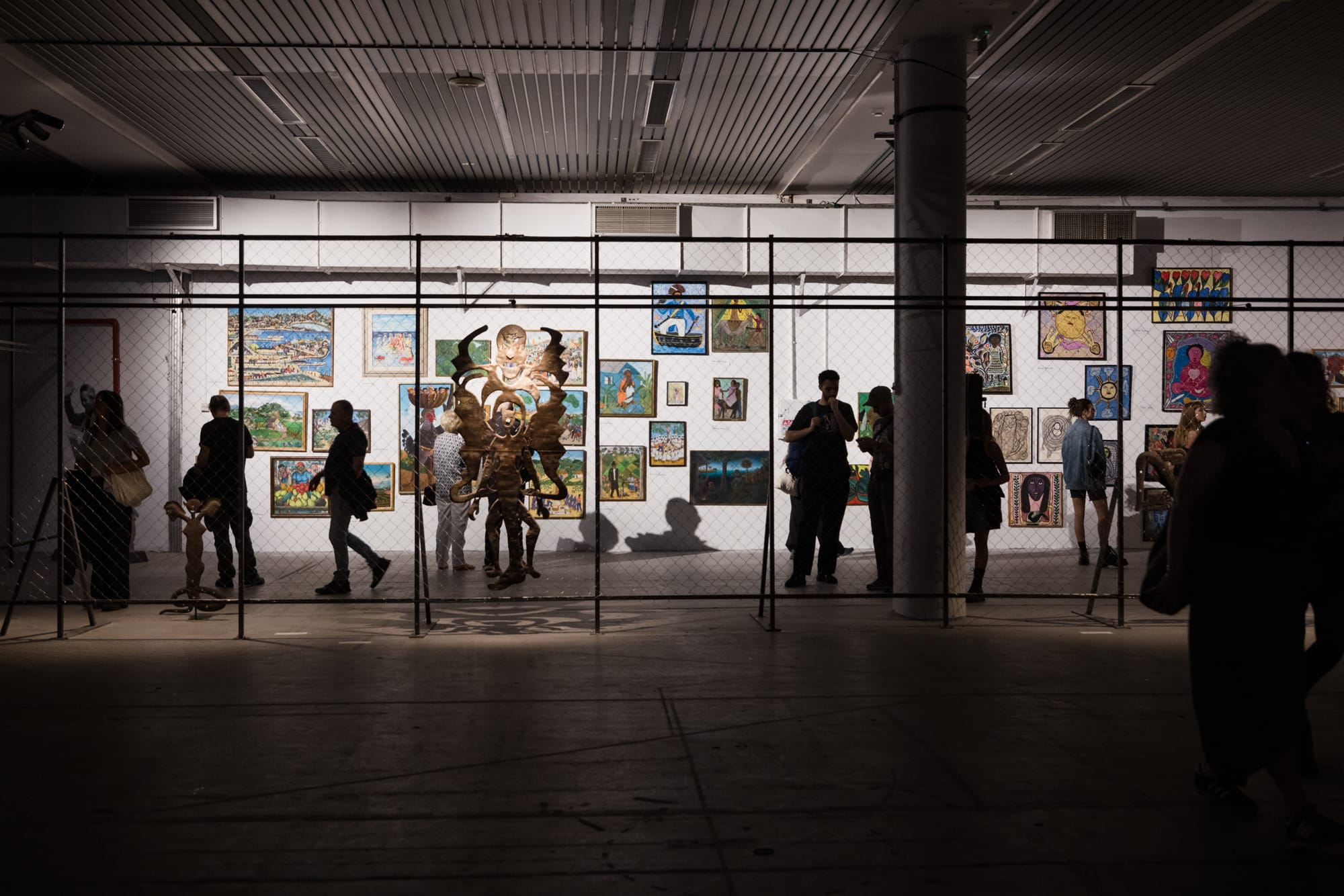
The Museum of Friendship presents artworks from the collection of Jean-Marie Drot, housed in his home on the island of Ios and assembled through decades of travel, friendship, and collaboration. Bringing together Haitian, Greek, African, European, and Latin American artists, the collection reflects how artistic practices absorb, translate, and transform diverse histories and traditions. Confined within a cage-like structure, a selection of Haitian artworks and a collectively produced tapestry from the Ramses Wissa Wassef studio highlight these processes of cultural exchange and reinvention.
Kairos
The Biennale’s emphasis on improvisation, errant trajectories, and “joyful militancy” foregrounds the logic of kairos: a sensitivity to contingent moments in which transformation becomes possible. Within this framework, the curator reactivates neglected or forgotten historical examples, repositioning them as potent and operative within the present everything must change paradigm, where past practices are no longer read as closed histories but as latent openings for renewed forms of critical and collective agency.
An installation of archival materials brings together Maria Karavela’s pioneering socially engaged, anti-fascist, and anti-commercial practice with a wider constellation of artists whose work redefines art as action rather than representation, including Joseph Beuys, Allan Kaprow, Antonin Artaud, and Samuel Beckett. Read through the logic of kairos, the opportune moment in which transformation becomes possible, these practices appear not as fixed historical achievements but as contingent openings in time, where artistic action interrupts established political, social, and aesthetic orders through performance, participation, and the reconfiguration of space.
This kairotic structure extends into Pan Daimonium, which gathers Surrealist and related figures such as André Breton, Marcel Duchamp, Max Ernst, Wifredo Lam, André Masson, Victor Brauner, Nicolas Calas, Nikos Engonopoulos, Mario Prassinos, Jean Tinguely, and others, alongside the films Daphni (1951), directed by Angelos Prokopiou and George Hoyningen-Huene, and Dimos Theos’s Surrealist Happening (1983), where Surrealism emerges less as a historical movement than as a recurring state of heightened temporal rupture.
Across these works, the exhibition reactivates past artistic moments as kairotic intensities, latent situations in which the possibility of action is repeatedly reopened in the present rather than preserved as completed history.
Mask / Disguise
Dionissis Kavallieratos’s The Chivalrous Quest is a multimedia installation that addresses democracy, power, greed, war, genocide, and collective complacency through allegory, satire, absurdity, and symbolic figures rather than direct political advocacy or documentary representation. The ceramic knights, “Democretins,” “Democrushers,” animal heads, film, and drawings construct a fictional and grotesque world through which contemporary political realities are refracted.
Particularly striking is the queue of dressed-up and masked figures, whose bizarre and theatrical presence commands attention within the vast exhibition hall. Visually powerful and unsettling, these sculptural characters operate as a kind of political masquerade, redirecting the viewer’s gaze and drawing them into the work’s allegorical universe. Critique appears through displacement, metaphor, and performative exaggeration.
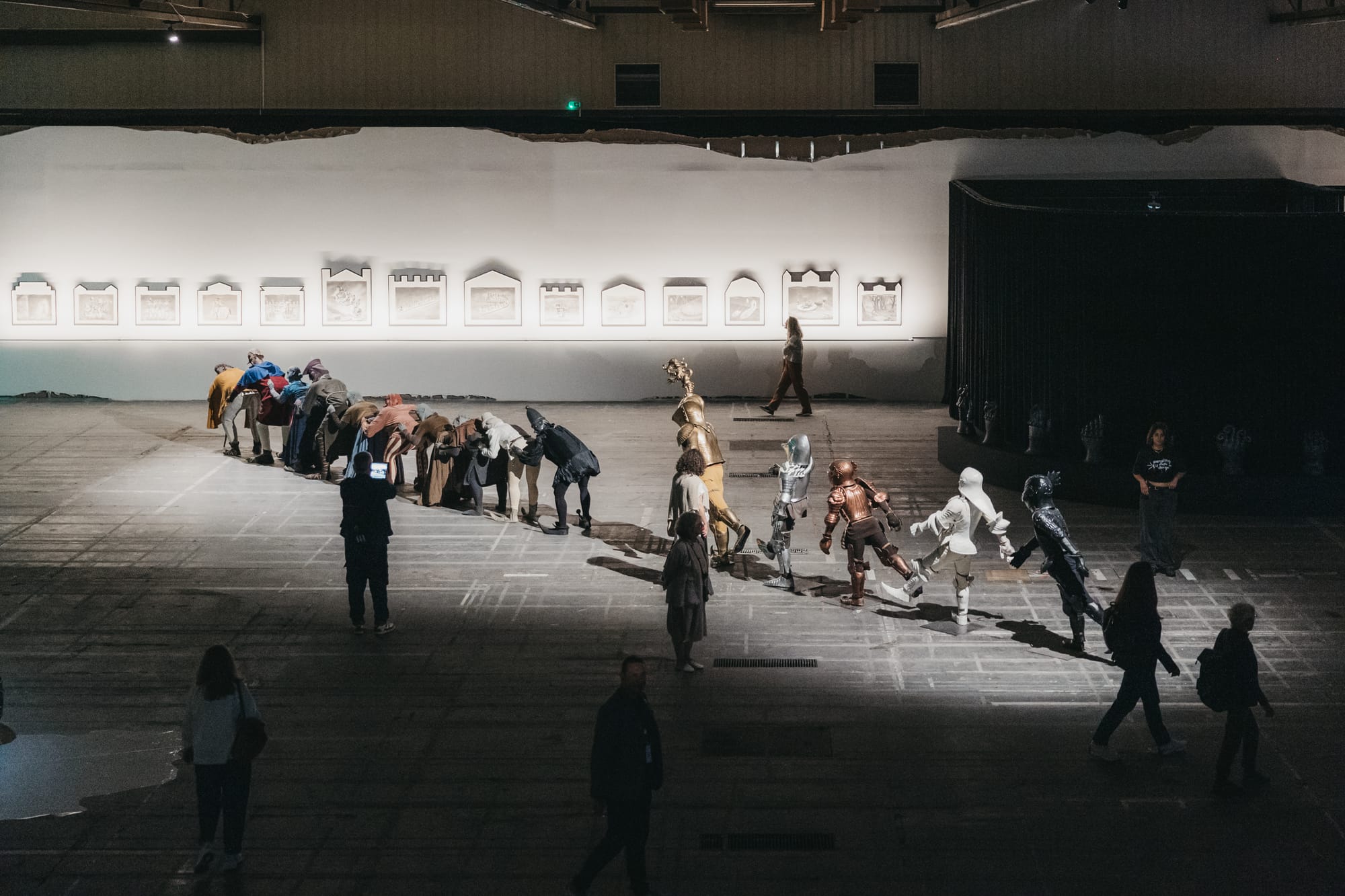
There are secondary elements of situational cunning, particularly in the use of humour, irony, and absurdity as tools for exposing structures of power. However, the dominant strategy remains indirect action, because the work seeks to produce critical reflection through allegorical forms rather than tactical immediacy.
Other artworks engaging speculative fiction and critical fabulation, such as projects by Eva Papamargariti and Marina Velisioti, operate through the invention of alternative worlds, hybrid identities, and unstable realities. Here intelligence emerges through disguise, mutation, and the multiplication of possible selves rather than through transparency or fixed knowledge. In this sense, RI.S9 does not simply thematise change; it stages mêtis as a mode of artistic and political survival, affirming metamorphosis itself as a form of intelligence.
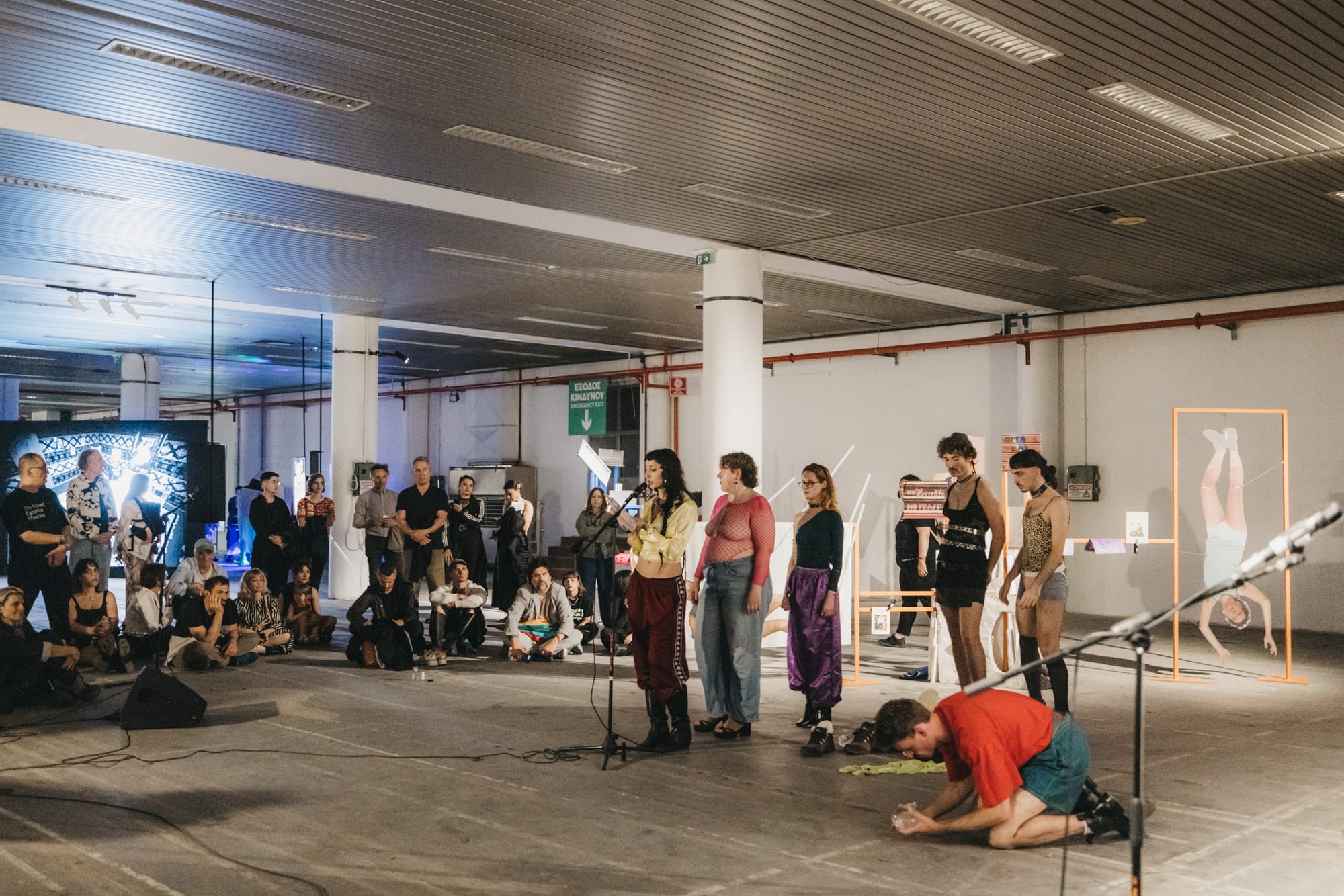
VASKOS’s From Vardari to Omonoia is a multi-part installation and performance that reclaims urban public space as a living archive of LGBTQ+ history. Through a collage of poetry, photographs, architectural structures, archival materials, and embodied action, the work reconstructs alternative genealogies of Thessaloniki and Athens, reactivating marginalised histories of desire, solidarity, violence, mourning, and collective resistance that have remained largely absent from official narratives.
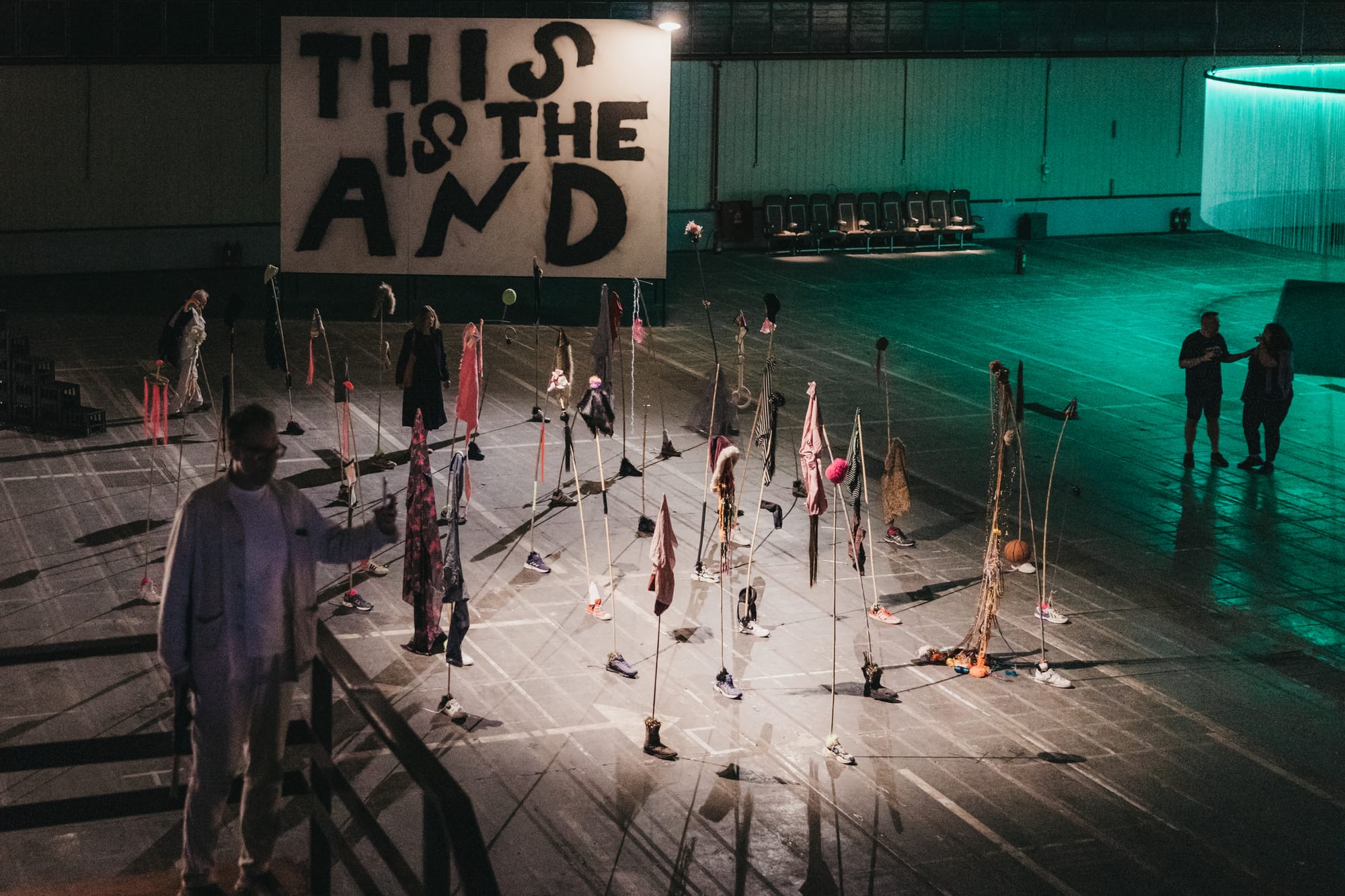
The Callas, Lakis and Aris Ionas, present Wanderers, Dream Baby Dream (Anti-Flags series), and Protest Song Machine as a shape-shifting strategy in which artistic, social, and political forms remain in constant transformation. Combining sculpture, painting, architecture, music, and collective action, the installation constructs temporary spaces of solidarity and what the artists describe as “Friendutopias”, fluid communities that operate as tools of resistance, creativity, and survival.
The hybrid figures of The Wanderers, the ritualistic architecture of Protest Song Machine, and the incantatory protest imagery of the Anti-Flags reject fixed identities and direct political messaging, instead mobilising collective imagination, affect, and symbolic transformation as forms of indirect action. What makes it distinct from Karavela or VASKOS is that its politics are less about reactivating historical struggles and more about creating mutable social forms and collective worlds in the present.
Metamorphosis
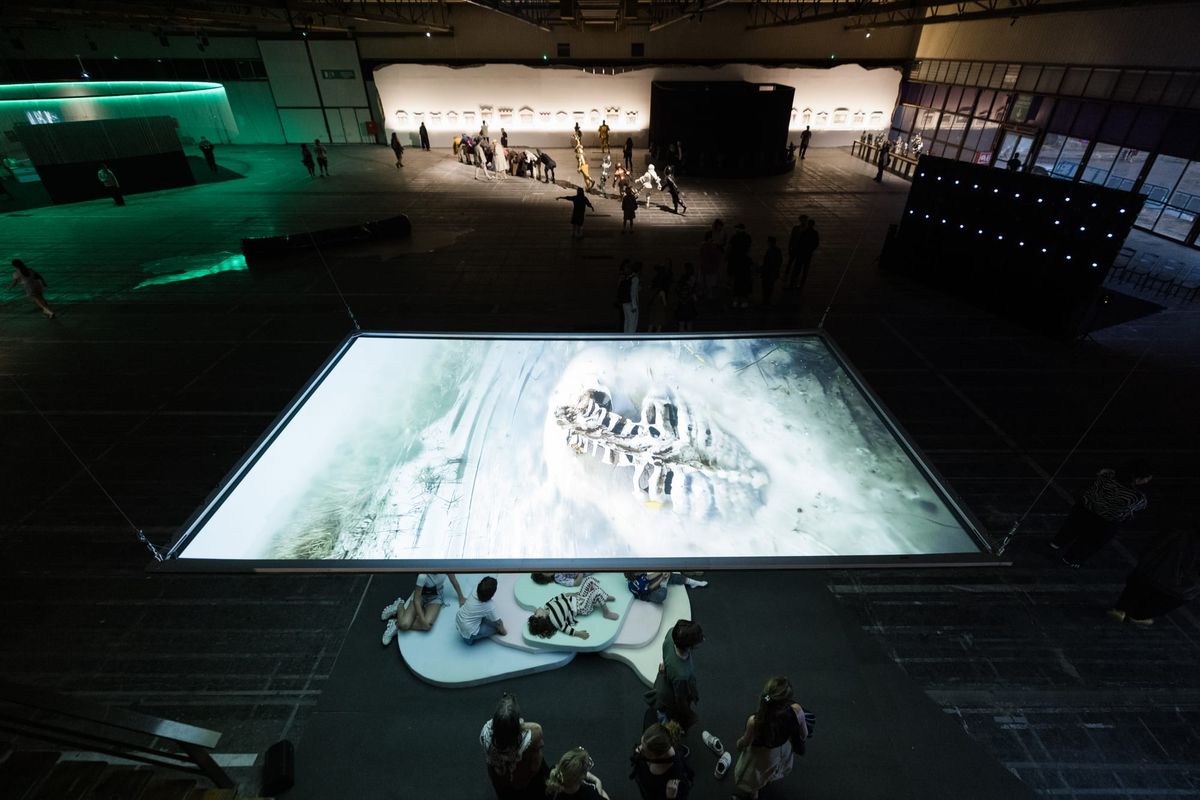
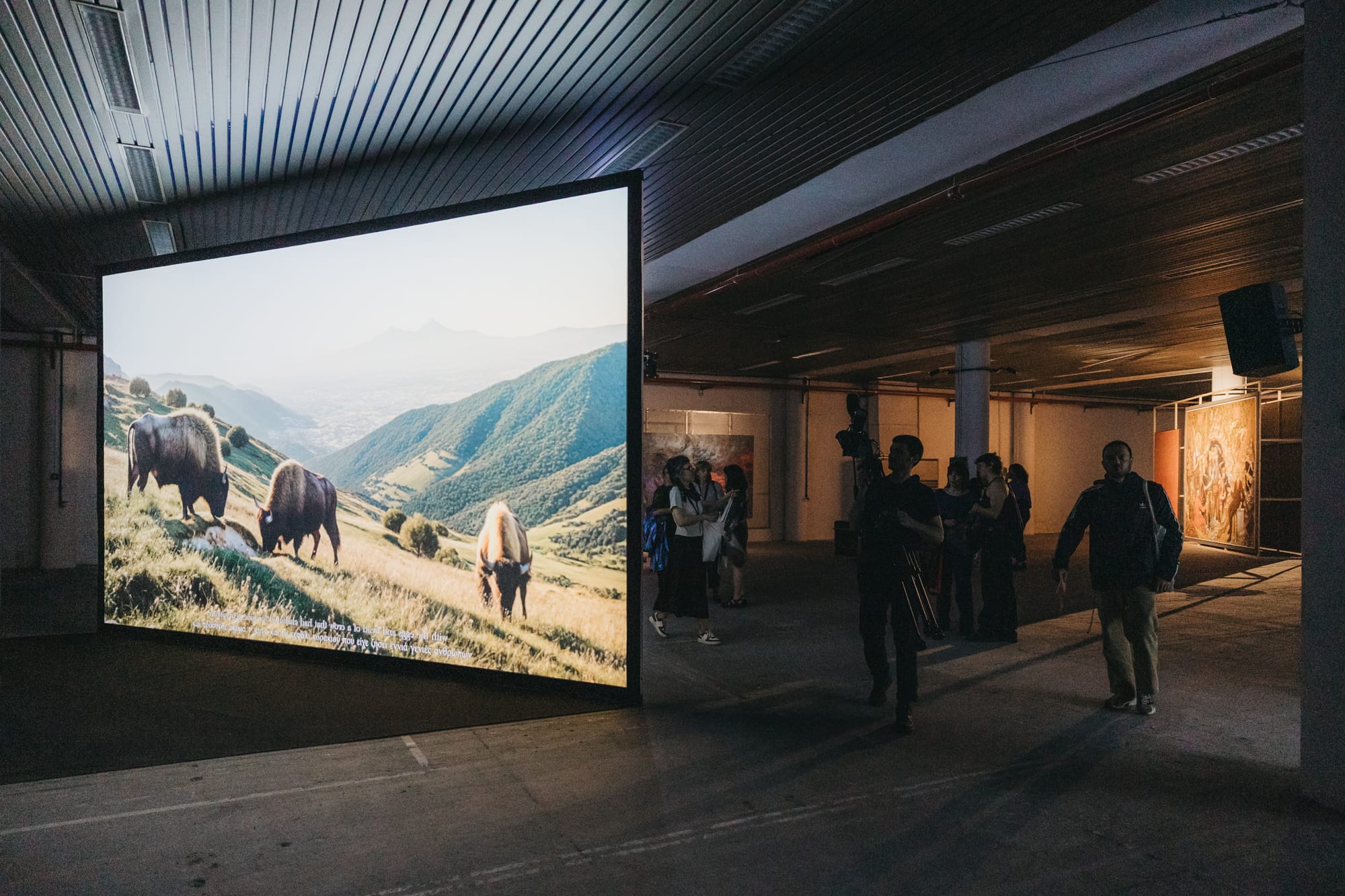
Sofia Dona’s In Tempe or The Dales of Arcady stages transformation as both historical condition and aesthetic method. Through AI-generated animations of extinct and endangered animals, the work collapses temporal distances between Palaeolithic life, classical mythology, and the 2023 Tempe railway disaster, a tragedy that plunged Greece into mourning and exposed deep political failures. The recurring references to Ovid’s Metamorphoses, particularly the transformation of Actaeon, underscore a conception of intelligence rooted not in permanence but in continual becoming. Here, metamorphosis emerges as a mode of mourning that traverses species, histories, and landscapes, revealing change itself as the only enduring condition.
Marina Velisioti’s Last Resort draws on a layered constellation of cultural references, Total Recall, Carl Jung, Tron, and The Illuminatus! Trilogy, to construct an in-between zone where subjectivity is continuously negotiated through image, myth, and affect.
The sanctuary of mutants from Total Recall is reactivated as a spatial tube referencing refuge and resistance, while Jung’s notion of the flying saucer as a projection of the collective unconscious is translated into a contemporary “intergalactic mandala,” where crisis becomes a generator of psychic and visual forms. The aesthetics of Tron and 1980s visual culture are not quoted nostalgically but mobilised as active memory structures, while the Discordian logic and countercultural tone of The Illuminatus! Trilogy introduce chaos not as breakdown but as an operative principle of transformation.
Within this framework, Last Resort stages a condition of ongoing metamorphosis: identity is performed through costume, armour, and ritualised movement, while the disco-ritual environment opens a kairotic threshold in which subjectivity is repeatedly reshaped between myth, simulation, and collective imagination.
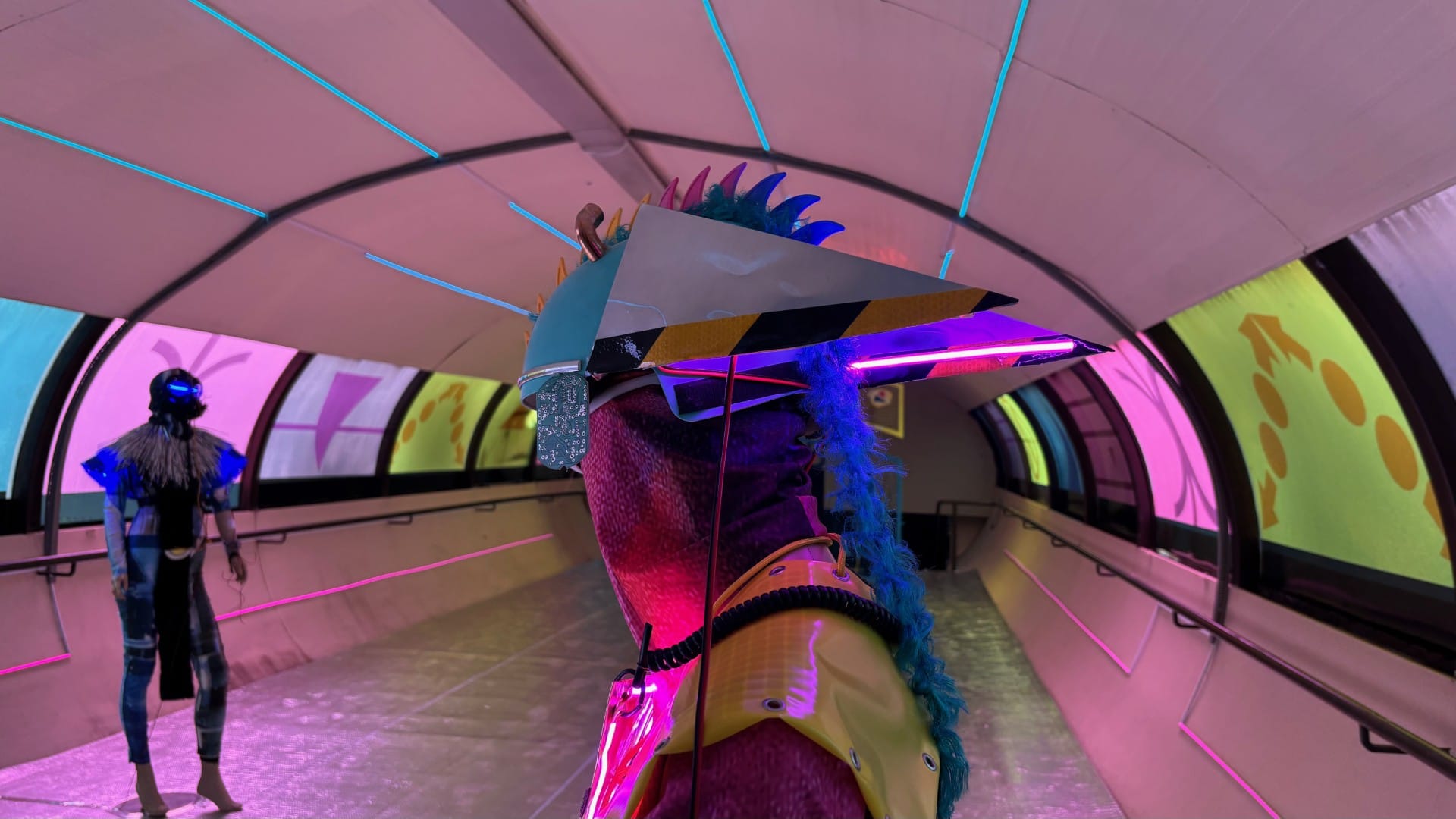
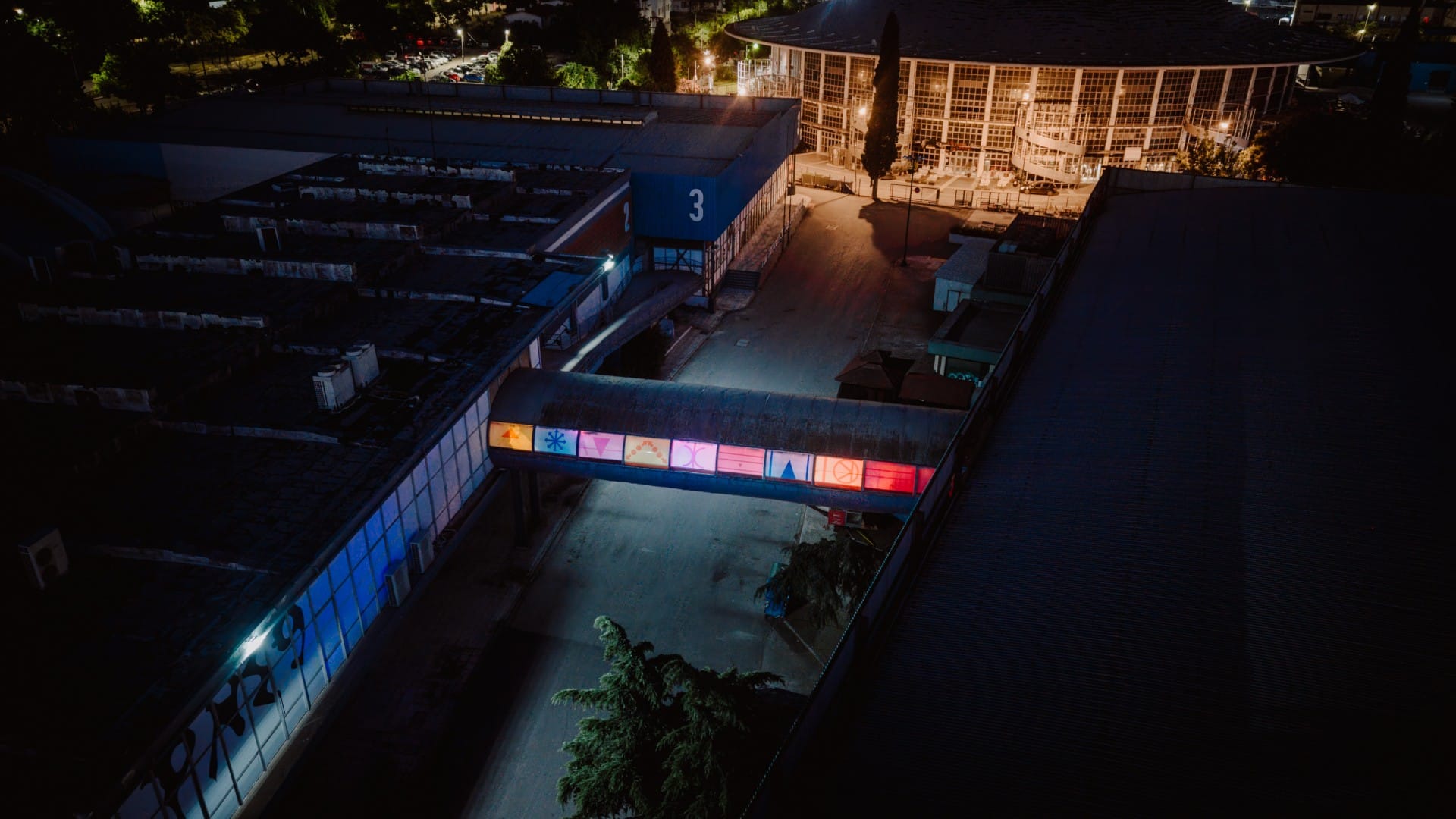
Marina Velisioti, Last Resort, 2026. Installation view, 9th Thessaloniki Biennale of Contemporary Art, Everything Must Change. RI.S9. Photo: Marina Velisioti and Fotis Vlachakis. Courtesy of the artist.
Four Interacting Vectors of Intelligence
Many artworks are not exclusive to one category; they operate as interacting vectors of intelligence rather than rigid compartments. The Biennale is deliberately mêtis-rich in this sense.
Eva Papamargariti’s In This Swamp, We Are All Monsters unfolds as shape-shifting intelligence, with indirect action moving beneath its surface. The work constructs a mutable, immersive digital ecosystem where bodies, land, data, and simulation continuously merge and reconfigure. Through its three-screen moving-image environment and materially hybrid sculptural elements, it produces a swamp as both physical and computational space: rhizomatic, unstable, and constantly in flux. Meaning emerges not through fixed representation but through transformation, ambiguity, and shifting relations between organic and synthetic forms.
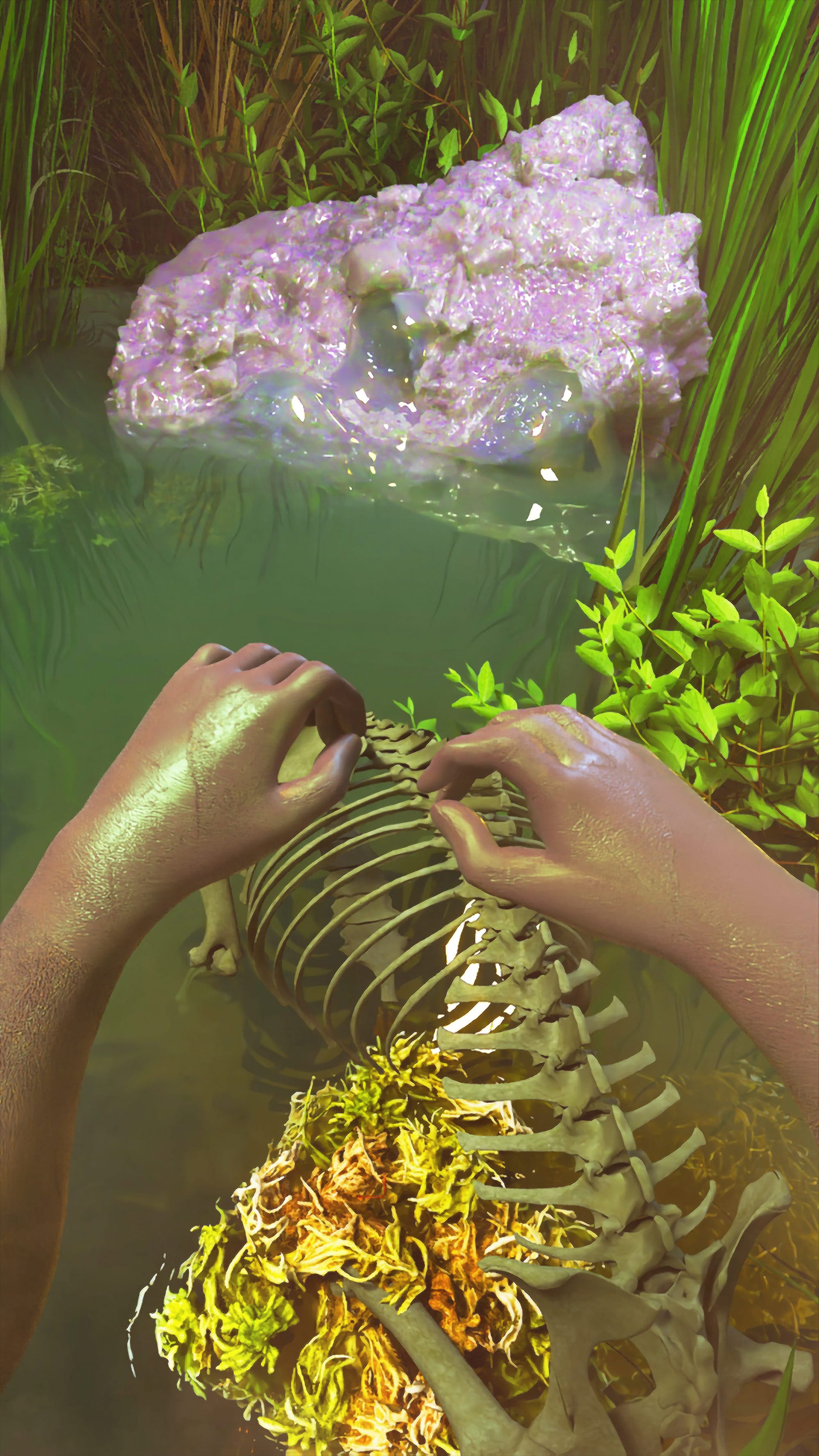
At the same time, it articulates ecological and political concerns — entanglement, environmental precarity, and digital oversaturation — through metaphor, sensory immersion, and atmospheric complexity rather than direct statement or narrative resolution.
Christos Karakolis’s Installation of Fifty-Nine Wooden Rods (Fifty-Four “Embroidered” on Their Bark and Five “Naked” Ones) and Eleven “Difficult” Wood Carvings (1990–ongoing) extends mêtis into adaptive intelligence and indirect action.
The artwork constitutes a long-duration system of embodied knowledge in which carved wooden rods and difficult wood forms function as tactile inscriptions of observation, time, and landscape. Through processes of carving, marking, and “embroidering” bark, the practice develops an adaptive intelligence, where scientific curiosity, rural material engagement, and perceptual attention are continuously adjusted and refined through lived experience. At the same time, its epistemic content is not explicitly stated but embedded in material procedures and symbolic gestures that require interpretation through touch, duration, and close looking.
Oliver Ressler’s Everything’s Coming Together While Everything’s Falling Apart (2016–2020), together with The Economy Is Wounded – Let It Die! (2016), brings indirect action into a kairotic structure.
The artwork does not present climate crisis as representation but as a distributed field of political practice, assembling sites of resistance, civil disobedience, and infrastructural disruption into a networked ecology of refusal. Across its video and photographic components, it condenses activism, blockade, occupation, and media intervention into situated acts that reveal how ecological breakdown is inseparable from the operations of fossil capitalism and global trade.
Already widely circulated within the contemporary art system, the artwork functions as an important footnote or manual of attitude within climate discourse: a repertoire of tactics, positions, and forms of refusal that operates as a reference structure for oppositional praxis rather than a closed aesthetic statement, while foregrounding the kairotic moments in which political action becomes possible within conditions of systemic delay and crisis.
Ruins Speak in Codes
This Biennale brings a range of compelling Greek artistic practices, contemporary and historical, including Panos Koutrouboussis, Stelios Faitakis, Leonidas Christakis, and Nanos Valaoritis, into sharper visibility within international art discourse, revealing a scene shaped between the rudimentary and the conditioned, where cybernetics and chance operate as intertwined logics of production and perception.
Ruins speak in codes, suggesting that what remains, archival fragments, urban residues, and cultural debris, does not disappear but reconfigures itself as a system of encrypted meaning. Within this framework, camouflage emerges not only as an aesthetic strategy but also as a tactic of survival under the rise of the right wing, as in the work of Danielle Brathwaite-Shirley: a mode of opacity, displacement, and adaptive visibility.
What unfolds is a sensibility that resists fixed orthodoxy, engaging instability, fragmentation, and chaos not as absence of order but as a generative field of coded perception, political awareness, and artistic possibility.
As professor T. J. Demos, essayist of the Biennale catalogue and interlocutor of its curator, notes: “Speculative fabulations of emancipatory futurity take shape in the ruins… These are sites of contradiction where the aesthetic becomes situational, tactical—a terrain for struggle. In the convergence of art and politics, the question is not whether resistance is possible, but how it will now be composed, at what cost, to whom… Small steps matter, even when everything must change.”
Yet alongside these coded terrains run red lines, the ones that cannot be crossed without consequence. If the world is understood as a system in contraction, shaped by ongoing breakdowns and negotiations, then every act of bargaining raises a critical question of ethical threshold: how much is exchanged before one crosses oneself?
In this condition of unstable agreements and shifting truths, clarity becomes not a naïve demand but an urgent necessity, where clear truth is preferable to a carefully protected lie. By tracing the many forms of mêtis, this biennial did not resolve these contradictions but brought us closer to the clarity needed to confront them.
Review by Maja Ćirić | Curator & Art Writer
© ART Walkway. All Rights Reserved.