
The ADAA Fair and the Work Beyond the Armory
The Art Dealers Association of America's return to New York brings together more than a smaller exhibition. Across membership, professional representation and cultural funding, the relaunched fair places different forms of commercial and institutional participation in proximity.
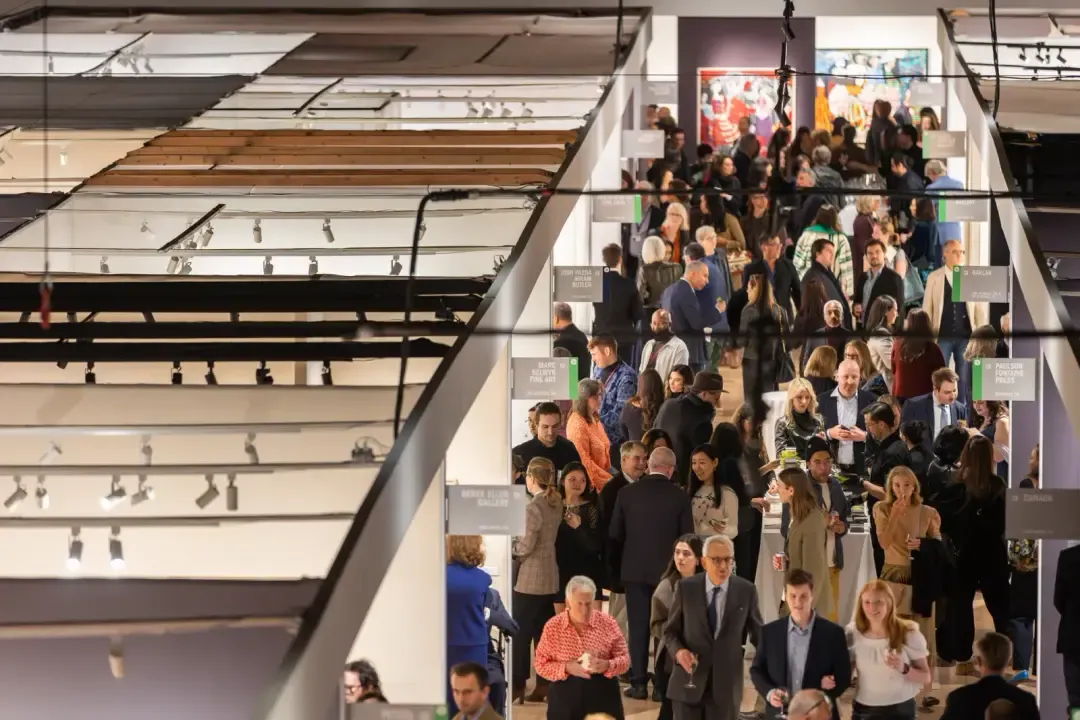
The ADAA Fair has returned to the Park Avenue Armory with 63 galleries from 23 American cities. The Whitney Museum of American Art has replaced Henry Street Settlement as the beneficiary of its Preview Gala, while the fair itself now carries the name of the association that has organised it since 1989.
The change brings the Art Dealers Association of America more directly into the public identity of the event. Founded in 1962, the association predates its fair by nearly three decades, with a membership extending across primary and secondary markets, specialist dealerships and galleries working with contemporary artists.
Following the cancellation of its 2025 edition, the fair reopened to the public on November 13, 2026. Among its exhibitors are galleries that participated in the inaugural event, alongside recently admitted members and businesses making their first appearance.
Their presence at the Armory follows relationships that began elsewhere. The ADAA has approximately 200 member galleries across nearly 40 American cities, with admission determined through a process of professional nomination, review and approval.
That process contains a revealing connection to the fair itself.
The Membership Within the Fair
ADAA membership requires more than an established commercial business. Prospective galleries are considered through criteria addressing exhibition programmes, scholarship, professional conduct, financial soundness and relationships with artists and institutions.
Candidates must ordinarily have operated in the United States for at least five years. Existing members participate through nominations, recommendations and voting, while the Membership Committee considers applications before final board approval.
Among the published criteria is a question about the prospective gallery's suitability for the ADAA Fair: whether members would regard it as qualified to participate and would want to exhibit alongside it.
The fair therefore enters the association's membership considerations before a new gallery has necessarily secured a place in the exhibition.
At the Armory, the relationship becomes visible in another direction. The exhibitors form a selection from a constituency already shaped through professional judgements about the businesses that belong to it.
Those judgements encompass galleries whose activities are not easily reduced to a common commercial model.
Berggruen Gallery, GRAY and Schoelkopf Gallery participated in the first fair in 1989 and return in 2026. Their presence alongside newer members carries different histories of collecting, representation, scholarship and relationships with museums.
Among the newer exhibitors is AH Arts, founded by secondary-market dealer Alix Holloway. In a published conversation with the association, Holloway describes working with collectors over extended periods, including occasions when previously placed works return through estates or beneficiaries.
An artwork can pass through successive collections while relationships with dealers, advisers and institutions persist. The responsibilities surrounding its attribution, provenance, preservation and subsequent sale may change with each transfer.
For galleries principally representing living artists, the sequence can be different. Production, exhibitions, career development, representation agreements and institutional recognition may be closely connected to a gallery's commercial commitments. Other businesses move between these markets or maintain narrower specialisations.
The association brings such practices into a shared professional constituency, but the businesses do not enter it with equivalent resources, histories or market positions.
Its membership procedures establish a boundary as well as a point of connection.
Beyond that boundary, the American gallery sector includes younger businesses, alternative models and dealers whose professional concerns may resemble those of ADAA members without being represented through the association.
Within it, galleries participate in a collective identity whose commercial and institutional implications differ according to their circumstances.
The fair gives that selected constituency a concentrated public presence. Its membership framework also reaches into professional activities that continue long after an exhibition has closed.
From Professional Recognition to Collective Interests
The ADAA's Code of Ethics and Professional Practices follows transactions and relationships that extend beyond an individual sale.
Its provisions address authenticity, ownership, consignments, financial arrangements, obligations towards artists and estates, and dealings among art professionals.
A historical work may reach the market with documentation assembled through several previous owners. Questions about attribution, authenticity or title can remain relevant long after the dealer responsible for an earlier transaction has left the immediate commercial relationship.
For galleries representing living artists, records, exhibition arrangements and the payment of proceeds introduce other responsibilities, some continuing through years of professional collaboration.
The code creates shared expectations across these different activities. It also provides for complaints and disciplinary measures, while leaving members subject to their independent legal obligations.
Such provisions cannot establish the conduct of every member or remove the possibility of disputes. They do, however, place professional recognition in relation to responsibilities that extend beyond admission to the association.
The same movement from individual businesses towards collective obligations appears in ADAA's advocacy.
Through regulatory information, professional resources and engagement with policymakers, the association represents dealer interests beyond the fair.
Those interests are not necessarily experienced uniformly.
A gallery working across national borders may encounter trade and compliance questions differently from a regional business focused on domestic collectors. A primary-market gallery negotiating representation and production commitments may face circumstances unlike those of a specialist dealer handling established collections.
Membership allows these businesses to participate in a shared professional forum. Their differences remain part of what that forum must accommodate.
The association's collective positions consequently emerge from a constituency that is both selected and internally varied. Admission, standards and advocacy connect its members, although the responsibilities and benefits of belonging are not distributed identically across them.
Another form of participation extends from the association into institutions that are not its members.
Where Membership Reaches Beyond Itself
The ADAA Foundation was established in 1970, nineteen years before the first Armory fair. Primarily supported by contributions from member galleries, it provides grants to nonprofit visual-arts organisations across the United States.
Its current programme focuses on institutions with operating budgets of $6 million or less, supporting exhibitions, curatorial research, education and community engagement.
The process introduces a form of institutional selection different from that governing ADAA membership.
Where galleries enter the association through professional nomination and peer review, the Foundation invites randomly selected eligible institutions to submit funding proposals. Grant decisions then concern particular projects undertaken by organisations outside the dealers' membership.
The two processes serve different purposes. One shapes a professional constituency; the other distributes support beyond it.
Yet they operate within connected organisations whose resources, governance and professional relationships originate in the gallery sector.
The Foundation's 2025 grants ranged from $5,000 to $10,000. Among the recipients, the Museum of Contemporary Art Detroit received support associated with Carole Harris: This Side of the River, while the DuSable Black History Museum and Education Center in Chicago was supported in connection with Paris in Black: Internationalism and the Black Renaissance.
The projects involve different institutions, artistic histories and audiences.
At MOCAD, the support enters a programme concerned with the practice of a Detroit-based textile artist whose work has developed over several decades. At DuSable, it enters an exhibition examining Black internationalism and the cultural histories connecting Paris with wider intellectual and artistic movements.
The grants form part of each institution's wider exhibition and research resources. Their contribution cannot be separated entirely from the other financial, curatorial and organisational conditions under which those projects develop.
The Foundation's announced 2026 recipients include the Aldrich Contemporary Art Museum, the Bronx Museum of the Arts, the Harn Museum of Art at the University of Florida and the Kemper Art Museum at Washington University in St. Louis. Their supported projects extend into 2027 and 2028.
Across successive grant cycles, resources originating in the commercial gallery sector enter institutions with different local constituencies, collection histories, scholarly priorities and financial capacities.
The Foundation's programme does not require those organisations to share the commercial interests of the dealers supporting it.
Their relationship takes shape through a different set of institutional decisions.
The relaunched fair introduces another route for cultural support.
For decades, benefit previews of The Art Show supported Henry Street Settlement, contributing to more than $38 million raised for the New York social-services organisation.
That partnership has ended. The Preview Gala of the 2026 ADAA Fair instead benefits the Whitney Museum's education and artistic programmes.
The change places the fair's principal charitable beneficiary within the visual-arts museum sector, while the Foundation continues its separate national grantmaking programme.
The Whitney and the Foundation's recipient institutions occupy different positions in the American cultural landscape. Their resources, public profiles, institutional capacities and relationships with collectors and donors are not interchangeable.
Nor are the forms of support involved. The Whitney receives proceeds connected to a major benefit event; Foundation recipients receive project-based grants through a separate charitable organisation.
Both arrangements bring commercial gallery networks into contact with nonprofit institutions, although the routes through which support is organised—and the circumstances of those receiving it—remain different.
The fair's new beneficiary brings one of those relationships closer to its public identity. The Foundation's grants continue through projects taking place across several years and cities.
The Relationships Around an Artwork
The fair's 2026 public programme moves into another part of this field, where commercial and institutional responsibilities meet through the circulation of artworks.
A discussion involving Barbara and Ted Alfond and curator Abigail Ross Goodman considers collecting in relation to education and community life at Rollins College. The Alfond Collection of Contemporary Art connects private collecting with a university museum, while the Alfond Inn directs hospitality-related revenue towards student scholarships.
Another discussion concerns collection stewardship, bringing together questions of preservation, risk, insurance and the responsibilities associated with ownership.
A third, organised around Betye Saar's centennial, involves representatives of the Museum of Modern Art, the Getty Research Institute and Roberts Projects.
The discussions approach different stages in the relationships through which art is acquired, preserved, researched and brought into public view.
Works entering private collections may eventually return to the market, move into institutions or remain within families for generations. Artists' archives may become sources for scholarship well after the circumstances of their production have changed. Galleries and museums may share an interest in an artist's historical recognition while approaching that work through different professional responsibilities.
Those relationships are neither exclusively commercial nor exclusively institutional.
A dealer may contribute knowledge assembled through years of representation or transactions. A museum may bring conservation, public access and research commitments. A collector may provide resources, loans or gifts while retaining authority over works in private ownership.
Their interests can reinforce one another without following identical priorities.
The ADAA Fair brings several of these participants together through its exhibition, public programming and institutional partnerships.
Commercial arrangements remain part of that setting. Intact Insurance is the fair's Exclusive Lead Insurance Partner, while its collaboration with Art Week NYC is cross-promotional. These relationships contribute different forms of financial or promotional support from those operating through the Preview Gala or the Foundation.
Across the event, galleries participate simultaneously in a market, a professional association and a wider field of cultural relationships whose terms continue to develop elsewhere.
What Remains in Motion
The relaunched ADAA Fair is smaller than its predecessor, with a new name, a different charitable beneficiary and a programme attentive to the relationships between dealers, collectors and institutions.
Those changes arrive in a market where participation in international fairs, gallery operating costs and the distribution of commercial opportunities remain uneven.
The first edition cannot establish how the revised format will affect participating businesses over time. Reported opening sales provide evidence of transactions, but not of the financial returns or wider professional benefits experienced across the membership.
The association's different activities meet those conditions from different positions.
Membership admission continues to shape the professional constituency represented at the fair. Ethical standards follow artworks and relationships beyond individual transactions. Advocacy brings commercial interests into collective discussion, while the Foundation directs resources towards institutions whose work is organised around other priorities.
These arrangements have developed over different periods and do not necessarily change together.
The fair's return brings their connections into closer view, particularly the relationship between a membership selected through professional recognition and a public event through which some of that membership gains commercial and institutional visibility.
Yet the association's collective identity contains businesses that differ in size, specialisation, resources and relationships with the institutions around them.
The terms of belonging, representation and participation remain connected without becoming the same.
At the Armory, galleries meet as members of a common professional body. Beyond it, they continue to occupy different positions within the market, while the institutions, collections and artists with which they work follow their own histories.
The ADAA's relaunched fair brings those positions into proximity again. How they continue to shape one another extends beyond the four days in which the association assembles them.
© ART Walkway. All Rights Reserved.


