Canal Cheong Jagerroos and What the Surface Holds
At Meilahti Art Hall, Canal Cheong Jagerroos’s Beneath the Surface does not arrive as a closed statement of origin or identity. Seen through her layered paintings, Floating Island, and the long Blue and Red dialogue with Nanna Susi, the work keeps movement active without resolving where it belongs.

At first, the paintings do not ask to be translated.
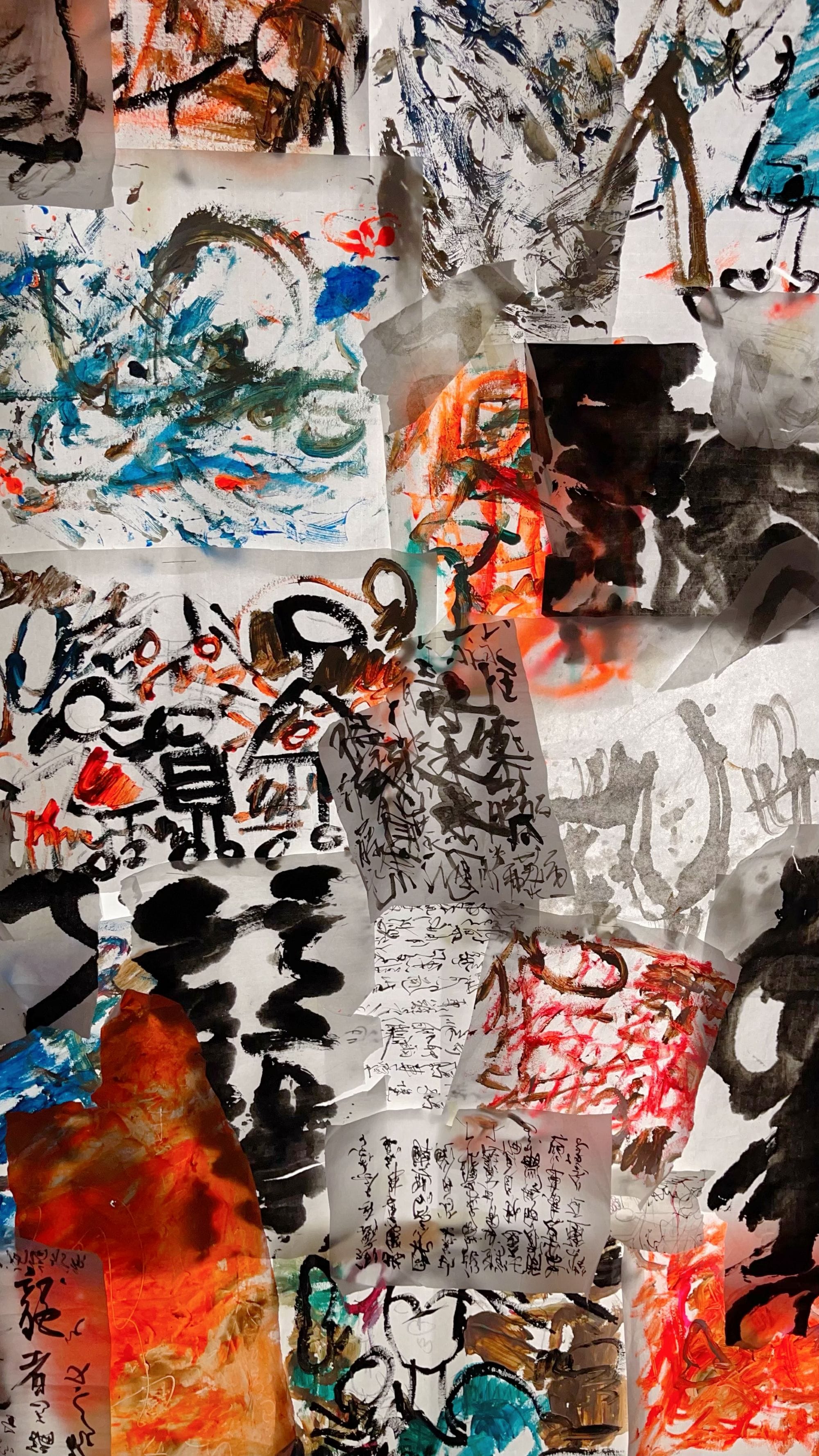
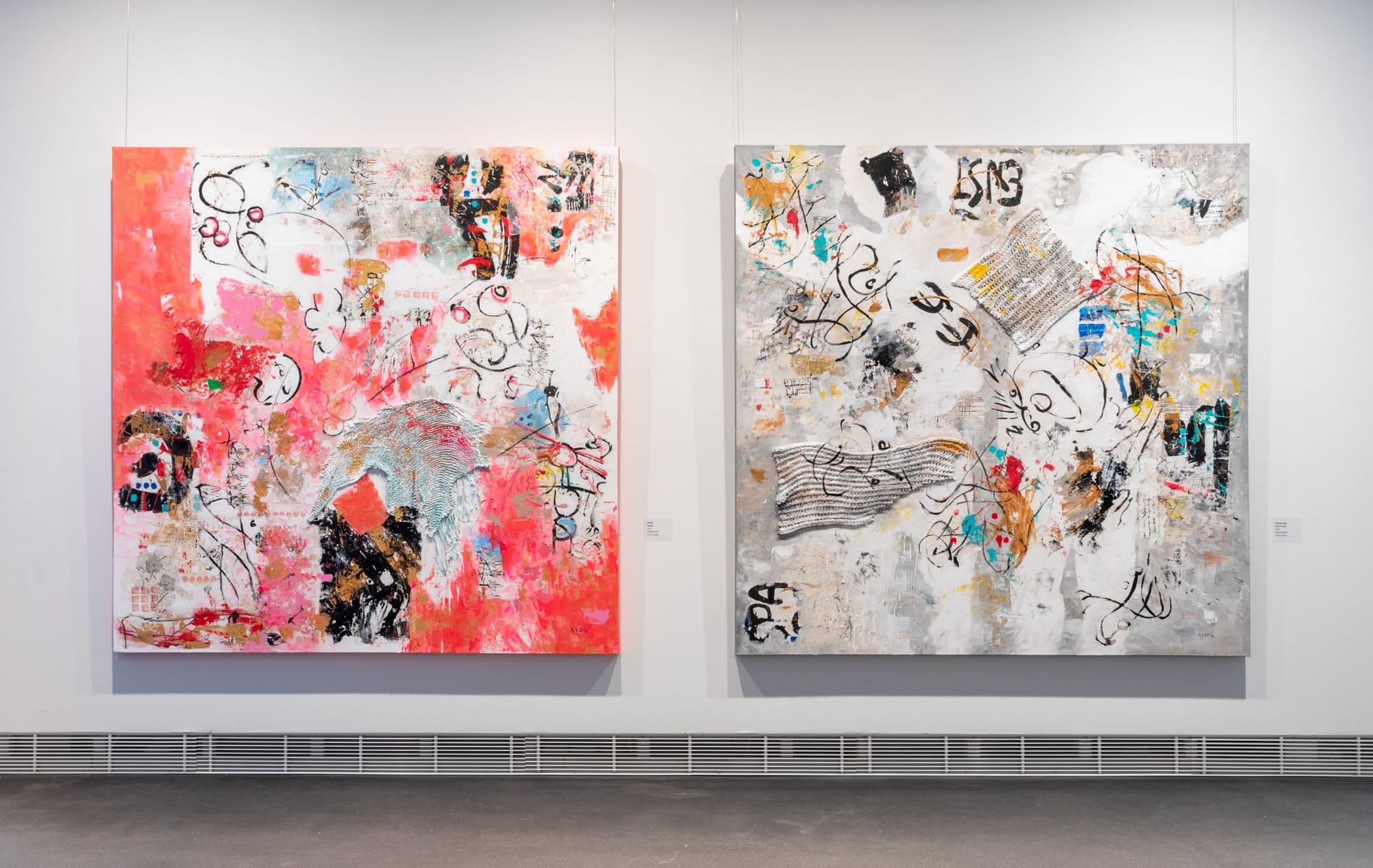
In Canal Cheong Jagerroos’s room at Meilahti Art Hall, colour arrives before biography. Large mixed-media surfaces hold traces of black, white, orange, blue, grey and turquoise; marks gather and loosen; forms seem to have passed through writing without remaining fully available as language. The works carry the memory of calligraphy, but not its obedience. Something has been written, or almost written, then interrupted.
The room belongs to Beneath the Surface, Jagerroos’s section within Nanna Susi’s Joy and Asymmetry. The title is useful because it does not direct the viewer toward origin. It directs attention downward: not only to where the work comes from, but to what the surface has absorbed.
Only after standing with the works does the familiar vocabulary begin to appear.
Macau. Helsinki. Shanghai. Nice. Berlin. Tokyo. East and West. Past and present. Chinese tradition and contemporary abstraction. These coordinates are real, and they belong to Jagerroos’s history. But in front of the paintings they do not behave like explanations. They behave more like fragments already folded into the work.
The surface does not reject biography.
It slows it down.
Jagerroos’s practice has long been framed through movement between cultures: past and present, East and West, a life and practice shaped by Asia, Europe and Africa. But the more useful clue is not the pairing of worlds. It is the repeated action beneath the work: rebuilding the language, signs and symbols of traditional Chinese art through layered colour, mixed materials and forms in which material is not allowed to limit the image.
Rebuilding is the word that stays with the paintings.
Not illustrating.
Not preserving.
Not translating.
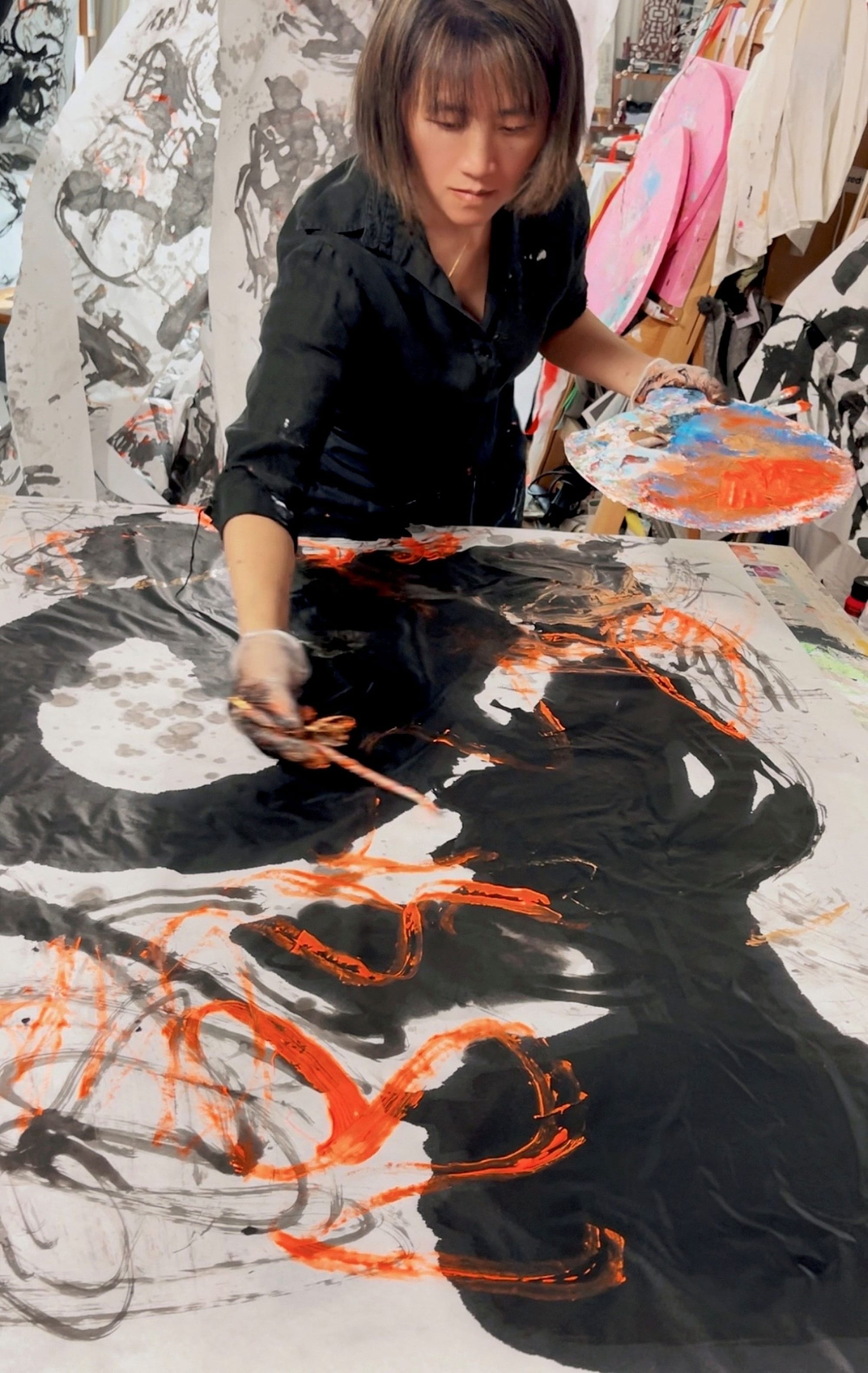
Jagerroos’s process begins with discipline. Rice paper, or Xuan paper, has been present since childhood and remains one of the main elements of her work. She layers rice-paper paintings with acrylic, oil and mixed media to create depth. She has also continued to develop what she calls the “explosive free calligraphy stroke,” a trained technique that depends on brush control, balance and the charged relation between image and empty space.
The phrase contains its own tension.
Explosive, but trained.
Free, but controlled.
Calligraphic, but no longer only writing.
That tension moves through the paintings at Meilahti. The marks seem to remember a discipline they no longer fully submit to. Empty space is not emptiness. It behaves like pressure. Colour does not simply fill the surface; it carries interruption, return, residue.
The works often begin before the final canvas exists. Large rice-paper paintings are made, then torn apart and reconstructed with acrylic, oil and mixed media. The violence of that process can be easy to miss because the completed surfaces often look luminous. But the luminosity is not untouched.
It arrives after rupture.
A mark has been released from one condition and asked to survive in another. A piece of paper has lost the image it first belonged to. A sign may still carry cultural memory, but it has been loosened from a single reading. The work does not abandon tradition. It makes tradition unstable enough to continue.
At Meilahti Art Hall, that process has a quieter scale than Floating Island, but the pressure remains.
Floating Island made Jagerroos’s method spatial. Works from across her decades-long career were gathered into adaptive immersive environments, where paintings, fabric, lights and mirrors turned artistic history into a condition one could enter. Earlier works were not sealed as past achievements. They returned as material. They mingled, shifted, reflected and reappeared.
The project began from a studio that would not stay still.
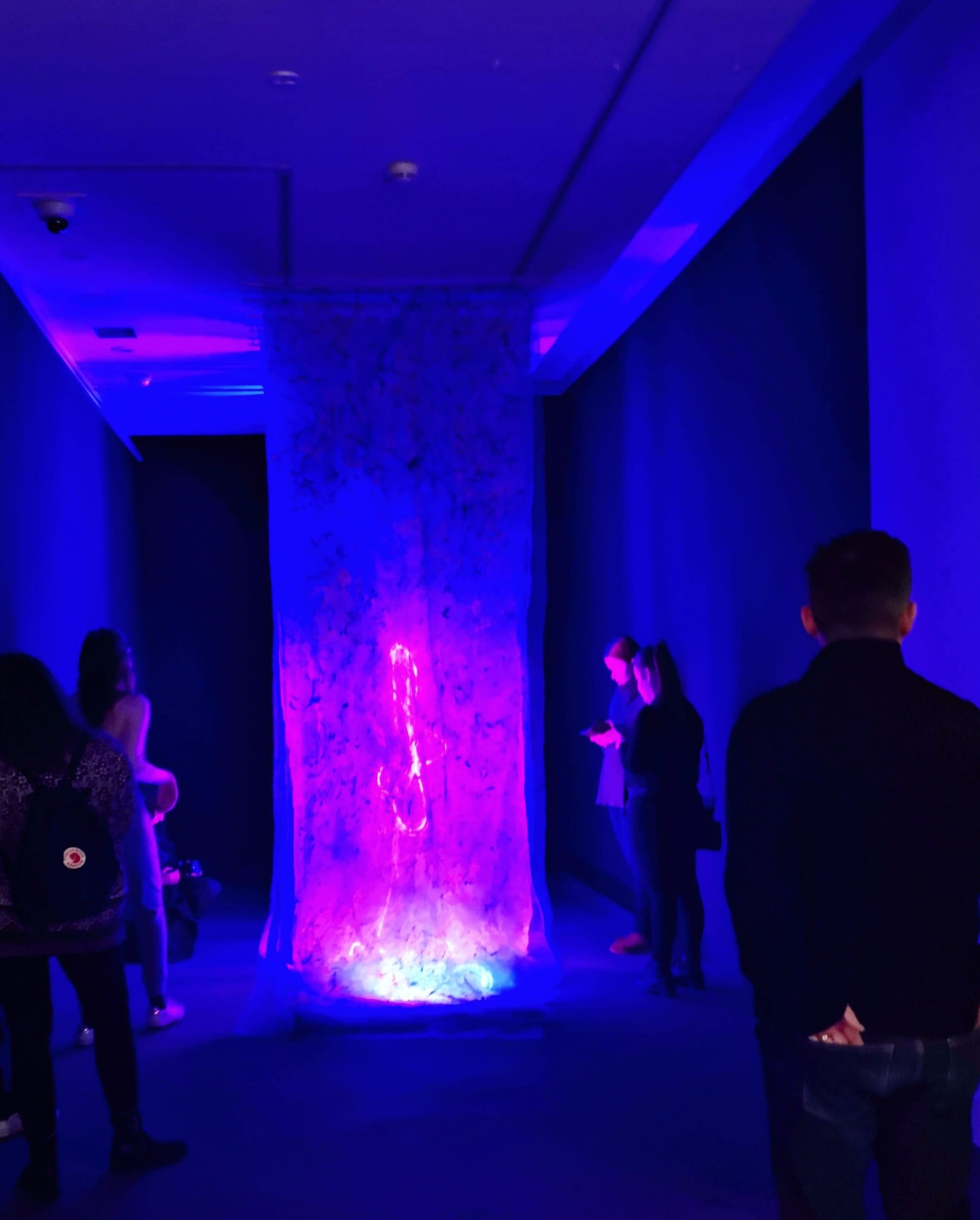
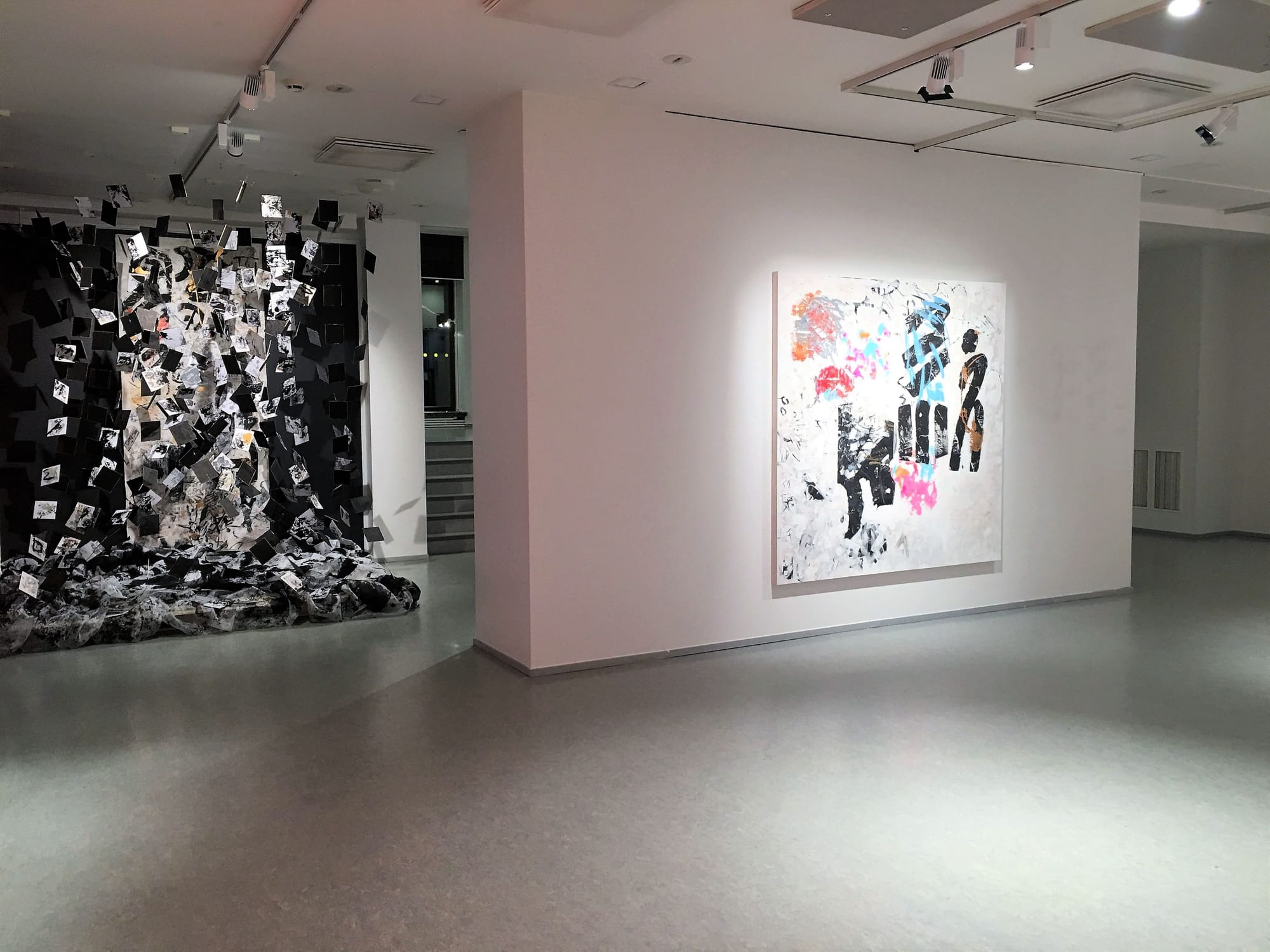
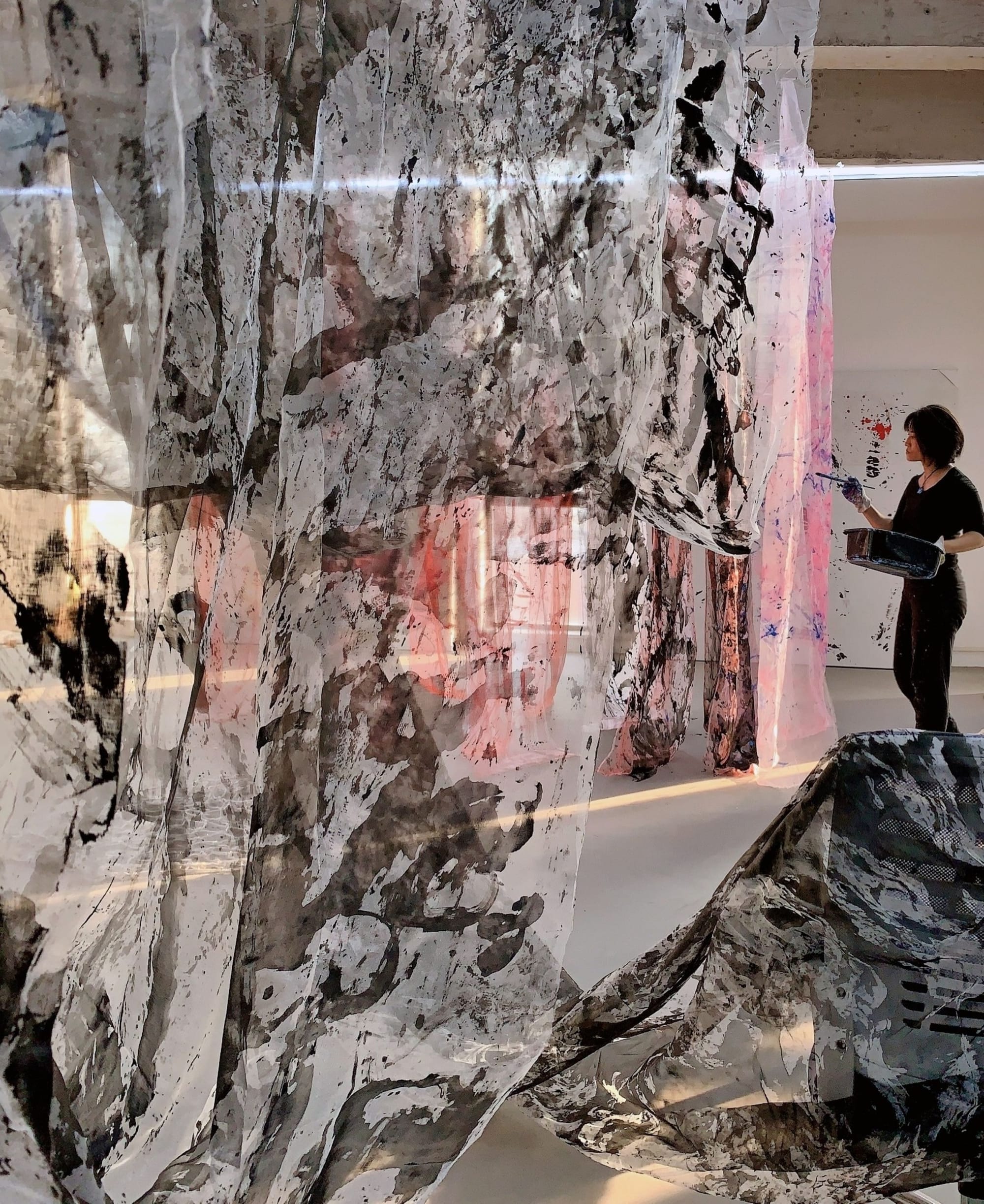
Canal Cheong Jagerroos’s Floating Island moves between museum installation and studio process. Views from Jyväskylä Art Museum and Korundi, Rovaniemi Art Museum, together with work-in-progress material from the artist’s Shanghai studio, show the project as a travelling condition rather than a fixed archive. Photo courtesy of the artist.
Invited in 2017 to make an installation after a lifetime of painting, Jagerroos moved the contents of her studio — tools, materials, pieces of rice-paper paintings, carried fragments — into an exhibition space. Looking at the things that had travelled with her from place to place, she saw not an archive in storage, but a floating entity.
The studio became visible as movement.
Later versions of Floating Island changed according to site. In an underground cave space at Saimaa Art Centre, running water, music and fog entered the work in response to the location. The island did not become a fixed format. It kept adapting, moving toward forests, beaches, train stations, streets, and other conditions where installation might continue without a final border.
In Meilahti, the island is not built as an environment. It seems compressed back into painting.
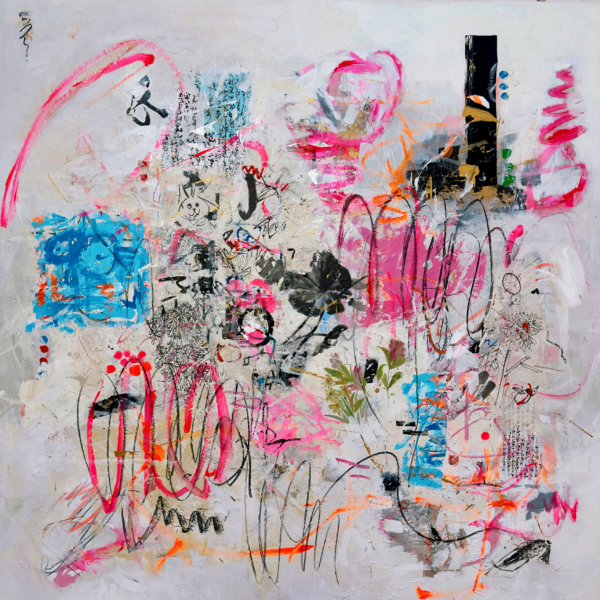
The viewer does not walk around the artist’s travelling studio. The surface does the carrying. Marks, fragments, materials and memories appear as if they have passed through more than one room before arriving here. A painting such as Between Now and Now, shown in the exhibition as a mixed-media work from 2026, already carries that temporal instability in its title: not past and future, not departure and arrival, but a repeated present that does not quite settle.
The surface holds for a while what an installation might spread through space.
It does not explain everything it has carried.
Susi’s presence is felt before it is explained.
Joy and Asymmetry gathers six artists: Kari Cavén, Hanna Westerberg, Paavo Halonen, Liivia Sirola, Minja Karoliina Laakso and Canal Cheong Jagerroos. Curated by Nanna Susi, the exhibition speaks of imperfection, human difference, mutual need and art as a shared language. It also marks Susi’s first broadly curated group exhibition, made of six independent artistic positions forming a larger whole in their own verses.
The movement through the rooms does not flatten those positions into one mood. Cavén’s transformed materials open one register of asymmetry. Westerberg’s birds and houses slow the rhythm into a quieter architecture. Halonen’s assemblages shift the exhibition toward object-play and altered function. Sirola and Laakso extend the sequence through image, figure, narration and nocturnal atmosphere.
By the time the visitor reaches Jagerroos, the exhibition has already prepared the eye for unevenness.
It can be too easily named through oppositions: China and Finland, East and West, painting and installation, discipline and freedom, sign and abstraction. But the paintings do not hold those terms as opposites. They leave them overlapping, unfinished, sometimes unresolved inside the same surface.
The connection between Susi and Jagerroos does not begin at Meilahti Art Hall.
In 2015, the two artists launched the Blue and Red Art Project, a Finland–China exchange built through travel, artistic dialogue and direct encounter with one another’s worlds. The project moved through both countries, through museums and journeys, through the accumulation of distance as artistic material. Over five years, the two artists travelled almost 25,000 kilometres through China and Finland, held exhibitions across both countries and filmed a documentary about the journey.
That history sits quietly behind the Meilahti room.
Susi is not only the curator who placed Jagerroos at the end of a group exhibition. She is part of a longer artistic exchange in which travel, colour, difference and friendship became working material. The current room is not a return to Blue and Red, but it is not separate from it either. It feels like a later surface of the same conversation, one in which exchange no longer needs to announce itself as exchange.
It has entered the way the works are held.
Their earlier institutional pairing already made the difference visible: Jagerroos’s reconstruction of signs and materials beside Susi’s language of emotion, colour and entry into the painted space. Susi’s own painting has been framed through emotion not as drama, but as presence and an understanding of what it is to be human. She has also called emotions a form of intelligence.
That phrase should not be passed over too quickly. Emotion as intelligence.
It helps explain something about Susi’s curatorial room at Meilahti without turning the exhibition into biography. The show is not cool in the usual Finnish sense. It does not protect seriousness by stripping away warmth, colour or eccentricity. But it also does not collapse into atmosphere. The rooms are composed through differences of tempo: found material, painted interiority, assemblage, staged image, nocturnal fiction, layered abstraction.
The exhibition does not correct asymmetry. It lets asymmetry remain active.
Jagerroos becomes the place where this is tested most strongly, because her work brings the largest invisible geography into the room. Yet the paintings do not perform that geography as a map. They do not offer Macau here, Finland there, China underneath, Europe on top. The places are not arranged for recognition. They seem already broken down into pressure, tone, gesture, paper, interval.
Here, the Finnish exhibition room begins to matter.
Part of Finnish exhibition culture still trusts restraint as one of the safer signs of seriousness. Coolness can protect a work from sentiment. Spareness can protect it from excess. Distance can protect it from being misread as decorative. But those protections can become limits when a practice arrives through colour, symbolic density, emotional openness or cross-cultural movement.
Jagerroos’s work moves close to that limit.
It can look generous. It can look luminous. It can even look hopeful. In another context, those qualities might be made too easy. Yet the process complicates them. The surface may glow, but the work has passed through tearing. The colour may open outward, but the image has been built through disassembly. The paintings may invite the viewer, but they do not surrender their fragments into one explanation.
The work keeps something back.
“East and West” is not enough, but neither is any single replacement. Origin becoming material opens one path into the surface. Calligraphy becoming gesture opens another. The studio becoming nomadic opens another. Colour carrying the memory of different climates, cities and states of mind opens another. Each path reaches the work only partly.
In Floating Island, Jagerroos allowed parts of her artistic past to return as an environment.
At Meilahti Art Hall, those returns are less theatrical. They arrive as density. The painting is not a window into the artist’s life, but neither is it detached from it. It is closer to a place where carried things lose their first names.
A line may have begun as writing.
A fragment may have belonged to another image.
A colour may remember another climate.
A surface may hold a journey without becoming evidence of it.
This is why Beneath the Surface is a precise title. It does not ask the viewer to dig for one hidden meaning. It suggests that the visible surface is already layered with what cannot fully rise into view. The work is not concealing a simple truth underneath. It is built from conditions that remain partly submerged: discipline, rupture, travel, memory, collaboration, recovery.
Nanna Susi’s Joy and Asymmetry gives those conditions a particular room.
Not a museum survey.
Not a fair booth.
Not an immersive installation.
Not a national exchange project.
A local Helsinki art hall, where the scale is smaller and the histories do not announce themselves immediately.
That smaller scale changes the encounter. It does not reduce the work, but it removes some of the machinery around it. The viewer meets the paintings without the full architecture of Floating Island, without the official scale of Korundi, without the programmatic framing of Blue and Red. What remains is surface, room, and the unsettled question of how much a painting can carry before it becomes too readable.
The answer does not fully arrive. At Meilahti Art Hall, the surface does not resolve those movements. It holds them for a while.
A mark may still be a remnant of writing. A colour may still carry a place without naming it. A torn fragment may still remember the image it once belonged to. The painting does not gather these things into a single origin, nor does it release them fully from it.
It leaves them moving.
Beneath the surface, that may be the more difficult form of belonging: not arrival, not translation, but the refusal to become still.
© ART Walkway. All Rights Reserved.
Image credits: Images courtesy of Canal Cheong Jagerroos. Photography credits include Canal Cheong Jagerroos, Jussi Tiainen, Sari Tenni, and Rovaniemi Art Museum / Arto Litti.