Busan Biennale 2026: The Politics of the Interval
Across three sites, Dissident Chorus tests whether sound can hold political difference without turning it into harmony, as protest memory, public assembly and international circulation meet unequal conditions of access.
In Dissident Chorus, sound does not gather Busan into a single voice. It moves through the intervals between protest and repetition, body and archive, museum and port, opacity and public address—testing whether a biennale can hold voices together without turning difference into harmony.
By the end of its opening weekend, Busan Biennale 2026 had not released itself as one exhibition.
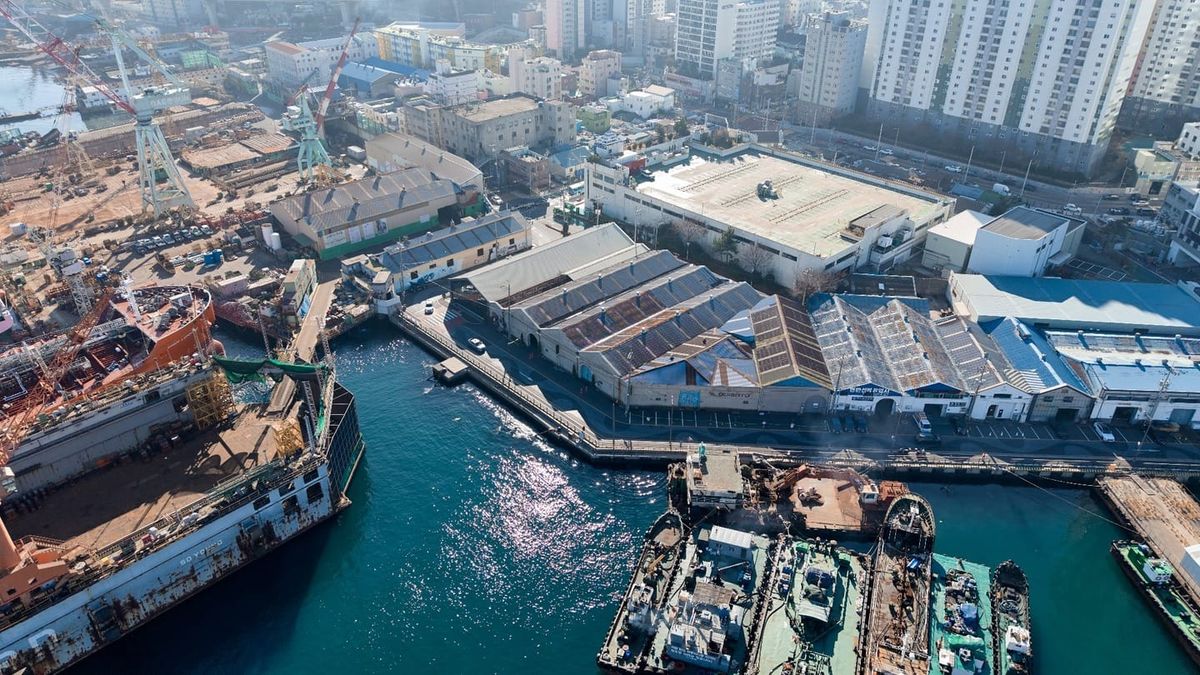
Forty-six artists and collectives are distributed across three sites on Eulsukdo and Yeongdo. Twenty-eight are concentrated at the Busan Museum of Contemporary Art. Others occupy Space OneZ, a century-old marine-supplies warehouse, and the former Busan Nam High School, vacated only months before the opening. A shuttle connects the route. The museum is ticketed; the two Yeongdo venues are free. Performances, radio broadcasts, workshops, talks, a cruise journey, and a party occupy times that do not coincide with continuous exhibition hours.
The edition is encountered in parts.
This condition is more than logistical. Dissident Chorus, led by co-artistic directors Evelyn Simons and Amal Khalaf, proposes sound as a way of being together without requiring agreement. Work songs, protest songs, ritual rhythms, club frequencies, breath, gesture, and bodies gathered in proximity form a chorus that the curators describe as conductorless and unruly.
But a chorus is never made from voices alone. It depends on intervals: differences of pitch, timing, position, memory, and force. Remove the interval and polyphony collapses into unison. Widen it too far and voices cease to register as belonging to the same composition.
Busan Biennale begins inside that tension.
Its political question is not simply who speaks. It is what must remain between voices for their difference to be heard at all.
Before Sound
Before visitors moved between the three venues, the edition’s language had already travelled.
“Sound, like water, resists containment.” “The body as archive.” “Assembly as political form.” “A chorus without conductor.” “A rehearsal for other ways of being together.” The phrases passed through announcements, program descriptions, and public introductions with little change in frequency.
That circulation did not merely describe the exhibition. It prepared its audibility.
Sound arrived already distinguished from music and already charged as political. Listening was positioned against algorithmic oversaturation and extractive images. Opacity was positioned against surveillance and compulsory revelation. Gathering was positioned against the exhaustion of sanctioned speech.
By opening day, the sonic had acquired an ethical assignment. It was expected to slow the visitor, carry memory, register nonhuman life, restore bodily relation, and create solidarity where ordinary language had failed.
This assignment gives the exhibition coherence. An archival recording enters as more than document. A club reference enters as temporary social form. Breath and gesture enter as political registers. Rhythm becomes a method of organizing bodies rather than an accompaniment to their gathering.
The risk is that sound becomes politically certified before it is heard.
If every vibration is approached as resistance, listening loses its capacity to discover conflict, refusal, pleasure, boredom, exclusion, or indifference on less prepared terms. The curatorial language opens the ear while telling it what political sound should become.
The first interval therefore appears between sound and its announced meaning.
The exhibition begins there, whether it intends to or not.
Noise
For Jacques Rancière, politics turns on a division between those recognized as speaking and those heard only as producing noise. Political appearance occurs when people denied a place in the common world demonstrate that what was dismissed as sound already contained thought, grievance, and a claim to equality.
Dissident Chorus enters this division directly.
Busan supplies a dense history of voices whose political force did not begin with institutional recognition. The Bu-Ma Democratic Uprising, labour struggles around the port, candlelight rallies, and the anti-martial-law protests of 2024 form part of the exhibition’s historical pressure. Work songs, banned songs, chants, and popular music have organized bodies before those bodies entered museums as political subjects.
That inheritance is not shared evenly across generations. Kim Jin-suk’s nearly yearlong occupation of a Hanjin crane in 2011 and the fiftieth anniversary of a ban on protest songs place political memory inside bodies formed at different distances from those events. Some younger practices resist treating han—repressed grief claimed as culturally continuous—as an inherited obligation. Political organization can begin through viral expression before returning to the street. What appears as amnesia from one position may be a change in political medium from another.
The distinction between voice and noise is unstable here. A protest song may be prohibited as dangerous speech, retained as private memory, then return through popular culture after its original conditions have receded. Club sound can be dismissed as entertainment while producing forms of bodily collectivity that political language cannot. Port noise can signify industry, extraction, livelihood, or ecological harm depending on who is listening and from where.
The biennale attempts to move these sounds across the threshold of recognition. It gives them archives, commissions, sites, captions, performances, and an international audience.
Yet recognition changes the sound it receives.
Once protest enters the exhibition as cultural memory, it becomes available to forms of attention different from the urgency that produced it. Once club culture enters a curatorial framework, temporary community acquires institutional duration. Once labour is heard through the warehouse, the building’s history begins to perform alongside the work.
This is not simply neutralization. Museums can preserve voices that power would prefer to dissipate. They can also reorganize those voices into a field where dissent is encountered as significance rather than interruption.
The political threshold does not disappear when noise becomes audible.
It moves inside the act of listening.
Interval
The exhibition calls its three venues movements in a polyphonic score. Each is assigned a different register.
At the Busan Museum of Contemporary Art, where river and sea meet near wetlands and bird-migration routes, the first movement gathers ecology, care, regeneration, and world-building. Space OneZ lowers the register toward port histories, dock labour, maritime movement, underwater imagination, protest, and the residue of clandestine club nights. The former Busan Nam High School becomes a rehearsal space for oral knowledge, censored materials, alternative pedagogy, and futures still being formed.
The sequence is clear:
ecology, labour, pedagogy.
But the biennale is not heard as a seamless passage between them. The sites are separated by water, roads, travel time, admission conditions, and unequal institutional weight. The museum remains the main stage and holds most of the participants. The Yeongdo venues are free to enter but smaller in concentration. A shuttle produces continuity between locations that the visitor cannot experience simultaneously.
The interval is therefore both compositional and material.
It gives each site room to establish a frequency without becoming an exhibition department. It also determines who can construct the relation among them. A visitor with a full day, working transport, program information, and the ability to return for live events encounters one biennale. A visitor arriving once encounters another: partial, spatially weighted, and governed by what is available at that hour.
Minouk Lim’s forthcoming S.O.S–Fire Butterfly makes this distribution literal. On the biennale’s final day, audiences will board the Jagalchi Cruise for a single journey along Busan’s coastline, approaching histories of democratization, labour, migration, and redevelopment from a moving vessel. The work does not abolish the distance between spectator and city; it organizes that distance. Political memory becomes visible through the apparatus of a cruise while the shore continually recedes from those looking toward it. Advance reservation and a single departure gather one public by excluding everyone arriving at another hour. Here, the interval is not a metaphor applied to the work. It is the position from which the work can be seen.
The curatorial score asks movement to complete what no venue contains.
This keeps the exhibition from becoming one total image of Busan. It also risks making the visitor responsible for producing unity from an arrangement the institution has already named as a whole.
The interval does not merely separate the works.
It distributes the labour of relation.
Echo
An echo is not an original voice preserved intact. It is a return altered by distance, surface, and delay.
The House of Korean Protest Songs gives this temporal structure a local body. Its archive holds political music through domestic collection and repeated use rather than through the authority of a state repository. “Morning Dew,” banned decades ago for its association with pro-democracy struggle, was later sung by younger generations in changed popular contexts. What returns is not full historical consciousness. A melody survives where origin may only partially follow.
That gap is often described as amnesia. The exhibition allows another reading. Political transmission may depend on incomplete knowledge. A song can carry affective and bodily memory without delivering a complete lesson about itself. Its recurrence is neither pure continuity nor appropriation alone. It is an unstable inheritance.
This is where the biennale’s interest in scores becomes more than an organizational metaphor.
Suki Seokyeong Kang’s thinking about notation places the score between instruction and action. Drawings and maps by Ursula K. Le Guin extend the question beyond sound: a score and a map both organize possible movement without determining every act that will occur. Their lines become conditions for actions they cannot fully control.
The same is true of historical sound. An archive can preserve a route of return, but it cannot guarantee what the returning voice will mean.
Echo complicates the biennale’s allocation of audibility. Once a score enters other bodies, it begins to exceed the context that certified it. It can be forgotten, misheard, commercialized, revived, or made newly dangerous.
The official fifteen-colour Dissident Chorus light stick condenses that unstable return into an object. Developed through fandom, redirected through political demonstrations, and incorporated into the biennale’s identity and retail program, it crosses entertainment, protest, institution, and commodity. Its passage is not adequately described as resistance becoming merchandise. Each use alters the object without completely erasing the others.
The institution can amplify the return.
It cannot own the distance through which the echo travelled.
Opacity
The edition repeatedly turns toward opacity: what resists revelation, holds secrets, or cannot be exhausted by sanctioned speech.
Édouard Glissant’s right to opacity offers a demanding way to read this claim. Opacity is not obscurity for its own sake. It is the possibility of relation without requiring another person, culture, or history to become transparent—and therefore administratively knowable—before relation can begin.
For a biennale, that right is difficult to hold.
Jota Mombaça’s newly commissioned drowning is not a poem, but it's not not a poem either, developed with Anti Ribeiro, brings underwater acoustics into collective vocalization. Hydrophone recordings made off the Busan coast moved into work with the Yeongdo-gu Women’s Choir and Poema Artcenter; seawater-dyed textiles carry the encounter into Space OneZ. Sea, technology, local bodies, and material surface remain distinct even as the installation draws them together. Its anti-colonial imagination does not require the nonhuman world to become a metaphorical extension of human politics. Nkisi turns phonographic archives into a colonial problem: what was captured, classified, removed from its conditions, and made repeatable for another listener. Natasha Tontey’s movement among Minahasan mythology, ancestral ritual, Cold War violence, and patriarchal control unsettles the authority of official history to determine what counts as evidence.
These practices do not simply add marginalized content to an existing public field. They question the demand that entry into that field requires complete translation.
Yet opacity enters Dissident Chorus through selection, commissioning, description, and publicity. The institution must explain why the unexplained matters. Secrecy becomes an announced value. Resistance to revelation becomes a legible curatorial position.
This does not expose opacity as false. It reveals its institutional paradox.
A biennale may protect what cannot be fully translated, but it must still provide enough framing for that resistance to be recognized rather than neglected. Too much explanation converts opacity into theme. Too little risks reproducing the silence the exhibition wants to oppose.
Opacity survives in the interval between those failures.
Rehearsal
The former Busan Nam High School carries the edition’s political grammar most directly.
Vacated earlier in 2026, the school retains routines without continuing their former use. Classrooms, corridors, and the playground hold traces of instruction, discipline, peer relation, attendance, boredom, aspiration, and daily return. The biennale enters before these traces have settled into heritage.
Calling the site a rehearsal space shifts education away from curriculum and toward unfinished practice. Oral transmission, embodied knowledge, censored material, and bottom-up archives appear as ways of learning that official systems fail to hold.
Rehearsal matters because it postpones the demand for a completed political form.
It permits repetition, adjustment, failure, and return. It imagines gathering not as proof that a community already exists, but as practice for relations that remain uncertain.
Judith Butler’s “bodies in alliance,” explicitly present in the biennale’s curatorial framework, gives bodily assembly political force through the act of appearing together. But the school site adds pressure to that account. Bodies do not gather in an abstract public sphere. Someone opens the building, sets the hours, selects the participants, provides technical support, and determines when rehearsal becomes public program.
With much of the exhibition newly commissioned, this infrastructure entered the works before opening. Participants helped Aliaskar Abarkas produce Spell through a multiday workshop before its activation with daegeum player Hyelim Kim. Moe Satt developed Body, Face and Fingers with dancers in Busan for a performance on the biennale’s final day. Local bodies enter production under different degrees of authorship, while the artist and institution retain control over what becomes the work.
This is especially visible in a biennale organized around live work. A performance can create attention and risk that continuous display cannot. It can also be missed. A cruise requires boarding and duration. A radio broadcast occupies a time even when it exceeds a venue. A party produces social permeability for some bodies and another threshold for others.
Generosity and demand remain close together.
The exhibition’s opening does not release the whole work. Parts of its meaning remain stored in future gatherings and in the people able to reach them. Rehearsal keeps the edition alive across its duration, but it also makes access dependent on schedule, information, mobility, and return.
The political value of assembly cannot be separated from the infrastructure that permits some bodies to appear together.
Leakage
If allocation describes how the biennale positions voices, leakage describes where that positioning begins to fail.
Sound passes through walls. Radio detaches a voice from the room that produced it. A protest song enters a body too young to remember its prohibition. Club rhythms organize temporary communities outside museum etiquette. Underwater acoustics move through a medium indifferent to national borders and human ownership. A cruise carries an audience along routes that cannot be reduced to a gallery plan.
The curators’ decision to hold a party outside the museum is minor in scale but revealing in structure. It acknowledges that some forms of gathering weaken when institutionalized too completely. The museum can support the event while conceding that it may not be the right acoustic or social container for it.
The biennale’s work with Output Busan and Radio Revolution moves artists into club and community-radio infrastructures beyond the museum. These spaces protect another social threshold while exposing a harder asymmetry. A biennale can enter and amplify local cultural infrastructure, but it cannot replace the urban conditions that sustain it. What leaks beyond the museum may be freer in form and more vulnerable in duration.
Leakage, however, is not freedom by another name.
Ports are built around controlled passage. Water carries, but borders, logistics, capital, and surveillance determine what is permitted to move. Radio extends access while producing different exclusions. Popular circulation can keep a political song alive while stripping away the conflict that once made it urgent.
What escapes one frame may enter another.
This prevents Dissident Chorus from settling into a simple opposition between unruly sound and institutional containment. The biennale is itself part of the leakage system. It gives archives new listeners, allows performances to leave conventional venues, and connects local sound histories to international practices. At the same time, it selects which leakages become program, which returns become heritage, and which forms of opacity receive protection.
The score does not disappear.
It becomes porous enough for some sounds to alter it.
Feedback
The Busan Biennale x Frieze Film Seoul program adds another circuit. Moving-image works by participating artists screen free at SongEun during Frieze and Kiaf, when the Korean art calendar encourages movement among Seoul, Busan, and Gwangju. In Busan, the exhibition is distributed through port time, ecological thresholds, local protest histories, and travel between dispersed venues. In Gangnam, selected works enter compressed itineraries, professional circulation, fair adjacency, and an audience already moving among commercial and institutional platforms.
This is not simple transmission from a local source to a global receiver. In an acoustic system, feedback occurs when output returns as input and changes the signal. Works produced through Busan’s maritime, political, and social conditions can reach an art-week audience without that audience encountering the sites and relations from which the wider exhibition derives its specificity. The works do not become less political when they travel, but the conditions under which their politics are heard change.
Port memory becomes portable. Dissidence becomes program adjacency. A local history of gathering enters a calendar governed by another kind of congregation.
Feedback can enrich a signal or overwhelm it.
Coproduction offers another route beyond publicity by extending the life of newly commissioned works. Yet wider international circulation does not necessarily strengthen the local spaces through which their politics become audible. An artwork can acquire a longer institutional life without producing a more durable cultural infrastructure around it.
The question is not whether the collaboration contaminates the biennale. Purity would be the wrong measure for an exhibition built around circulation, echo, and relation. The sharper question is what returns to Busan after the international art week has amplified the parts of its chorus most able to travel.
What Remains Between Voices
Dissident Chorus does not ask its participants to agree. Its ambition is harder: to hold differences in proximity without forcing them into harmony.
The interval allows a protest song to return without pretending the present is identical to the struggle that produced it. It permits human and nonhuman sound to meet without resolving into one language, and three sites to belong to one exhibition without becoming one room.
It also carries the edition’s inequalities. Not everyone can travel the complete route or return for a work available at one hour. Not every political history becomes equally audible through the chosen frequencies of port, protest, ecology, migration, club culture, and pedagogy. Some antagonisms do not want to resonate. Some refusals do not become richer through gathering. Some silences cease to be dissident once the institution identifies them as such.
If the exhibition made every voice immediately intelligible, it would betray its commitment to opacity. If it made every difference resonate, it would turn dissensus into atmosphere. If it treated every sound as resistance, it would lose the political distinction between being heard and merely being present in the acoustic field.
The strength of Dissident Chorus may therefore lie less in the unity of its score than in the moments when the score cannot secure what follows from it.
The biennale gives these movements institutional support without resolving their contradictions. That is more than a failure of control. It is the condition under which the exhibition can remain politically alive.
A dissident chorus needs form, or its voices never become audible together.
It also needs something that form cannot hold: an interval in which a voice may return as an echo, withdraw into opacity, break into noise, or refuse the harmony prepared for it.
© ART Walkway. All Rights Reserved.