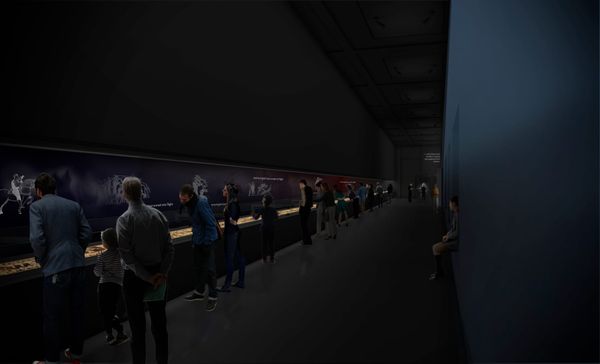
Basquiat After the Head
Between Louisiana and Miami, Jean-Michel Basquiat is not moving from purity to spectacle. He is moving through the full structure of his afterlife: private study, public masterpiece, market object, civic event — and still, if the viewer stays long enough, a difficult work of art.


Jean-Michel Basquiat is present before the visitor begins looking.
The crown arrives first. Then the prices, the photographs, the downtown mythology, the auction records, the celebrity collectors, the familiar story of speed and collapse. Brooklyn. SAMO. Warhol. Fame. Twenty-seven. Few artists of the late twentieth century have been made to circulate so widely, and fewer have had recognition arrive so quickly ahead of encounter.
Basquiat is no longer difficult to identify. That is part of the difficulty.
An artist can become so legible as a sign that looking begins too late. The name performs some of the encounter in advance. The viewer enters already aware that the work matters, already aware that the market has confirmed it, already aware that Basquiat belongs to a small group of artists whose images now operate beyond the museum: in fashion, music, advertising, auction rooms, private collections and public memory.
This is not a failure of the work. It is one of the conditions around it.
In 2026, that condition became unusually visible through two exhibitions. Basquiat – Headstrong closed at the Louisiana Museum of Modern Art in Denmark on 17 May after focusing on works on paper and the recurring motif of the human head. Five weeks later, on 25 June, Pérez Art Museum Miami opened Basquiat: Figures, Signs, Symbols, built around ten works from the Kenneth C. Griffin Collection.
The two exhibitions are not formally paired. They do not make the same claim, nor do they operate at the same scale. But they belong to the same cultural sequence. Griffin’s support helped make the Louisiana exhibition possible; his collection now forms the basis of the Miami show. Through that passage, Basquiat moves from one form of visibility to another: from works he kept close to works now made public through major private ownership.
Louisiana asked what could still be seen if the mythology were quieted.
Miami asks whether close looking can survive when the mythology, the market, the city and the institution all enter the room with the work.
Before the Crown
At Louisiana, the exhibition began by narrowing the field.
Headstrong focused on Basquiat’s works on paper, especially drawings from the early 1980s in which the human head appears again and again: skull-like, mask-like, anatomical, comic, wounded, alert. These were not the crowded, text-driven canvases through which Basquiat is often introduced. They were more concentrated and less explanatory. They did not offer the viewer the usual route through language, citation or cultural inventory.
The absence was part of their force.
Without the familiar density of names, symbols and fragments, the head became less a motif than a site. It held pressure. It absorbed looking. It appeared as a threshold between surface and interior, flesh and thought, exposure and withdrawal.
Many of the heads seem suspended rather than placed. The white of the paper does not calm them; it isolates them. A face may hover in the center of the sheet as if the space around it has been cleared by force. Mouths and eyes become openings where the drawing turns inward. Teeth lock into grids. Lines gather around cheekbones, skulls, brows and jaws without settling into anatomy. The image remains a face, but only barely. It is also a diagram of strain.
The works did not behave like portraits. They did not settle into identity. A mouth opened without speech. Eyes stared, emptied out, bulged, receded. Lines moved quickly but did not feel careless. The heads seemed to register states rather than people: agitation, alertness, interior noise, self-recognition under pressure.
This was the strength of Anders Kold’s curatorial approach. Louisiana did not try to rescue Basquiat from his fame by denying it. It simply refused to begin there. The exhibition allowed the works to sit before the story arrived.
That sounds simple. It is not.
For an artist as mythologized as Basquiat, subtraction becomes a form of care. To remove Warhol, Madonna, the club world, the auction record and the shorthand of genius is not to erase context. It is to delay the reflex by which context replaces looking.
What remained at Louisiana was the head before the crown fully reassembled around it.
What the Drawings Withheld
The drawings in Headstrong were not preparatory in any easy sense. They did not feel like fragments awaiting completion elsewhere. Their scale, density and force made them complete objects, even when they seemed to be testing the limits of completion itself.
They also carried a different kind of intimacy.
Some had been kept from public view during Basquiat’s lifetime. That fact can be over-romanticized, but it matters. These were not works immediately shaped by public reception. They belonged closer to the studio, to repetition, to a process the artist returned to without needing to explain it. They were not hidden confessions, but neither were they simply market-facing images.
Their privacy was formal as much as biographical.
They withheld text. They withheld easy symbolism. They withheld the larger compositional drama associated with Basquiat’s paintings. In doing so, they concentrated attention on the line itself: how it entered the paper, how it thickened, broke, turned jagged or fluid, how it could describe anatomy and undo it at the same time.
Basquiat’s speed is often treated as temperament. At Louisiana, it appeared more like method.
The drawings looked fast because they had to be fast, but not because they were uncontrolled. They held the tension between urgency and decision. A line could seem improvised while arriving exactly where it needed to be. A face could appear at the edge of disintegration without becoming loose. The paper could carry pressure without giving way.
This is where the exhibition quietly corrected one of the more persistent myths around Basquiat: that spontaneity was the opposite of discipline.
Here, spontaneity looked like discipline under force.
The Head as Pressure System
The head was never neutral for Basquiat.
It could be skull, mask, vessel, wound, diagram, joke, warning. It could hold the history of looking and the violence of being looked at. It could suggest the body as something read by others before it is understood from within.
That pressure cannot be separated from Basquiat’s position as a young Black artist moving through an art world that was ready to consume his difference before it knew how to fully recognize his intelligence. Visibility was not simply arrival. It was scrutiny, projection, extraction and demand.
The heads in Headstrong did not announce this through slogans. They did something more difficult. They made visibility feel physical.
Eyes and mouths became openings, but not invitations. Skulls appeared without offering stable allegory. Faces hovered between exposure and refusal. The drawings seemed to ask how identity is held inside a body when the world insists on turning that body into an image.
This is why Louisiana’s quietness mattered. It did not soften Basquiat. It made the violence of looking easier to sense.
The exhibition did not need to argue that the head was political. It allowed the viewer to feel that the head had always been where politics entered the body.
Miami’s Different Claim
PAMM’s Basquiat: Figures, Signs, Symbols begins from another premise.
It does not isolate the head. It opens the field back out: figures, language, symbols, painting, sculpture, cultural code. Included among the works are the 1982 skull painting Untitled, Pez Dispenser from 1984, and In Italian from 1983 — objects that carry very different forms of Basquiat’s intelligence. One confronts the viewer with the skull as image, emblem and wound. One turns a consumer object into something playful and strange. One operates as portrait, study, linguistic puzzle and historical compression.
These works do not ask to be quiet.
In Pez Dispenser, the dinosaur is at once childish and heraldic, a toy-like creature made strange by the crown that converts play into rank. The image can look almost cheerful at a distance, but its comedy is unstable. A consumer object becomes animal, emblem, joke and warning. The crown does not simply decorate the figure. It changes the terms under which the figure can be read.
In Untitled, the skull does not sit quietly as a symbol of death. It vibrates between head, mask and exposed nervous system. The face seems both constructed and flayed, animated by color and fracture. It is not a memento mori in the classical sense. It does not ask the viewer to contemplate mortality from a safe distance. It pushes the viewer toward the exposed structure of looking itself.
In Italian moves differently again. Dense with figure, script and anatomical reference, it feels less like a single image than a charged field of historical pressure. Renaissance study, bodily diagram, portrait, writing and autobiography collide without resolving into illustration. The work does not quote history from outside. It drags history into the present tense of the surface.
These works belong to Basquiat’s public force: the dense surfaces, the restless writing, the collision of anatomy, art history, commerce, music, race, language and street syntax. If Louisiana showed the head under pressure, PAMM shows the field in which that pressure expands.
The Miami context matters here. Basquiat was born in Brooklyn to a Haitian father and a Puerto Rican mother. His work moved through Black Atlantic, Caribbean, Latin American and New York histories without reducing them to identity markers. Miami, shaped by migration, diaspora, wealth, spectacle and cultural hybridity, is not a neutral backdrop for this exhibition. It is one of the places where Basquiat’s languages can be felt with particular immediacy.
That gives PAMM a claim beyond access.
Under Franklin Sirmans, who has long engaged Basquiat’s work, the exhibition is not simply presenting trophies from a private collection. It is attempting to place major works inside a city where questions of language, migration, race, visibility and exchange are already part of the atmosphere. Miami does not solve the problem of Basquiat’s market afterlife. But it gives that problem a charged civic setting.
The show therefore faces a different task from Louisiana. It cannot strip away the public Basquiat. It has to work through him.
The Crown Returns
Still, the conditions of the Miami exhibition cannot be ignored.
At PAMM, the works are public, but their publicness depends on private ownership. The exhibition is a major institutional event, a statement of access, and a reminder that many of the works through which modern and contemporary art history is encountered now reach the public through collectors, donors and patrons.
This does not make the exhibition cynical. It makes it contemporary.
Museums today rarely stand outside the systems that enable them. They rely on collectors, civic alliances, naming structures, sponsorships, hospitality economies and the promise of attendance. A blockbuster exhibition is never only an exhibition. It is also a way for a museum, a city and a patron to become visible through one another.
Basquiat clarifies this because his work already understood such systems. His paintings were alert to power, money, race, language, ownership, status and display. They did not describe these forces from a distance. They absorbed them into the instability of the surface.
At PAMM, the crown does not only belong to Basquiat’s figures. It also hovers above the conditions under which Basquiat is now shown.
When Ownership Becomes Part of the Room
The difficulty is not that expensive paintings cannot be moving. They can.
Nor is it that private collectors cannot make important works publicly available. They often do, and public institutions depend on that access. The question is not whether ownership invalidates encounter. That would be too blunt, and too easy.
The more difficult question is what ownership does to the room before the viewer begins looking.
A painting with an enormous price attached to it arrives differently. Even when the price is not printed on the wall, it circulates in advance. It shapes anticipation. It creates an atmosphere of importance before the work has had time to earn it again in the viewer’s body. The visitor may look, but the market has already looked first.
This is one of the strange rituals of contemporary art: value is invoked so it can be set aside. The price is not the point, everyone says, but it remains part of the air. The work is described as priceless only after the numbers have done their work.
Basquiat’s paintings are strong enough to survive this. That is not the issue.
The issue is whether the conditions that make them visible also make them harder to encounter without mediation. Fame, price and ownership do not block looking completely. They crowd the threshold. They stand near the entrance to the work and speak before the painting does.
PAMM’s task, then, is not simply to show Basquiat. It is to restore difficulty to works that arrive already certified as important.
The Griffin Bridge
Kenneth Griffin matters here less as a personality than as a structure.
His support helped make Louisiana’s Headstrong possible. His collection now forms the basis of PAMM’s Figures, Signs, Symbols. Through him, Basquiat moves from one mode of publicness to another: from works on paper framed as intimate, focused and resistant to market legibility, to major works presented through the civic authority of a private collection.
That movement is the story.
First, patronage helps reveal a Basquiat who kept certain works close. Then ownership presents a Basquiat whose works have become some of the most visible objects through which cultural value is now organized. The passage is not a contradiction to be solved. It is a condition to be read.
Basquiat’s afterlife now depends, in part, on the systems his work helps us question.
That does not mean the work has been defeated by those systems. It means the work remains active inside them. It continues to ask what power looks like, how signs accumulate authority, how bodies and images are used, how value is produced and who gets to control access.
The paintings at PAMM do not stop being Basquiats because they are Griffin’s. But they are encountered through Griffin’s public act of making them available. The gesture is generous, strategic, civic and self-revealing at once. Contemporary patronage often is.
To pretend otherwise would be naïve.
To reduce the exhibition to that fact would be equally limiting.
Reproduction Is Not Access
There is another difficulty, smaller in appearance but central to the problem.
Basquiat is one of the most reproduced artists in the world, and yet authorized images of his work are not simple to obtain. For publishers, critics and smaller art platforms, images are rarely neutral illustrations. They are rights, permissions, fees, estates, agencies, lenders and institutional policies. A Basquiat image may circulate endlessly as style, symbol or commodity, while the specific artwork remains tightly controlled as a licensed object.
That tension sharpens the point.
The work is everywhere as a sign, but not everywhere as an experience. It can appear on clothing, screens, advertisements, auction previews and cultural memory, while serious editorial reproduction remains difficult and expensive. The viewer may feel surrounded by Basquiat and still lack access to the conditions that make looking precise: scale, surface, installation, proximity, permission.
This is not merely an administrative issue. It belongs to the afterlife of the work.
To write about Basquiat without easy images is to encounter the same system from another side. Description has to do more work. The prose must carry the object back into visibility without pretending to replace it. It has to acknowledge that reproduction can extend access, but also flatten it; that licensing can protect an artist’s estate, but also reinforce scarcity; that an image can be culturally ubiquitous and materially inaccessible at the same time.
This is why the room still matters.
Against the flood of recognizable Basquiat signs, the actual works remain stubbornly specific: paper under oil stick, paint over canvas, marks that change at close range, surfaces that refuse the speed of circulation. Reproduction can announce them. It cannot fully deliver them.
Fame Is Not Presence. Ownership Is Not Encounter.
There is a difference between availability and presence.
Availability means the work can be seen. Presence means it can still act on the viewer before being converted into a sign of something else.
Basquiat’s problem today is not invisibility. It is over-recognition. His images circulate so widely that they can begin to function before they are looked at. The crown signals Basquiat. The skull signals value. The name signals importance. The market signals certainty. Each recognition makes the next one easier.
But the paintings themselves resist ease.
Their surfaces do not behave like icons. They are restless, contradictory, abrupt. They contain jokes that are not simply funny, violence that is not simply expressive, language that does not clarify, figures that refuse stable identity. They move too quickly for summary and too unevenly for branding. Even when reproduced endlessly, they retain a kind of internal disorder that asks for proximity.
This is why the movement from Louisiana to Miami matters. Louisiana protected the conditions of proximity by narrowing the field. Miami must create proximity inside spectacle.
One exhibition slowed Basquiat down by stripping away noise.
The other must slow the viewer down despite the noise.
Not Purity, But Pressure
It would be too easy to make Louisiana the pure exhibition and Miami the compromised one.
That is not what the sequence shows.
Louisiana had its own structures of patronage, private loans and institutional framing. PAMM has its own genuine curatorial stakes, especially in a city where Basquiat’s diasporic languages do not feel distant. Both exhibitions depend on systems of access. Both ask museums to mediate between private holdings and public looking. Both show that Basquiat’s work now reaches viewers through conditions that are never neutral.
The difference lies in emphasis.
Louisiana made pressure intimate. Miami makes pressure public.
Louisiana asked how the head could hold interior life under scrutiny. Miami asks how paintings already surrounded by fame, money and civic expectation can still be encountered as works rather than confirmations of value.
Neither question cancels the other. Together, they make the problem clearer.
After the Head
The head and the crown are not opposites.
Basquiat needed both. The head held pressure, thought, injury, perception, selfhood. The crown named power, aspiration, irony, inheritance, victory and burden. One turned inward. The other faced the world. Both were unstable.
Between Louisiana and Miami, those forms return as exhibition conditions. The head becomes the private chamber of the work: what it contains before it is explained. The crown becomes the public structure around the work: the fame, value, ownership and institutional authority through which it is now encountered.
The danger is not that one cancels the other. The danger is that the crown speaks too quickly.
Louisiana’s Headstrong showed what could happen when the visitor was asked to remain with Basquiat before the story hardened around him. PAMM’s Figures, Signs, Symbols opens inside the full force of that story. It has the harder task, because the work arrives already surrounded by importance.
But Basquiat’s art has always known how to work under pressure.
That may be why it continues to matter inside conditions that might otherwise overwhelm it. The paintings do not offer purity. They do not ask to be rescued from money, fame or power as though those forces were external to them. They make those forces visible, unstable and difficult to possess completely.
The question now is not whether Basquiat can survive the market, the museum, the collector, the license or the brand. He already has, though not unchanged.
The question is whether viewers can still stay long enough with the work to notice what survives there.
Not the name.
Not the price.
Not the crown arriving first.
The head still asks what it means to be seen.
The crown answers too quickly.
© ART Walkway. All Rights Reserved.