Art Basel Basel 2026: First Access as Control System
The flagship fair is not simply showing market strength. It is using delayed visibility, historical depth, and physical encounter to make selective confidence legible again.
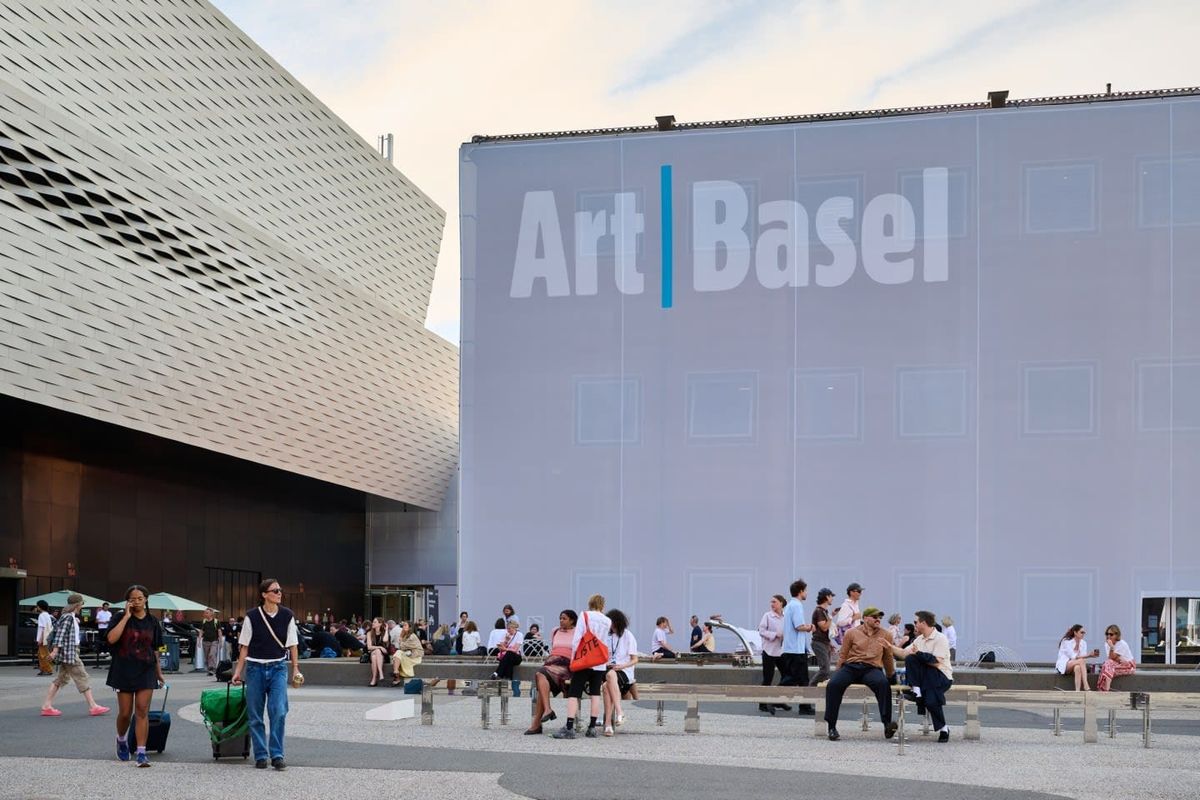
By the time Art Basel opened its 2026 edition in Basel, the question was not whether the fair still mattered. That question belongs to weaker platforms.
Basel begins from incumbency. Its authority is assumed by the galleries that bring major works, by collectors who still treat the week as a necessary test, and by institutions that use the fair as a concentrated field of comparison. The fair does not need to prove importance. It needs to prove that its importance still organizes market time.
That is a different problem.
The market now begins before Basel. Works circulate through PDFs, advisers, online viewing rooms, private previews, back-channel reservations, and off-floor viewing spaces before the doors open. Collectors arrive informed. Galleries arrive partly committed. Visibility has moved upstream. The fair opening, once the threshold where discovery, competition, and decision met in public, risks becoming a confirmation point for choices already formed elsewhere.
Basel 2026 is organized against that erosion.
Its official language is familiar: global reference point, museum-quality depth, connoisseurship, breadth across generations and geographies, public commissions, sectoral strength, and citywide activation. Underneath that language is a more operational claim. Basel is trying to show that the fair moment still governs the market even when the market has already begun.
This is why Basel Exclusive matters, but it is not the whole subject.
First access is the mechanism. The subject is control: control over timing, attention, scarcity, and the conditions under which selective buying can still appear as confidence rather than caution.
Basel’s 2026 edition is not organized around market exuberance. It is organized around the management of confidence after exuberance.
The fair’s confidence is real. But it is confidence produced through filters.
Basel’s strength lies in making control look like confidence. Its proximity value lies in showing where that control has to work hardest.
The Fair After the Market Has Already Begun
The defining condition of Basel 2026 is pre-circulation.
This is not a breakdown of the fair model. It is the result of its professionalization. Serious collectors do not arrive unprepared. Advisers ask for material early. Galleries test appetite before shipping. Institutions begin conversations before the booth is built. Private rooms absorb the most sensitive inventory. The fair still opens, but parts of the market have already moved.
For many galleries, this is practical. For Basel, it is existential.
A flagship fair cannot only host the market after it has been distributed. It must make the market feel gathered. It must make arrival matter not only socially, but structurally. The live encounter must do more than confirm prior interest; it must restore the sense that value becomes visible, comparable, and actionable here.
That is the pressure underneath the 2026 edition.
Basel’s position is not equivalent to Hong Kong’s or Qatar’s. Hong Kong must prove centrality under changed regional and global conditions. Qatar must show how a new fair-city structure can become infrastructure. Basel must defend an older authority against a more subtle form of erosion: the possibility that the market still respects the fair but no longer needs the fair to order its sequence.
That is why the opening matters so much.
Not because everything is first seen there.
Because Basel needs first seeing to become meaningful again.
Basel Exclusive and the Repair of Arrival
Basel Exclusive is the clearest acknowledgement that the fair’s threshold has weakened.
The initiative asks participating galleries to hold back selected works from pre-fair previews, online viewing rooms, PDFs, and advance sales, unveiling them publicly during the VIP opening. On the surface, this restores surprise. Structurally, it restores delay.
Delay has become a market tool.
In a system saturated with early information, the scarce thing is not visibility. It is meaningful timing. Basel Exclusive turns withholding into a positive procedure. The work is protected from premature circulation so that its appearance can produce a shared moment of attention.
That moment is not sentimental. It is hierarchical.
Not everyone sees first. Not everyone can act first. Not everyone can absorb the uncertainty of acting before broader confirmation arrives. First access reactivates an older fair logic: presence as advantage, priority as privilege, timing as market power.
This is why the initiative matters beyond the works selected for it. It names the problem Basel is trying to solve. The fair does not lack objects, galleries, collectors, or institutions. It risks losing command over the moment when those forces converge.
Basel Exclusive attempts to repair that moment.
It also gives galleries permission to resist total pre-circulation. In a market where collectors expect to see everything early, withholding can look risky. Under Basel Exclusive, withholding becomes institutionalized. The fair gives delay a rationale.
That permission is valuable because it restores friction.
A market without friction becomes too efficient for discovery. A fair without discovery becomes too dependent on logistics. Basel is trying to bring friction back without making the market feel slower. It does this by making delay look like quality.
Strong Opening, No Boom Psychology
The first reports from the VIP days point to activity. Major galleries announced strong sales. Hauser & Wirth’s Picasso sale became an immediate proof point. Gagosian placed a de Kooning while its monumental Henry Moore remained as a visible signal of trophy-scale ambition. Thaddaeus Ropac reported sales across Soulages, Frankenthaler, Fontana, and Baselitz. Gray placed Hockney. Zwirner reported broad activity across Josef Albers, Isa Genzken, Victor Man, Lucas Arruda, and others. White Cube moved works by Lynne Drexler and Doris Salcedo. Pace, Almine Rech, Xavier Hufkens, Jessica Silverman, and Perrotin produced the kind of opening-day evidence Basel needs.
The aisles were busy. Works moved. Dealers sounded more confident than they did a year ago.
But the atmosphere does not read as a return to speculative excess. That distinction is essential.
The strength was carried by highly defensible categories: Picasso, de Kooning, Moore, Hockney, Soulages, Frankenthaler, Fontana, Albers, Bourgeois, Genzken, Salcedo, and established living artists with institutional traction. Even where younger or contemporary works sold well, the language surrounding them was not speed but support, placement, and confidence after correction.
This is not the psychology of a boom.
It is the psychology of a market trying to prove that disciplined buying can still produce momentum.
The speculative energy around young artists that defined parts of the early post-pandemic market has cooled. Buyers are more measured. Dealers are more cost-sensitive. Decisions take longer unless the work carries enough authority to make hesitation unnecessary. The market is active, but it is not indiscriminate.
Basel’s task is to make that selectivity read as maturity.
A weaker fair might allow caution to look like softness. Basel recodes it. Slower buying becomes connoisseurship. Reduced speculation becomes discipline. Historical depth becomes protection. Carefully framed new production becomes seriousness. First access becomes urgency without frenzy.
This is the fair’s most important opening operation. It converts a cautious market into a serious one.
Quality as Defensive Infrastructure
Basel’s most repeated word is quality.
It is easy to treat that as brand language. But in 2026, quality has a technical role. It filters risk.
For galleries, quality justifies the cost of participation at a moment when overhead remains high and sales growth is uneven. For collectors, quality provides defensibility: a reason to act in a market where price, resale risk, and advisory scrutiny matter more than they did during the speculative cycle. For institutions, quality allows market encounters to be framed as scholarship, rediscovery, acquisition logic, or long-term cultural responsibility rather than appetite.
Quality is therefore not only what Basel displays. It is how Basel manages uncertainty.
Historical material performs this function most efficiently. Modern and postwar works, rediscovered twentieth-century positions, and major works by established artists create a stabilizing grammar around the fair. They provide provenance, scarcity, scholarship, and museum comparability. They make buying look like judgment.
The 2026 fair leans into this. Feature, Kabinett, and historically dense main-sector booths are not simply curatorial enhancements. They are instruments of confidence management. They allow galleries to present works as arguments rather than inventory. They make seriousness visible before transaction becomes necessary.
This matters because the market is no longer easily animated by speed alone. It needs reasons.
Basel supplies reasons in layers: historical authority, institutional recognition, curated framing, physical encounter, comparative density, first access, and scarcity timed to the opening.
Together, these layers make the fair less a marketplace than a system for converting uncertainty into defensible attention.
Sectoral Breadth as Classification
Basel’s sectoral structure is one of its strongest claims to flagship status.
The fair presents itself as the most complete expression of the global market: Galleries, Feature, Statements, Premiere, Edition, Kabinett, Unlimited, Parcours, Zero 10, public commissions, conversations, and institutional programs. This breadth can look generous. It is also administrative.
Each sector solves a different problem.
Feature secures art-historical depth.
Statements introduces emerging artists through contained solo focus.
Premiere makes recent production institutionally legible.
Kabinett concentrates attention inside the main booth.
Unlimited turns scale into curatorial seriousness.
Parcours extends the fair into civic space.
Zero 10 brings digital art under historical and critical discipline.
Basel Exclusive restores timing as scarcity.
This is not only programming. It is classification.
Basel absorbs the field by giving each form of value a place. The historical, the emerging, the monumental, the digital, the public, the editioned, the newly produced, and the rediscovered all enter the fair through specific formats. Difference becomes legible because it is assigned a channel.
That channeling is what allows Basel to claim completeness without losing hierarchy.
The fair can appear plural while still controlling how each kind of practice is read. Newness arrives curated. Scale arrives institutional. Digitality arrives historicized. Public art arrives through sanctioned routes. Emerging practice arrives under solo discipline. Rediscovery arrives through scholarship and connoisseurship.
The field remains broad in appearance. Its movement through the fair is tightly formatted.
Newness Under Control
The most revealing part of Basel’s 2026 structure is not its commitment to old strength, but its method for absorbing newness.
Premiere, Statements, and Zero 10 are central here. They allow Basel to appear responsive to recent production, younger galleries, digital culture, and emerging forms of practice. But none of these enters the fair as raw novelty. Each is disciplined by format.
Premiere is recent production made manageable through tight presentation. Statements gives emerging artists solo focus, but also compresses their complexity into a booth-sized proposition. Zero 10 brings digital art into the flagship through curatorial and historical framing rather than market hype.
That move matters.
Digital art cannot return to Basel as speculative noise. It has to be stabilized. With Trevor Paglen and Eli Scheinman framing Zero 10 through computational systems, artificial intelligence, image circulation, and digital life, the sector gives digital practice a genealogy. It connects the present to postwar experimentation, media art, institutional collections, and critical debates around technology.
The inclusion of figures and positions such as Hito Steyerl, Vera Molnar, Harold Cohen, Rafael Lozano-Hemmer, Ryoji Ikeda, Andreas Gursky, Agnieszka Kurant, John Gerrard, and HEK as a research institution matters because it shifts the register from novelty to lineage. Digital art is not presented simply as the market’s future. It is framed as a field with predecessors, institutions, arguments, and technical histories.
Basel does not reject volatility; it gives volatility an institutional corridor.
This is inclusion through discipline.
The digital practices most likely to benefit are those that can be explained through recognizable questions: AI, surveillance, ecology, computation, generative systems, network culture, media saturation, and the politics of images. Practices that remain platform-native, commercially awkward, community-dependent, or resistant to institutional translation may find the passage narrower.
Basel expands the category by controlling the terms of expansion.
This is not a contradiction. It is how the flagship works.
It absorbs newness only after making it legible.
Unlimited and the Scale of Capital
Unlimited gives Basel another form of proof.
It is the sector where scale becomes visible as capacity: capacity to ship, install, insure, light, stage, contextualize, and sustain works that exceed the booth. In ordinary fair logic, scale can become spectacle. In Basel, scale is made to read as seriousness.
Ruba Katrib’s 2026 Unlimited carries historical and political weight across works that address violence, mediation, language, architecture, memory, and the body. Chris Burden’s oversized L.A.P.D. Uniforms operates as an opening statement on state power and its afterlives. Alfredo Jaar’s The Power of Words turns image, language, and crisis into a darkened chamber of political mediation. Peter Hujar’s Gracie Mansion photographs bring the intimacy of a historical exhibition into the fair’s monumental hall. Isa Genzken’s airplane-window installation converts the readymade fragment into a dissected architecture of contemporary life. Tracey Emin’s Knowing My Enemy stages precarious shelter and exposure. Theaster Gates’s installation of sake bottles gathers social ritual, labour, and accumulation into a structure of scale.
The sector’s monumentality is not only physical. It is infrastructural.
Unlimited shows what kind of art can be supported when galleries, collectors, institutions, and fair architecture align around large-scale ambition. That alignment is one of Basel’s core advantages.
Few fairs can make this kind of scale feel routine. Few can place monumental work inside a market context while preserving the aura of exhibition. Unlimited does not erase commerce. It gives commerce museum-like conditions.
This is why the sector matters to the mapping of Basel. It is where the fair’s claim to seriousness becomes spatial. The works do not simply occupy space; they demonstrate the system’s ability to mobilize space on behalf of value.
But scale also reveals hierarchy.
Unlimited favors galleries with the resources to manage complex logistics and artists whose work can survive institutional framing under fair conditions. It privileges practices that can absorb monumentality without collapsing into décor or spectacle. It proves ambition, but it also proves capacity.
At Basel, capacity is never neutral. It is part of the market’s language of authority.
Paris Inside Basel
Basel’s authority is also pressured by Art Basel’s own calendar.
Paris now functions as an internal comparison point. It offers glamour, institutional density, hospitality, cultural ease, and a city whose social infrastructure is more attractive to some collectors, especially from the United States. Miami Beach has social velocity. Hong Kong has regional density. Qatar proposes an anchor model. Basel must defend flagship status inside a system that has become more differentiated and more competitive.
Its answer is not lifestyle.
Basel cannot out-Paris Paris. It has to insist on something else: depth, seriousness, scale, concentration, and the strongest comparative field. Paris may offer atmosphere. Basel offers consequence. That is the claim.
The fact that the claim must now be sharpened is important.
Basel’s centrality is still real, but it is no longer protected by habit alone. When some collectors decide where to spend their time, Basel must offer more than tradition. It must offer irreplaceability.
Basel Exclusive participates in this defense. So does Unlimited. So does the emphasis on museum-quality works, historical depth, major public commissions, and sectoral completeness. Each element argues that Basel remains the place where the field appears with the greatest density and seriousness.
The flagship is not simply competing with other fairs. It is competing with the redistribution of attention.
The Middle That Does Not Stabilize
A strong Basel opening does not automatically mean a secure field.
The fair can generate major sales and still expose structural unevenness. The top end moves when works carry prestige, scarcity, and defensibility. Lower-priced works can move because they allow participation without the same level of exposure. The middle is more vulnerable.
This is one of the market’s clearest pressure points.
Mid-level works often require conviction without providing the symbolic protection of trophy status or the ease of lower-risk entry. Mid-size galleries face rising costs, slower decisions, and collectors who are more disciplined. They need the fair, but the fair does not reduce their exposure equally.
Basel clarifies this tension.
It offers the most concentrated audience in the art market. But access to that audience is expensive, competitive, and governed by thresholds of quality and presentation that reward galleries already able to operate at high levels of capital, logistics, and institutional fluency.
The fair proves that money is present. It does not prove that confidence is evenly distributed.
This distinction matters because Basel’s public image depends on visible strength. Strong openings, seven-figure sales, major historical works, and museum placements create the impression of market health. But the health is selective. It passes through filters before it becomes visible.
Those filters are the fair’s real structure.
What Basel’s Language Manages
Art Basel’s official language is not wrong. Basel is a global reference point. It does bring together museum-quality works. It does generate exceptional encounters. It does activate the city. It does present historical depth alongside new production.
The issue is what that language manages.
“Quality” manages risk.
“Connoisseurship” manages slowness.
“First encounter” manages pre-circulation.
“Breadth” manages hierarchy.
“Discovery” manages access.
“Digital innovation” manages volatility.
“Citywide activation” manages the fair’s expansion beyond commerce.
“Flagship” manages the pressure of internal competition.
This is the critical layer of Basel 2026.
The fair is not hiding market recalibration. It is translating recalibration into a language it can govern. That translation is the fair’s strength. It allows Basel to make a selective, cost-pressured, post-speculative market appear disciplined rather than diminished.
But translation always excludes something.
Practices that cannot be quickly historicized, framed, priced, or defended move with more friction. Galleries without deep inventories or institutional bridges face greater exposure. Artists whose work requires ambiguity, local context, or longer interpretive duration may remain visible but less easily converted into the fair’s dominant forms of seriousness.
Basel does not need to exclude directly. It only needs to define what passes smoothly.
What Basel Is Really Proving
Basel 2026 is not proving that the market has returned to abundance.
It is proving that a recalibrated market still needs a flagship to make its selectivity legible as strength.
That is the fair’s central operation. It takes a market marked by pre-circulation, caution, cost pressure, online fatigue, high-end selectivity, Paris competition, and uneven confidence, then reorganizes those conditions into a hierarchy of timing, quality, and presence.
Basel Exclusive is the emblem, but not the totality. The entire fair participates: historical anchors, curated sectors, public commissions, digital framing, large-scale projects, citywide extensions, and the disciplined language of connoisseurship.
Together they argue that Basel remains the place where the market becomes readable to itself.
Not because everything begins here. Because what begins elsewhere still seeks confirmation here.
That is the flagship’s power. It is also its vulnerability. If the market no longer needs Basel to convert circulation into proof, Basel becomes one strong platform among others. If it does, the fair retains something more important than scale: the ability to order market time.
In 2026, Basel’s claim is not exuberance but control: over when works appear, how confidence is staged, what counts as quality, how newness is disciplined, and how recalibration is translated into maturity.
The fair’s confidence is not false. It is produced.
That production is what Basel does better than anyone else. It gathers the field, filters it, formats it, and returns it to the market as evidence of its own coherence.
But the system is not frictionless. The more refined Basel’s grammar of confidence becomes, the more clearly it reveals who can move through that grammar and who cannot. Its strength is not only in what it gathers, but in what it makes passable.
The question is no longer whether Basel still gathers the art world.
The question is whether Basel’s restored grammar of confidence can still widen the field, or whether it now works mainly by making a narrower field look coherent.
© ART Walkway. All rights reserved.