When an Art School Is Still Thinking
As California College of the Arts prepares to close as an independent institution, its final years reveal a widening gap between cultural vitality and institutional survivability.

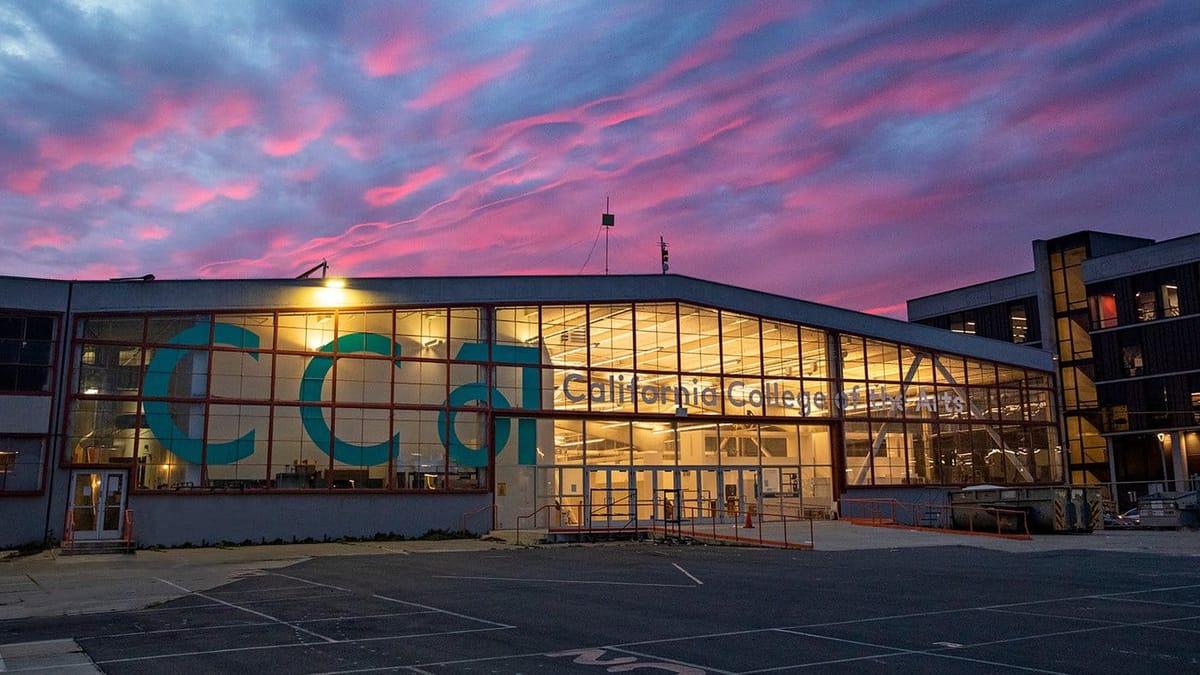
At the moment it announced that it would cease operating as an independent institution, California College of the Arts was not withdrawing from public life. It was extending it. The school was hosting a public inquiry into artificial intelligence and civic imagination, presenting exhibitions in architecture and contemporary art, and sustaining a yearlong research program on labor, time, and rest. The campus remained open and densely programmed—less a site of institutional retreat than one of continued address.
And yet, the decision had already been made.
In a message circulated to the CCA community in January 2026, President David Howse announced that the college would conclude operations by the end of the 2026–27 academic year following an agreement with Vanderbilt University. The tone of the announcement was measured. “This was not a decision we reached lightly,” Howse wrote, acknowledging that the news would likely be met with “shock, frustration, and disappointment.”
The agreement outlines a controlled wind-down rather than an abrupt closure. CCA will continue teaching through the 2026–27 academic year, with students on track able to graduate as planned and others supported through transfer and completion pathways. Vanderbilt will assume ownership of the campus and establish undergraduate and graduate programming there, including art and design programs. It will also operate a CCA Institute housing archival materials and the Wattis Institute for Contemporary Arts, intended to maintain research activity and alumni engagement.
Howse framed the transition as a way “to honor CCA’s significant role in the Bay Area’s creative ecosystem,” emphasizing continuity rather than rescue. The language is deliberate. It positions the agreement not as a response to cultural exhaustion, but as an act of institutional stewardship.
What it leaves largely unstated—but what ultimately governs the outcome—is a structural misalignment now familiar across art education. CCA’s closure is not the result of diminished relevance. Its programming remained closely attuned to the questions contemporary institutions are most frequently asked to engage: automation and authorship, labor and value, public access, and civic responsibility.
The difficulty lies in the conditions under which such engagement is sustained. As Howse wrote plainly, “with declining enrollment, CCA’s tuition-driven business model is not sustainable.” Demographic shifts and a persistent structural deficit placed growing pressure on an institution whose public value was never designed to register primarily through enrollment figures. Emergency fundraising, state support—including a $20 million grant from California—and successive budget reductions provided time, but not resolution. “Ultimately, neither of these are enough to ensure CCA can continue to operate independently,” Howse noted.
Seen in this light, the agreement with Vanderbilt reads less as a solution than as a recalibration. It acknowledges that lasting financial independence was no longer attainable under existing constraints and proposes a different institutional logic in its place. The college’s leadership describes the decision as “a decisive act of stewardship,” intended to ensure that CCA’s mission “outlives our current structure.”
What is preserved in such transitions is continuity of record, not continuity of experience.
Independent art schools operate under conditions distinct from those of art departments housed within comprehensive universities. Their scale is smaller, their margins thinner, and their exposure more direct. That exposure often produces cultural intensity: dense programming, porous public access, and interdisciplinary experimentation that responds quickly to local conditions. It also amplifies vulnerability. Cultural value circulates differently from tuition revenue. Public engagement does not scale in the same way as enrollment targets.
CCA’s recent programming makes this tension visible. Its public forums approached artificial intelligence not as a technical problem but as a cultural and civic condition. Its exhibitions treated architecture and contemporary art as processes rather than resolved objects. These initiatives are central to the institution’s intellectual identity. They are also difficult to convert into durable financial stability.
The agreement promises continuity. Howse assured the community that CCA’s legacy “will not vanish,” emphasizing that Vanderbilt “clearly respect our 120-year legacy” and see “great value” in it for future generations of students. The structures outlined are substantial, and the commitment appears genuine. But preservation is not the same as presence. Archives do not replace daily use. Institutes do not reproduce the social density of a school in session.
CCA’s final years will not be marked by withdrawal. Classes will be taught. Exhibitions will open. Public programs will continue to address the city. The institution does not end because it stopped thinking. It ends because the conditions under which it thought—independently, publicly, and at scale—could no longer be sustained.
This clarifies a broader condition now shaping art education. Cultural productivity and institutional durability are no longer aligned by default. Increasingly, intellectual ambition survives by attaching itself to larger systems capable of absorbing risk and redistributing cost. What recedes is not culture, but autonomy: the capacity for an art school to exist on its own terms, embedded in civic life and accountable first to the publics it serves.
CCA’s story is not exceptional. It is diagnostic. The institution concludes its operations not at a moment of exhaustion, but at one of sustained engagement. That is the condition under which art education now finds itself—active, generative, and increasingly unable to remain independent.
© ART Walkway 2025. All Rights Reserved.