London Art Fair 2026: When Centrality Becomes Maintenance
London Art Fair 2026 positions itself less as a discovery engine than as a stabilizing mechanism—synchronizing legacy confidence, institutional authority, and controlled novelty at the start of a year marked by mid-market contraction and calendar congestion in London’s art ecosystem.
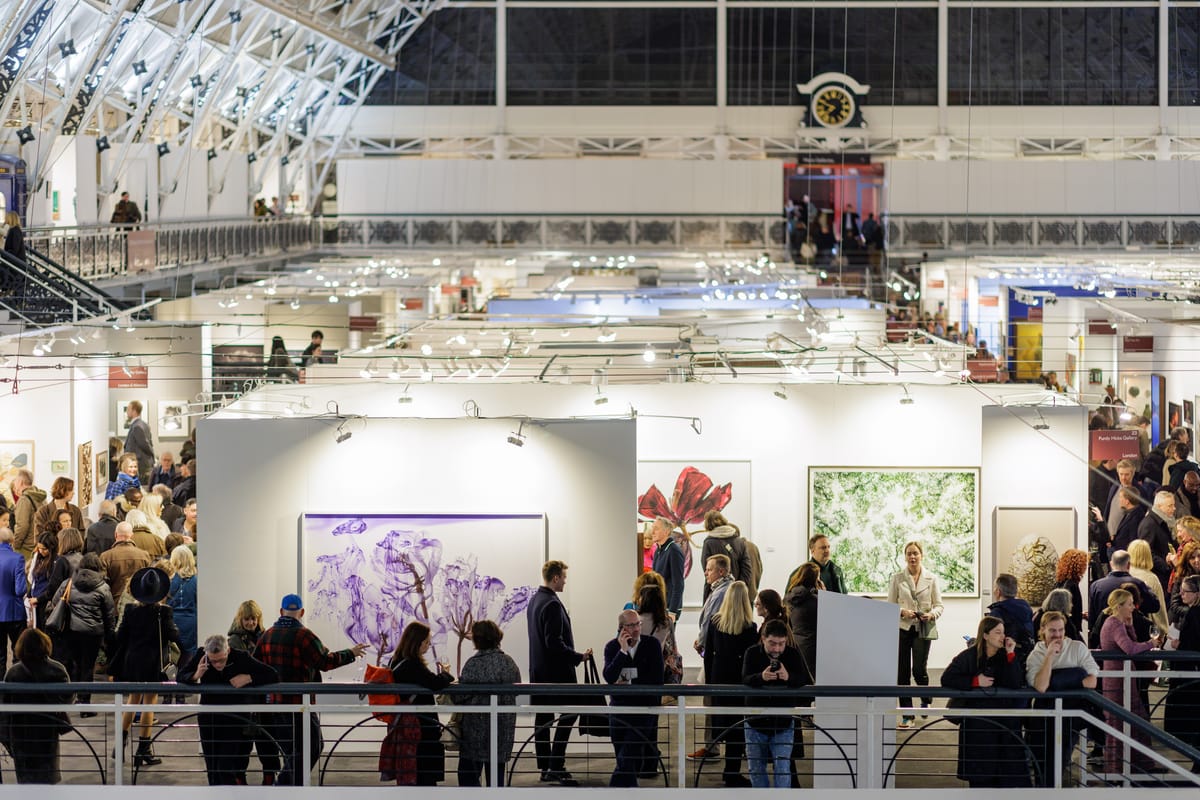
By the time London Art Fair opens its 38th edition in January 2026, the question of relevance has already been answered—not through expansion, but through persistence. In a city defined by cultural density rather than scarcity, relevance is no longer produced by novelty. It is produced by maintenance.
London does not lack fairs, museums, auctions, or institutional gravity. It lacks temporal clarity. London Art Fair’s role is to supply that clarity at a specific moment: the beginning of the year, before Frieze rhythms, auction intensity, and museum blockbusters fully claim attention. The fair does not attempt to reorganize the ecosystem. It stabilizes it—briefly, deliberately, and with calibrated ambition.
From Discovery Engine to Reset Mechanism
The language surrounding London Art Fair 2026—“trusted destination,” “cornerstone,” “kick off the collecting season”—reads as conservative only if restraint is mistaken for inertia. Structurally, it signals something else: a fair no longer competing to define taste, but to synchronize activity.
At this point in London’s cycle, the fair functions as a reset mechanism. Galleries place inventory with confidence rather than speculation. Collectors re-enter the year without the pressure of high-stakes auctions. Institutions attach their authority to a format that privileges legibility over provocation. What is being offered is not discovery at scale, but re-entry under controlled conditions.
This function has become more consequential as London’s mid-market contracts under pressure: gallery closures, consolidation, and reduced risk appetite have made early-year cash flow and predictable visibility materially more important than symbolic experimentation.
Segmentation as Governance
London Art Fair’s internal architecture clarifies how this stabilization is achieved. Its core components—Museum Partner, Platform, Encounters—operate less as curatorial statements than as interfaces. Each allows a different public to move through the same commercial environment without requiring alignment on purpose.
- The Museum Partner, led in 2026 by the National Trust, imports custodial authority and the language of care.
- Platform, curated by Dr Ferren Gipson under the title The Unexpected, signals contemporary seriousness through material experimentation and craft–fine art permeability.
- Encounters provides controlled access for emerging and international galleries, subsidized and framed to minimize risk while expanding reach.
This is not fragmentation. It is governance through segmentation. The fair does not insist on a unified narrative; it designs parallel lanes through which attention can circulate efficiently.
Custodianship Without Duration
The National Trust partnership is the most revealing structural gesture of the 2026 edition. By presenting works from two modernist homes—2 Willow Road and The Homewood—the Trust introduces a model of culture rooted in continuity: art embedded in architecture, domestic space, and long-term care.
Placed inside a fair, that model performs a specific function. It lends the fair the optics of stewardship while remaining detached from stewardship’s obligations. Rare works that seldom travel are encountered briefly, intensely, and then returned to their sites of duration.
This asymmetry is not accidental. It reflects a broader contemporary formula: museum authority paired with event agility. Public culture becomes encounter-based rather than durational, and seriousness is delivered without continuity.
London Art Fair does not invent this condition. It operationalizes it with unusual clarity.
Surrealism as Coordination Device
The prominence of surrealism across the fair’s framing—modern British lineages, European masters, contemporary reactivations—should not be read primarily as a historical revival. At fair scale, movements function less as interpretation than as coordination devices.
Surrealism accommodates contradiction. It allows modern canon and contemporary experimentation to coexist without conflict. It offers collectors narrative depth alongside market confidence. It enables institutions to frame talks, loans, and programming within a legible historical arc.
In this sense, surrealism does not resolve tension. It renders tension administrable—and therefore scalable.
Brand Civility and Soft Infrastructure
The fair’s partnership ecosystem reinforces this positioning. Automotive, property, spirits, destination marketing: these are not incidental sponsors. They indicate a fair optimized for civility—predictable audiences, controlled optics, and an environment compatible with lifestyle adjacency.
The Visit Tampa Bay commission is emblematic. Cultural production is routed through tourism logic, and artistic process becomes part of a branded experiential pipeline. The work may be sincere, but the structure is explicit: art functioning as relay between place, narrative, and mobility.
London Art Fair is not positioned as a site of rupture. It is positioned as a well-lit interface between systems.
What the Reset Privileges—and What It Narrows
A fair designed to stabilize early-year activity inevitably advantages certain modes of practice. Works that translate quickly, sit comfortably within known categories, and assert value within short encounters move smoothly through the system. Practices that require extended research cycles, deferred reception, or sustained ambiguity encounter more friction.
This is not exclusion. It is alignment.
As reset mechanisms become more central to how culture is encountered, the ecosystem quietly reorganizes around moments rather than durations. Value intensifies, circulates, and moves on. What persists between those moments becomes harder to defend.
Mapping the Function
London Art Fair 2026 does not present itself as the city’s cutting edge. It presents itself as its stabilizer: a recalibration point where legacy confidence, institutional authority, and controlled novelty are synchronized before the year accelerates.
In a city where the problem is rarely lack of culture and increasingly lack of bandwidth, that role is not minor.
The fair’s success is not in question. The more consequential issue is what becomes normalized when maintenance replaces expansion as the primary cultural function—and which forms of practice will require active protection if legibility, predictability, and timing continue to outweigh duration and depth.
London Art Fair does not determine that outcome alone.
It makes the condition visible.
© ART Walkway 2025. All rights reserved.