Learning to See—or Learning to Withstand? Creative Pedagogy and Psychological Demand
An examination of creative pedagogy as a psychological system, tracing how ideals of iteration, critique, and “learning to see” presuppose specific temperamental capacities while quietly shaping who persists within art education.

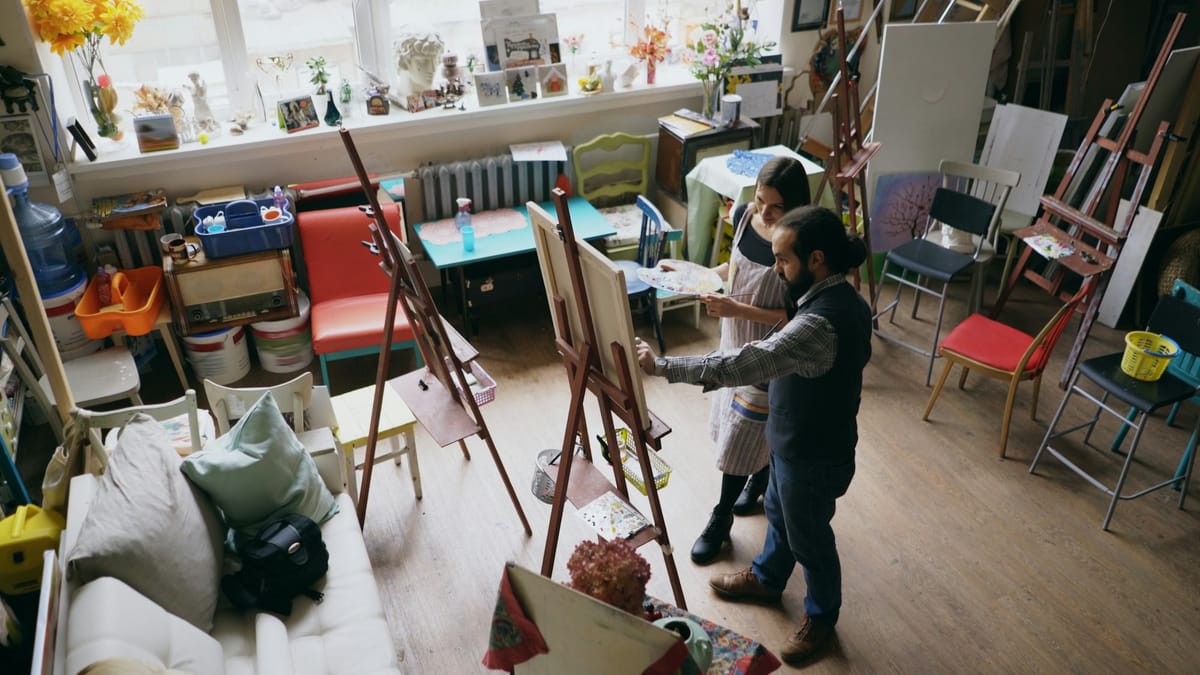
Creative pedagogy is often described as a process of awakening perception. Students are taught to look longer, notice more precisely, tolerate ambiguity, and recognize what their own work is doing before they decide what it should become. This is frequently framed as emancipation: learning to see is learning to create freely.
There is truth in this account. But it is incomplete.
What remains largely unexamined is the psychological cost embedded in this pedagogical ideal. Learning to see is not only a cognitive skill; it is an affective and temperamental demand. It requires sustained exposure to uncertainty, repeated confrontation with judgment, and the ability to narrate one’s own incompleteness in public. These demands are not evenly distributed, nor are they neutral.
To understand creative pedagogy clearly, it is not enough to ask what it teaches. We must also ask what kinds of psychological subjects it presumes.
The Pedagogical Ideal of Seeing
In art and design education, “learning to see” functions as a master concept. It names a shift away from linear problem-solving toward iterative exploration; away from execution toward process; away from certainty toward responsiveness. Students are encouraged to sit with unresolved work, to let materials push back, to abandon early ideas, and to articulate what is emerging rather than defend what was intended.
Psychologically, this is framed as growth. Students learn meta-cognition: how to observe their own decisions, recognize patterns in their practice, and adapt. Failure is reframed as information. Constraint becomes generative. Ambiguity is positioned as a necessary condition of discovery.
These principles are now widely accepted, not only in art schools but across creative industries. They are treated as universal lessons, transferable across disciplines and contexts.
What this consensus tends to obscure is that these practices presuppose specific psychological capacities.
Uncertainty as a Pedagogical Condition
Creative pedagogy relies heavily on uncertainty. Assignments are intentionally underdetermined. Feedback is provisional. Criteria shift. Evaluation is often qualitative and comparative rather than fixed. Students are asked to remain open, flexible, and self-questioning over extended periods.
For some, this environment is stimulating. For others, it is destabilizing.
Psychological research consistently shows that individuals vary widely in their tolerance for ambiguity, affective intensity, and sensitivity to evaluation. These differences are not simply matters of confidence or effort; they reflect relatively stable temperamental traits. While they can be moderated, they do not disappear through exposure alone.
Yet creative pedagogy often treats discomfort as evidence of productive struggle. Anxiety is framed as resistance to growth. Emotional volatility is interpreted as a phase to be worked through. The underlying assumption is that sustained exposure to uncertainty will, over time, recalibrate the student’s psychological response.
Sometimes it does. Often, it does not.
Visibility as Psychological Labor
Another unspoken demand of creative pedagogy is visibility. Students are not only asked to make work; they are asked to explain it, revise it publicly, and situate it within evolving narratives of intention and meaning. Critique is not merely evaluative; it is performative.
This requires a capacity for self-exposure that goes beyond skill. To repeatedly articulate what one does not yet understand—to speak from inside uncertainty without collapsing into defensiveness or withdrawal—is a form of psychological labor. It presumes emotional containment, verbal fluency under pressure, and a tolerance for being seen before one feels ready.
Students who struggle here are often read as disengaged, insufficiently reflective, or resistant to process. Less frequently is the possibility considered that the pedagogical format itself privileges a narrower psychological profile. Learning to see, in practice, often also means learning to withstand being seen.
Iteration, Failure, and the Asymmetry of Benefit
Iteration is rightly celebrated as central to creative work. But iteration is not psychologically neutral. It demands repeated abandonment of attachment, continual revision of self-narrative, and resilience in the absence of clear markers of progress.
For students with greater psychological or material security, failure can function as information. For others, it accumulates as threat. The same pedagogical structure can generate curiosity in one student and consolidation of anxiety in another.
Over time, pedagogical environments that treat psychological endurance as a prerequisite quietly sort for those who can metabolize uncertainty without visible cost, while interpreting withdrawal as a failure of engagement rather than a limit of fit.
Creative education rarely differentiates between these outcomes. The model assumes that failure is universally instructive and that those who benefit least simply require more exposure, more feedback, or more time. At a certain point, this ceases to be pedagogy and begins to resemble attrition.
Formation Without Limits
Art institutions are deeply invested in formation narratives. Development is assumed. Plasticity is celebrated. Even distress is often interpreted as evidence that something is working.
This investment has ethical appeal. It resists determinism and aligns with ideals of inclusion and opportunity. But it also produces a distortion. When individuals do not adapt in expected ways—when patterns persist despite support—the explanation is displaced. The problem becomes motivation, attitude, or unresolved personal history. The possibility that stable traits are interacting poorly with pedagogical conditions is rarely entertained.
As a result, the burden of adjustment remains largely individual. Students are encouraged to work on themselves—to become more open, more resilient, more reflective—while the structure of pedagogy remains intact.
What presents as care can quietly function as selection.
What Taking Psychology Seriously Would Require
To acknowledge the psychological demands of creative pedagogy is not to reject it. It is to take it seriously enough to examine its limits.
A pedagogy grounded in psychological realism would recognize that learning to see is not equally accessible at all times, to all people, or in all formats. It would distinguish between productive discomfort and destabilization. It would treat withdrawal and resistance not as moral or motivational failures but as signals of mismatch.
This does not require lowering standards or abandoning rigor. It requires acknowledging that rigor operates through human nervous systems, not abstract ideals.
Such an approach would also require institutions to be clearer about what they reward. If creative education continues to privilege those who can endure prolonged ambiguity, articulate uncertainty fluently, and absorb critique without visible cost, then it should acknowledge that these are not neutral achievements, but psychologically specific capacities.
Beyond the Romance of Formation
“Learning to see” remains a powerful description of creative development. But when it is treated as universally emancipatory, it obscures the quieter realities of who bears its cost.
Creative pedagogy does not simply teach skills; it tests dispositions. It does not only cultivate perception; it demands endurance. These demands are rarely named, yet they shape who persists, who adapts, and who quietly exits.
Until these thresholds are made visible, creative pedagogy will continue to mistake endurance for development and persistence for promise—reproducing its ideals through attrition rather than intention.
© ART Walkway 2025. All Rights Reserved.