Frieze Los Angeles 2026: Momentum as Allocation
How Frieze LA turns ‘momentum’ into a proof regime—routing availability through priority, producing civic optics without public obligation, and keeping hierarchy readable as logistics.
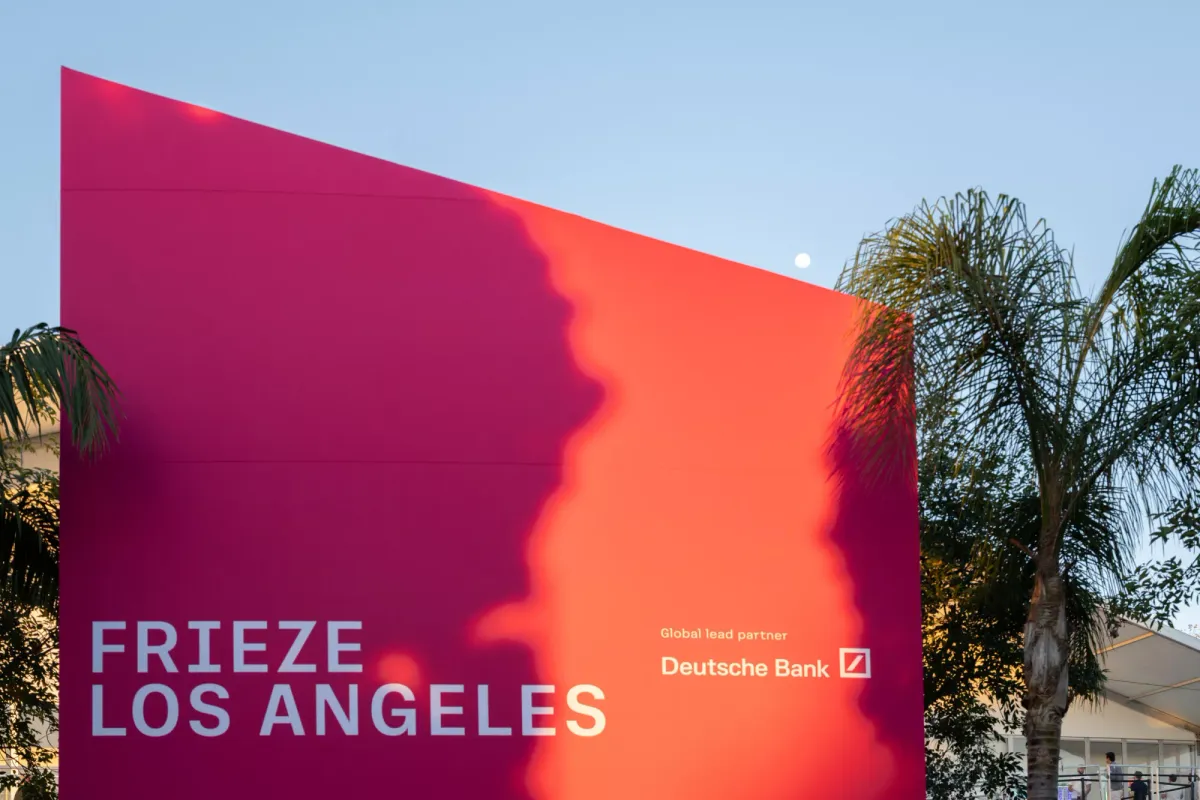
At the tent edge, the first conversations did not start with work. They started with status. “In discussion.” “Pending.” “Waiting on an institution.” The objects were still on the walls; availability had already moved into the backchannel vocabulary that travels faster than any crowd. People asked “is it released?” before they asked price.
By closing day, “momentum” had become the week’s preferred unit of proof. The word does not describe the floor so much as it governs what can be asked of the floor. Strength can be made legible without visible heat; decisiveness can be maintained without public theatre; stability can be claimed without a scoreboard.
In Los Angeles that vocabulary lands easily because the city already carries multiple authority stacks at once: museum acquisition timelines, foundation committees, studio-adjacent patronage, the Westside private-viewing circuit, and the entertainment social layer that turns a concentrated week into a familiar civic rhythm. A fair entering that ecology does not need to manufacture intensity. It needs to keep intensity from spilling into forms that are difficult to manage.
What “momentum” offers is a method: allocation as the way the week can remain decisive while looking composed.
Protocol
“Strong,” “confident,” “institutional,” “sustained” are terms that reduce the need for visible proof. They allow a week to be narrated as healthy even when the most consequential operations are not legible in public. They also allow authority to move without being named: from aisle to appointment, from booth to text thread, from preview to committee, from interest to “hold”—a city that can circulate images at studio speed while decisions move at committee speed.
The operative lexicon becomes administrative—phrases that circulate at booth edges and under breath: waiting on confirmation, not yet released, reserved for a museum group, subject to a decision later in the week. Sales remain present, but they are frequently described as placements, commitments, conversations that have moved forward. Work can be functionally unavailable while remaining visibly on view.
Under this regime, calm does not remove pressure. It routes pressure into timing.
Site and Sequencing
Santa Monica Airport works because it normalizes thresholding. It is built for queue, credential, route, wait, move. Control is experienced as logistics, and logistics are experienced as ordinary. The check-in logic persists inside: arrivals happen as scheduled drops, not wandering flows. Advisor groups moved like timed tours: five booths, then cars.
The fair needs to hold two incompatible images at once: open enough to read as civic, managed enough to keep hierarchy stable. The aisle functions as encounter; binding exchanges move elsewhere—into meals, into meetings off-site, into appointment chains that continue after the public days begin.
A convention center produces congestion as proof. An airport produces sequence. Sequence makes it easier for decisiveness to remain discreet.
Ecosystem
The tent does not hold the week on its own. The week is carried by coordination around it: museum groups moving as units, satellite fairs absorbing discovery and price diversity, off-site programming supplying a public register the tent cannot sustain without changing what it is.
Scarcity in Los Angeles does not need to be manufactured through crowding. It is produced through priority. Work is discussed as “held” before it is discussed as “sold.” Objects remain on walls while their status shifts into temporary inaccessibility: spoken for, pending, reserved, subject to confirmation. Often the status is not visible as signage; it is visible as behavior—staff stationed closer, longer conversations pulled inside the booth, the soft deflection of “circle back.”
This alters how the aisle is used. Attention drifts toward what still appears open. Conversations orbit around release: when something can be decided, whether it can be decided now, what must wait, what is already in discussion elsewhere.
“Later” becomes an instrument. It favors structures that can afford time: institutions moving through procedure, foundation committees that require internal sequencing, top-end clients for whom discretion is part of value. In the middle, “later” behaves differently. Visibility does not reliably convert when availability is managed through inside channels. Interest can be generated without permission. The object remains present; the transaction path becomes conditional.
The tent’s preferred look is editorial: propositions that can be read in one pass and repeated without distortion. In that environment, coherence becomes a selection device. Presentations arrive already shaped to survive short encounter and multiple retellings. Work that carries complexity while remaining coherent under pressure moves easily from booth to dinner to advisor to committee without losing its outline. Work that requires duration or interpretive sprawl remains present, but it moves differently—slower, more dependent on translation, more likely to become “interesting” rather than “available.”
Public programming supplies a parallel form of authorization. In Los Angeles, publicness is not only civic; it is media-legible. Publicness supplies images; obligation remains unassigned. It produces civic optics while preserving private routing. The question of care is deferred, displaced, left unspoken.
The satellites perform the pressure-valve function that keeps the main fair’s image intact. They hold louder commerce and looser conversion. They keep the city hot while the tent stays composed. The ecosystem functions as a single week with multiple registers; stability in one register is enabled by heat elsewhere.
Los Angeles supplies connective tissue across all of this: openings and dinners that act as informal decision rooms; studio-adjacent patronage that routes attention through social proximity; museum groups whose presence is felt less by announcement than by the way conversations shift when they arrive. A city with distributed authority allows the fair to distribute itself without losing coherence.
Coordination teaches a rhythm. Activities that do not fit that rhythm begin to sit slightly out of phase—not absent, not irrelevant, simply harder to convert into the week’s evidence.
Selection
That proof regime selects quietly. It favors actors who can operate in status language rather than in public signals; who can wait without losing leverage; who can translate work into propositions that survive retelling; who can route attention through appointment chains and foundation timelines; who can use publicness as authorization without depending on continuity to make the week work.
It becomes less friendly to anyone whose viability depends on open-floor conversion, whose work requires long metabolization without simplification, whose programming refuses calendar capture, whose publics demand relationship rather than activation.
Between editions, the ecosystem continues. It does not arrive as “momentum.” It does not organize itself as a coordinated circuit. It resists conversion into proof.
If momentum is the proof unit, allocation is the governance unit. The week returns not because it persuades, but because it makes hierarchy feel like logistics.
© ART Walkway 2026. All rights reserved.