Finland’s Quiet Correction: Helene Schjerfbeck and the Limits of Modernist Narratives
Helene Schjerfbeck’s first major U.S. exhibition at The Met is less a rediscovery than a recalibration—revealing how restraint, persistence, and silence have long been misread in modern art’s dominant narratives.
Seeing Silence: The Paintings of Helene Schjerfbeck, opening at The Metropolitan Museum of Art, belongs to the latter. Framed as the first major U.S. exhibition devoted to the Finnish painter, it does not arrive with the rhetoric of rescue or rediscovery. Instead, it exposes a longer-standing gap: not in Schjerfbeck’s stature, but in the narratives through which modern art has been told.
“Seeing Silence highlights the work of an extraordinary artist who, though long celebrated in Norway and Sweden as the most outstanding female painter of her time, has not yet achieved well-deserved visibility on this side of the Atlantic,” said Max Hollein, The Met’s Marina Kellen French Director and CEO, in the museum’s announcement. The exhibition, he added, invites U.S. audiences to encounter “the remarkable perspective and introspection of an artist wholly dedicated to her craft over the course of eight decades.”
The phrasing is measured. But its implication is sharper than it appears. If Schjerfbeck has long been central in Nordic art history yet marginal in the American canon, the issue is not geographic obscurity. It is a question of what kinds of modernism have historically been legible — and which have been quietly sidelined.
Organized by The Met in collaboration with the Finnish National Gallery / Ateneum Art Museum, Seeing Silence brings together nearly sixty works spanning Schjerfbeck’s career, from her Paris-trained early years to the austere, unsparing self-portraits of her final decade. It positions her not as an outlier, but as a necessary figure within modernism’s broader, uneven terrain.
Finland’s Long Game
From Finland’s perspective, this moment has not been accidental. The Ateneum has consistently framed the exhibition as the result of long-term institutional work — part of a sustained effort to place Finnish art within international narratives rather than alongside them.
Anna-Maria von Bonsdorff, director of the Ateneum Art Museum and consulting curator of the exhibition, described the Met presentation as “a dream come true” and “a unique moment in the history of Finnish art,” underscoring the significance of The Met as the world’s leading museum. She was also precise about the choice. “I am particularly pleased that of the Finnish artists, it is precisely Helene Schjerfbeck who gets an exhibition at The Met.”
That precision matters. Schjerfbeck is not Finland’s most easily exportable artist. Her work does not trade in national symbolism or romantic legibility. It resists quick consumption. To foreground her is not to market Finnish identity, but to insist on a particular standard of artistic seriousness.
This is not cultural branding. It is institutional positioning.
What the Canon Struggled to Register
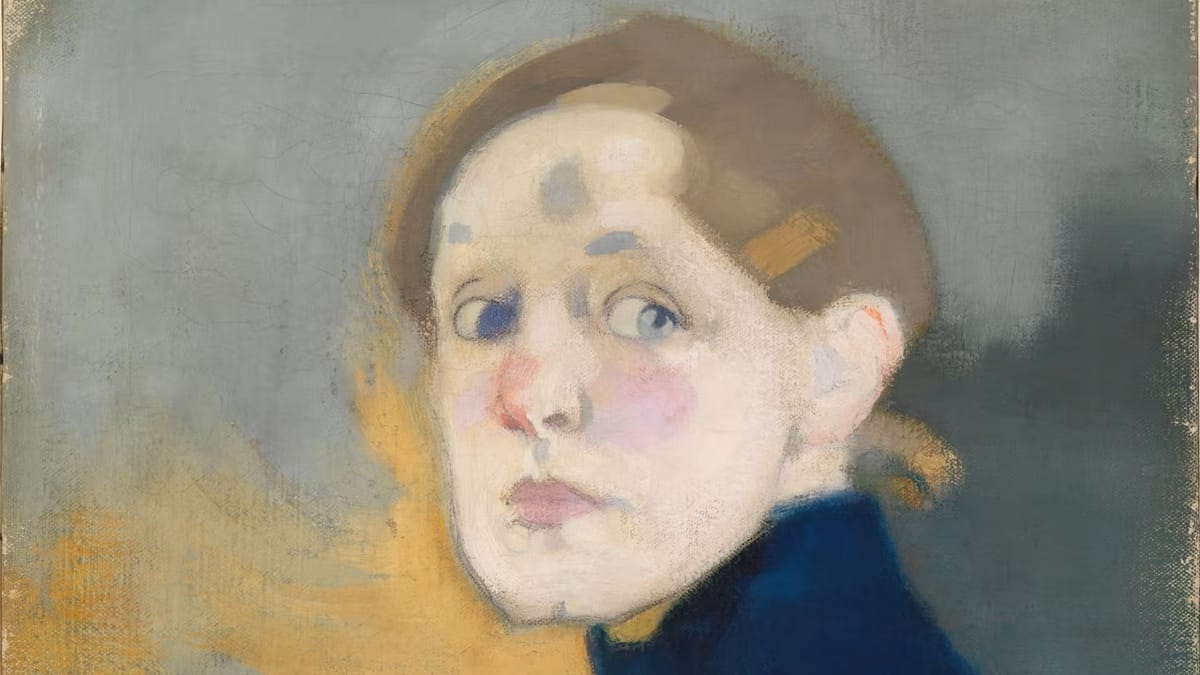
Schjerfbeck’s biography is well known: early recognition, Parisian training, participation in Salon culture, followed by decades of work in relative isolation in Finland and later Sweden. The Met’s exhibition traces her movement from naturalism toward a radically pared-down painterly language — one defined by scraped surfaces, compressed color, and an intense focus on formal relationships rather than narrative psychology.
Dita Amory, curator of the exhibition, describes Schjerfbeck as an artist who, working “in remote Finland without recourse to broader culture and the exchange of contemporary ideas,” created “her own language every day at her easel by sheer force of will,” overcoming immense personal and professional obstacles in the process.
What emerges across the exhibition is not withdrawal, but concentration. Silence, in Schjerfbeck’s hands, is not absence. It is a working method.
For decades, modernism’s institutional narrative has privileged rupture over persistence, visibility over rigor. Artists who advanced the medium through restraint, repetition, and reduction — rather than overt formal rebellion — often remained legible locally while slipping through the cracks of global accounts. Schjerfbeck’s delayed American recognition reflects that imbalance more than any failure of her work to travel.
Why Now: Restraint and Density
The timing of Seeing Silence matters.
Across contemporary art discourse, restraint has become a dominant aesthetic language: white space, reduction, quietness. But as ART Walkway noted in its 2025–26 Trends & Attention analysis, a parallel movement has gained momentum — one centered not on emptiness, but on emotional density, presence, and what it identifies as melancholy not as mood, but as trait.
“Where restraint seeks clarity through reduction,” the analysis observes, “melancholy finds it through density.”
This is not a historical claim about Schjerfbeck’s intentions, nor a retrospective emotional framing. It is a contemporary condition — one that helps explain why her work now feels newly legible within global institutions. Schjerfbeck’s paintings are reduced, but never vacant. They are quiet, but rarely light. Her later self-portraits, in particular, demonstrate how little is required to hold enormous psychological and material weight: thin paint, exposed canvas, compressed color, unyielding gaze.
In an attention economy saturated with speed, visibility, and performance, this kind of painting demands something else entirely: time, patience, and a willingness to remain with what does not resolve itself quickly.
If audiences are increasingly ready to engage with slowness and gravity — without needing explanation or spectacle — then Schjerfbeck’s arrival is not simply overdue. It is timely.
Not Peripheral, But Ahead
The Met’s framing avoids romanticizing Schjerfbeck’s isolation. Instead, it situates her as an artist who worked far from Europe’s dominant centers yet produced a visual language capable of standing alongside — and quietly challenging — canonical modernism.
What Finland elevates here is not national difference, but methodological discipline: an insistence that modernism can be slow, restrained, and uncompromising without becoming minor.
That insistence carries implications beyond this exhibition. If Seeing Silence feels corrective, it is worth asking whether the delay reflects Schjerfbeck’s position — or the limits of the narratives that once defined modern art itself.
Schjerfbeck does not arrive at The Met as a rediscovered footnote. She arrives as evidence that modernism’s history remains unfinished — and that some of its most rigorous thinking occurred not at its loudest centers, but in sustained, deliberate quiet.
Seeing Silence: The Paintings of Helene Schjerfbeck is on view at The Metropolitan Museum of Art from December 5, 2025, through April 5, 2026.
© ART Walkway 2025. All Rights Reserved.