ESTE ARTE 2026: Designing Intimacy Without Centrality
The 12th edition of ESTE ARTE formalizes a counter-tempo fair format—solo presentations, first-time works, and distributed context—examining whether intimacy can function as repeatable market infrastructure rather than ethos.

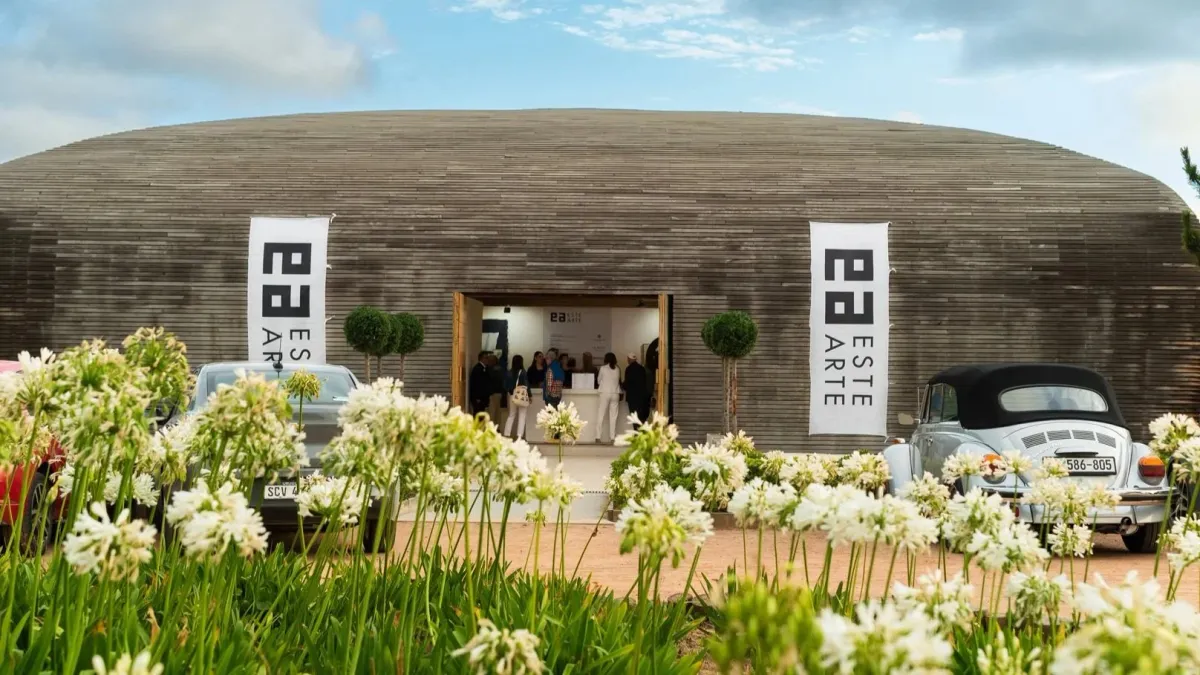
By the time ESTE ARTE opens its 12th edition in January 2026, the fair no longer needs to justify its existence as Uruguay’s only art fair. That origin narrative—market formation, institutional repair, diaspora return—has been established elsewhere. What now comes into focus is a different question: not why the fair exists, but how its format is being refined, and what kinds of cultural and market behavior that refinement begins to privilege.
ESTE ARTE does not seek calendar centrality. It seeks decisional density.
Staged over four evening hours each day at Pavilion VIK in José Ignacio, the fair operates as a deliberately compressed environment: limited exhibitors, single-artist booths, first-time works, and offsite presentations distributed across a tightly managed geography of movement. This is not slowness as ideology. It is slowness as protocol—designed, repeatable, and legible to collectors operating within increasingly saturated global cycles.
Whether this configuration remains viable as expectations shift is an open question. But the format now exists, and that alone alters the field in which the fair is read.
From Plurality to Deliberate Narrowing
The onsite rule is simple: one gallery, one artist. In practice, this does more than reduce visual noise. It governs attention.
Solo presentations convert booths from inventories into arguments. They reduce optionality while increasing interpretive clarity, allowing collectors to encounter a position rather than browse a selection. For galleries, the format concentrates risk while amplifying narrative force. Fewer works must carry more meaning; coherence becomes the primary currency.
This is not a retreat from commerce. It is commercial rationality reorganized around fewer, deeper decisions.
“Unseen” as Temporal Friction
ESTE ARTE’s insistence on first-time presentations—works created specifically for the fair, or historic works shown publicly for the first time—introduces friction into an ecosystem optimized for circulation. “Unseen” here is not a claim to purity. It is a temporal device.
By withholding comparability, the fair delays immediate benchmarking against auctions, fairs, and online archives. Valuation becomes more dependent on encounter, context, and trust. Attention regains weight—not because it is scarce, but because it is structured to feel consequential within a bounded timeframe.
Intimacy, in this sense, is not an affective gesture. It is a market condition.
Offsite Work and Distributed Encounter
The expansion into offsite presentations—performances, outdoor sculpture, sound, and video—extends the fair into a regional circuit spanning La Barra, Manantiales, Garzón, and Punta del Este. This diffusion does not transform the fair into urban infrastructure. It produces a curated itinerary.
Movement between sites becomes part of the encounter. Hospitality, mobility, and art presentation are designed to interlock, turning the surrounding landscape into a navigable exhibition interface. Public visibility is achieved without assuming public obligation; works appear intensely, then withdraw.
The result is encounter without duration—by design rather than omission.
Selection Committees and the Shape of Authority
ESTE ARTE’s selection committee—composed of philanthropists and internationally networked collectors—makes explicit a governance model increasingly prevalent at regional fairs. Validation is routed through patronage rather than institutional acquisition.
This structure delivers speed, clarity, and coherence. It also tightens the coupling between taste and capital at the point of entry. Terms such as “iconic,” “historic,” and “legendary” do not merely describe quality; they define the type of value the platform is structurally equipped to recognize.
Here, curatorial vision operates inseparably from market filtration.
Environmental Standards as Operating Language
ESTE ARTE’s alignment with the Gallery Climate Coalition and the Art Fair Toolkit for Environmental Responsibility situates the fair within a broader regime of sector-wide standardization. Sustainability functions less as ethical differentiation than as shared operating language: comparable benchmarks, collective timelines, and interoperable commitments toward 2030.
For a destination-based fair dependent on travel and hospitality, this alignment acts as a legitimacy protocol. It allows geographic peripherality to coexist with global governance standards—without resolving the contradictions such standards are designed to manage rather than eliminate.
What This Format Makes Easier—and Harder
A fair engineered around intimacy advantages certain practices:
- work that reads coherently within a solo grammar
- propositions that gain force from first-time encounter
- artists whose positions benefit from site and context
It introduces friction for others:
- practices dependent on long institutional durations
- strategies rooted in opacity, repetition, or deferred reception
- work that resists iconic framing or rapid legibility
This is not exclusion. It is alignment produced through design.
An Open Configuration
ESTE ARTE 2026 does not present itself as a discovery engine, a synchronizer, or a stabilizer within the global fair calendar. It tests a different configuration—one in which reduced scale becomes a tool for clarity, and intimacy functions as a repeatable protocol rather than a symbolic stance.
Whether this configuration consolidates or requires recalibration will depend on how collectors, galleries, and institutions continue to move within it. What is already clear is that ESTE ARTE is no longer operating in an experimental register alone. It has begun to formalize a mode of engagement that treats slowness, selectivity, and context not as values, but as infrastructure.
That shift does not resolve the pressures shaping contemporary fairs.
It sharpens one possible way of negotiating them—without claiming that it must, or will, become the dominant one.
© ART Walkway 2025. All rights reserved.