Expiry as Leverage: What Happens After the British Museum’s Three-Year Loans
When renewable loans replace permanent restitution, expiry becomes the decisive moment—redistributing risk, recalibrating authority, and testing whether circulation can substitute for ownership.

This article follows ART Walkway’s earlier analysis of the British Museum’s long-term loan model and its implications for restitution debates.
The most important feature of the British Museum’s new lending framework is not the scale of the objects, nor symbolism of their destination. It is the clock itself.
In Mumbai, the antiquities placed on long-term display at the Chhatrapati Shivaji Maharaj Vastu Sangrahalaya (CSMVS) arrived under a clearly defined horizon: a three-year arrangement, publicly described, contractually bounded, and deliberately finite. That temporal framing allows the museum to navigate restitution pressure—creating motion without surrendering title.
But expiry is not neutral. It is structural.
Time as Infrastructure
Long-term loans have always existed within the British Museum’s operational practice. What is new is how time itself has become a diplomatic instrument.
Three years is long enough to reshape interpretation, establish scholarly partnerships, and recalibrate public narratives. It is short enough to preserve legal ownership, avoid precedent, and re-enter negotiations from a position of retained control.
The architecture is shaped by statute. Under the British Museum Act 1963, the museum is largely prohibited from permanently deaccessioning objects from its collection. Legislative reform would require parliamentary intervention—a threshold successive governments have shown little appetite to cross. In that context, renewable loans become not merely pragmatic but structurally necessary.
Time here is policy.
The Mechanics After Expiry
Formally, the expectation is straightforward: unless renewed, the objects return to London. The structure is loan-and-return by default.
Recent arrangements illustrate the mechanism in practice. Loans of Asante regalia to Ghana and Kwakwaka’wakw masks to Canada have been structured as renewable agreements, typically revisited on a three-year cycle. Borrowing institutions acknowledge the British Museum’s legal title, allowing display in countries of origin without juridical restitution.
This produces a hybrid outcome: presence without transfer.
If renewal becomes routine, temporary display begins to resemble long-term settlement. The settlement, however, is procedural rather than legal. Ownership remains untouched; circulation absorbs the pressure.
The decisive moment is rarely the opening ceremony. It is the first quiet renewal negotiation.
The Asymmetry of Renewal
At first glance, renewal appears collaborative. Both parties must agree. But structurally, the leverage is not symmetrical.
The British Museum retains title and therefore retains the option of return. The borrowing institution, having invested interpretive capital, audience expectation, and institutional programming around the objects, faces the greater disruption if negotiations fail.
Time does not merely create opportunity. It redistributes risk.
For host institutions, the benefits of long-term loans are undeniable: access to high-profile material, international visibility, scholarly exchange, and narrative authority. Yet as expiry approaches, that authority remains contingent.
The longer an object is displayed, the more it feels embedded. The more embedded it feels, the higher the political and reputational cost of its removal.
Expiry, in this sense, becomes leverage.
Precedent Without Settlement
The British Museum has described the Mumbai arrangement as case-specific. Within the sector, however, it is already being read as operational precedent.
Governments and cultural ministries are watching closely—not only to see whether similar loans are offered, but to see what happens when they expire. Does time normalise circulation? Or does it intensify demands once temporary presence proves viable?
If renewable loans stabilise into long-term practice, restitution debates may shift from ownership to duration. The question becomes not “Who owns?” but “For how long, and under whose terms?”
That reframing would mark a significant transformation in the politics of cultural property.
The Comparison That Tests the Model
No discussion of this framework avoids Greece.
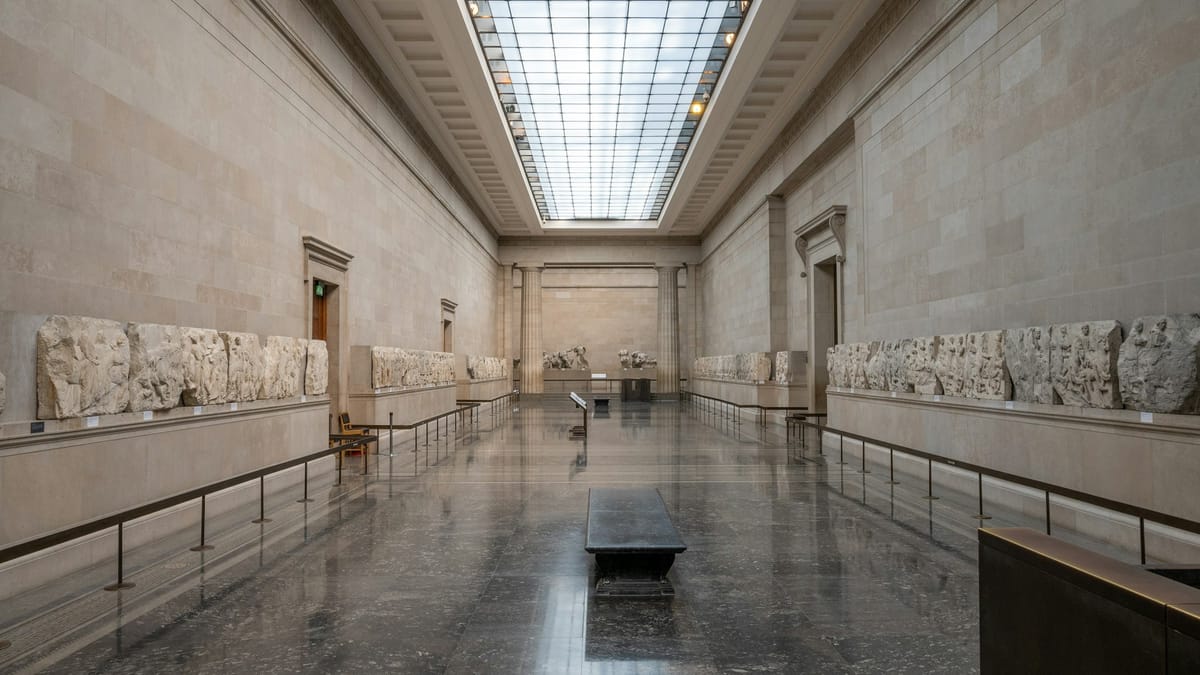
The possibility of applying a similar structure to the Parthenon Marbles has been raised publicly and rejected just as publicly by Greek authorities, who oppose any arrangement implying British ownership.
But the Greece case does more than test symbolism. It exposes the limits of circulation as a substitute for transfer. Where symbolic sovereignty is inseparable from title, renewable loans risk appearing procedural rather than reconciliatory.
The ongoing debate surrounding the Rosetta Stone reflects a similar tension. High-profile objects whose identity is bound to national narrative cannot easily be reframed through duration alone. In such cases, movement does not neutralise ownership; it intensifies its visibility.
Mumbai works because symbolism and title are not fused in the same way. Greece tests whether the model can function where they are.
If expiry in Mumbai produces quiet renewal, the framework gains credibility. If disputes such as Greece or Egypt resist renewal logic entirely, its boundaries become unmistakable.
When Temporary Becomes Structural
The British Museum’s three-year loans were never designed to resolve restitution outright. They were designed to reorganise it—moving debate from ownership to circulation, from transfer to temporality.
But temporality is not indefinite by default. It must be renewed.
If renewal becomes routine, the model may harden into a new equilibrium: circulation without deaccession, partnership without legislative reform. If renewal falters, expiry becomes confrontation.
The clock does not merely measure time. It measures leverage.
When it reaches zero, postponement becomes decision—and structure becomes consequence.
© ART Walkway 2025. All Rights Reserved.