Biennale Arte 2026: When Signature Becomes Protocol
How “In Minor Keys” re-routes authority from curatorial voice to procedural continuity—governing reception through cadence, thresholds, rest, and structured publics alongside the pavilion system’s parallel geopolitical tempo.
By the time Biennale Arte 2026 opens, the question will not be whether the institution can proceed without its appointed curator. It already is. What comes into focus is a different issue: how a biennial maintains authority when signature is no longer available as a legitimizing engine. The event must also absorb two incompatible tempos—its central exhibition calibrated for reception, its pavilion system calibrated for diplomatic visibility.
The edition’s primary move is procedural. Curatorial absence is converted into protocol. The exhibition proceeds as a completed score—framework, selection logic, spatial rhythm, editorial architecture—realized by the team embedded in its making. Authorship is not performed as continuity. It is routed through procedure.
Minor Keys as Constraint
“In Minor Keys” is built as a constraint on biennial reflexes. In a cycle where commentary has become a default exhibition grammar, the edition lowers frequency rather than expands claim. Seriousness is routed through reception design—listening, affect, sensorial attention—so that dwell-time becomes the primary currency.
This does not depoliticize the Biennale. It changes how politics is metabolized.
Cadence Without Departments
Instead of thematic sections, the show organizes through undercurrents: shrines, processional assemblies, enchantment, spiritual and physical rest, artist “universes,” schools. These operate as recurring interfaces, enabling adjacency without reinstating declared hierarchy.
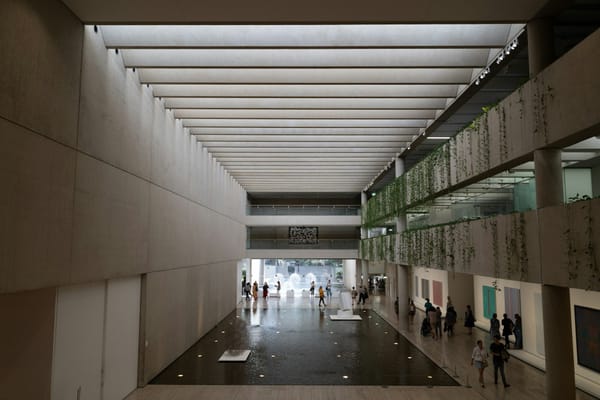
The scenography treats thresholds as the unit of encounter. Transitions are staged. Atmospheric shifts mark endings and beginnings. Movement is organized as a sequence of conditions rather than a continuous flow.
At this scale, tempo governs what is absorbed, compared, or dismissed. Authority is exerted through pacing and permeability more than partitioning.
Rest as Rate Limiter
Rest operates as infrastructure. Rest spaces, contemplative pause, and deep listening insert friction against throughput, preventing the exhibition from collapsing into an index consumed through exhaustion. The system advantages practices that hold through atmosphere, sound, durational attention, and slow recognition.
This is also where the edition narrows. Work that depends on speed, shock, or immediate discursive scaffolding meets a slower surface. The exhibition’s tempo stops aligning with headline legibility.
The Biennale’s Parallel Tempo
This low-frequency regime sits alongside the Biennale’s other legitimacy system: national representation. Pavilions route culture through diplomatic recognition, domestic politics, and public controversy, with high variance and public reversibility—withdrawal, reversal, procedural dispute, censorship narratives, unresolved participation.
The Biennale therefore runs on dual tempos. The central exhibition organizes attention as reception. Pavilion space organizes attention as geopolitics. Coexistence becomes the condition, not coherence.
Schools as Institutional Import
“Schools” introduce artist-led organizations as a parallel institutional layer inside the exhibition’s grammar. Their function is continuity: pedagogies, methods, local ecosystems that exceed event-time. Legitimacy is routed through institutional method rather than state optics or market adjacency.
Whether Schools operate as infrastructure or symbolic inclusion is an allocation question. They move beyond sanctioned adjacency only if they receive recurring visibility, programming authority, and editorial weight sufficient to behave as a spine rather than a reference.
Education as Structured Publics
The education architecture clarifies how the Biennale scales participation. University and large-group programs organize attendance into cohorts with designed pathways—multi-day access formats, seminar and workshop spaces within exhibition areas, guided itineraries, accessibility layers.
This is participation infrastructure that stabilizes relevance through repeatable institutional return: groups that visit, document, teach from the encounter, and re-enter on schedule.
Editorial and Standards as Maintenance Systems
The catalogue system functions as a second venue where interpretation consolidates in archive time while the exhibition governs affect in real time. Sustainability operates as shared operating language—carbon accounting, material reuse, energy sourcing, mitigation, mobility awareness—procedures that manage contradiction through standardization rather than through claim.
These are not add-ons. They are maintenance systems: how the Biennale holds continuity after the event releases its grip.
What This Configuration Privileges—and What It Forecloses
A Biennale built around paced reception privileges practices that can hold through sensorial encounter and durational attention, and that can remain coherent without immediate explanatory scaffolding. It strengthens institutional practices that can be presented as method—schools, pedagogies, transmission—rather than singular objects competing for rapid legibility.
It becomes harder to operate on unsynchronized timelines. Harder for practices that rely on tight argumentative framing, strategic opacity, or refusal as method to retain force inside slowed reception. Harder for work that requires long institutional digestion beyond the event to find comparable traction in a system optimized for paced encounter.
Biennale Arte 2026 does not attempt to out-speak the present. It reorganizes the tempo by which the present is encountered—and asks the rest of the Biennale system to move around that pace.
© ART Walkway 2026. All rights reserved.