Art Dubai 2026: When Time Becomes Infrastructure
At its twentieth edition, Art Dubai shifts from expansion to orchestration. Rather than staging novelty, the fair coordinates modernism, emergence, and digital practice as a temporal system—testing whether time itself can function as cultural infrastructure.
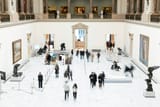

At a moment when international fairs are recalibrating under market contraction, institutional fatigue, and geopolitical reordering, the twentieth edition of Art Dubai does not arrive with the urgency of proof. At twenty years, the question for Art Dubai is no longer visibility, but operability. The fair no longer needs to argue for its relevance, its geography, or its legitimacy within the international calendar. Those questions—once central—have been settled through repetition rather than proclamation. What comes into focus in 2026 is a different concern: not what Art Dubai represents, but how it now operates.
This anniversary year does not read as a celebration. It reads as a recalibration.
Returning to Madinat Jumeirah in April 2026, Art Dubai presents itself less as a platform and more as a system—one designed to coordinate how artistic practices from different temporal registers are staged, synchronized, and validated within a single institutional environment. The fair is no longer primarily concerned with introducing the region to the world, or the world to the region. Its work is now infrastructural: managing simultaneity.
From Platform-Building to Temporal Governance
For much of its first two decades, Art Dubai functioned as a platform in the classical sense: a site of access, visibility, and exchange. Discovery mattered. Representation mattered. The fair’s identity was shaped by its ability to bring practices into proximity—geographic, cultural, and economic—that had previously circulated unevenly.
In 2026, that logic has shifted. Art Dubai no longer seeks to aggregate difference. It coordinates it.
More than 100 presentations across contemporary, modern, and digital practices from over 35 countries are not positioned as evidence of breadth, but as components within a calibrated system. Scale remains, but it is no longer expressive. It is managerial. The fair’s ambition now lies in how different kinds of value—historical, speculative, emergent, immersive—are allowed to coexist without collapsing into competition. That logic is visible in how historically anchored practices presented in Zamaniyyat sit structurally adjacent—not hierarchically—to speculative, installation-led work in Art Dubai Digital.
This is not neutrality. It is governance.
“Future, Past, Present” as Operating Logic
The anniversary framework, “Future, Past, Present,” functions less as a curatorial theme than as an operating logic. Rather than describing time, it allocates authority across time.
Each section is assigned a specific temporal function. Zamaniyyat anchors deep-time validation, revisiting modernisms from the 1950s to the 1990s across the Middle East, Africa, Asia, and Latin America. Its work is not revival, but stabilization: situating practices within longer arcs of pedagogy, circulation, and political contingency. Value here accumulates slowly, and legitimacy is retroactive.
Bawwaba, by contrast, operates in the mid-horizon. Curated around newly produced solo presentations, it foregrounds practices that are still forming their terms—often diasporic, research-driven, and relational. The introduction of the Bawwaba Gallery Support Programme makes explicit what has long been implicit: emergence at this level requires shared risk, not speculative bravado.
Art Dubai Digital, now in its fifth edition, occupies the present tense. Under the title Myth of the Digital, the section positions immersive and multisensory practices not as future-facing novelties, but as current cultural forces. The emphasis is on testing—how digital work behaves within market, institutional, and sensory frameworks that are still adapting to it.
Finally, Bawwaba Extended expands the system spatially. Large-scale installations and public-facing works spill across the Madinat Jumeirah campus, producing visibility without permanence. Encounter is intensified, then withdrawn. Public legibility is achieved without assuming public duration.
Together, these sections do not narrate time. They distribute it.
Continuity Without Inertia
This edition also marks the first under a new fair director, but the transition is notably undramatic. There is no rhetoric of reinvention, no symbolic rupture. Instead, the fair demonstrates a confidence characteristic of institutions that no longer need to announce change to enact it.
The structure holds. The interfaces are refined. Authority remains distributed rather than centralized. For a fair of this scale and age, restraint reads not as conservatism, but as control.
Discourse as Deferred Meaning
Within this tightly coordinated system, one element remains deliberately unresolved: the Global Art Forum. As of this writing, its 2026 theme has not been announced. This absence is not incidental. It preserves the Forum’s function as interpretive friction within an otherwise synchronized environment.
In previous editions, the Forum has often arrived as a speculative apparatus—testing language around prediction, climate, or digitality after the fair’s material propositions are already in place. While the fair aligns objects, markets, and institutions across time, the Forum arrives late. It resists pre-alignment. Meaning is not delivered alongside the work; it is tested after the fact.
In an ecosystem increasingly optimized for legibility, the Forum maintains a space where interpretation remains provisional rather than conclusive.
What the System Privileges
A fair organized around temporal coordination inevitably advantages certain modes of practice. Work that can operate across multiple timelines—historically grounded yet contemporarily legible, speculative yet institutionally adaptable—moves fluidly through the system. Practices that assert value within episodic encounters, rather than requiring long durational commitments, encounter less friction.
Other practices are not excluded, but they are strained: research that depends on extended institutional digestion, strategies rooted in refusal or opacity, work that resists iconic framing or rapid contextualization. These modes remain possible, but they are no longer structurally centered.
This is not a judgment. It is an alignment produced through design.
Making the Condition Visible
Art Dubai 2026 does not position itself as a discovery engine, a regional corrective, or a future forecast. It presents itself as a coordinator—of histories, presents, and futures that now circulate simultaneously within the same institutional field.
The fair does not claim to resolve the contradictions of scale, temporality, and value that define contemporary art. It formalizes them—not to resolve their tensions, but to make their management legible.
At twenty, Art Dubai no longer promises futures. It manages their coexistence.
© ART Walkway 2025. All rights reserved.