Art Basel Qatar 2026: Becoming as Institutional Form
How Art Basel Qatar operationalizes “Becoming” as an institutional interface—aligning curatorial ambition, public programming, and development partnerships at anchor-fair scale.
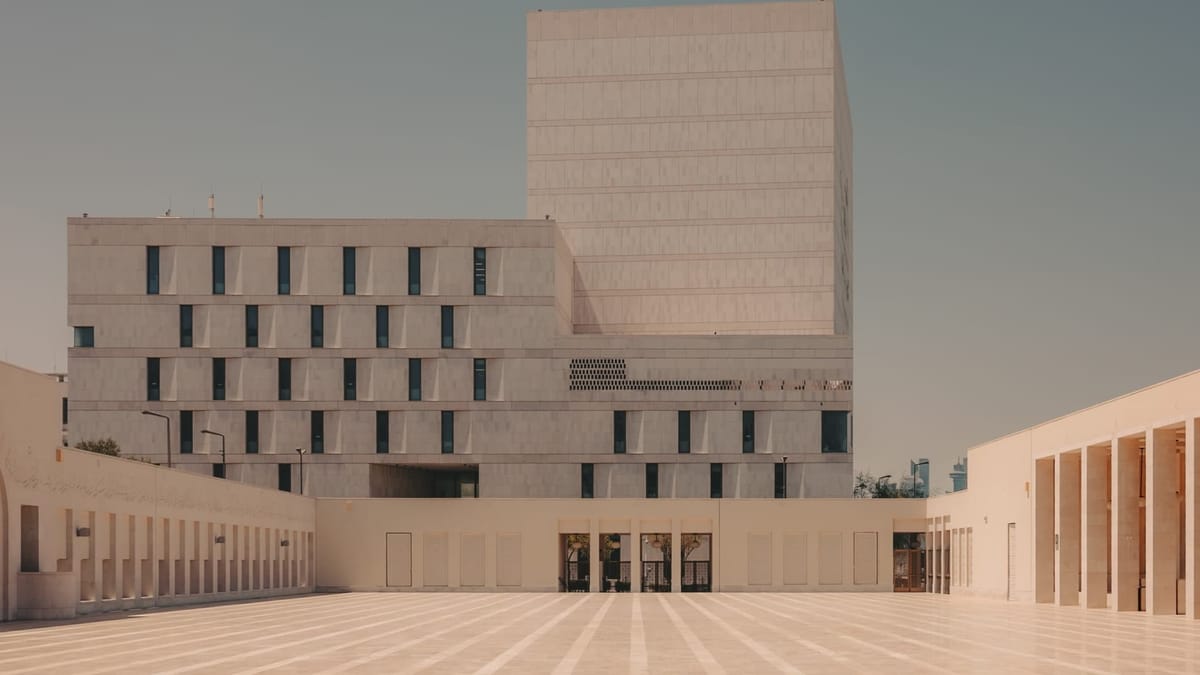
By the time Art Basel Qatar opens in February 2026, the question of whether the fair “belongs” in Doha will already be obsolete. The scale, partnerships, and curatorial architecture make clear that this is not an exploratory gesture but a structural insertion. What matters now is not legitimacy, but calibration: how a global certification system reorganizes itself when it embeds as an anchor rather than a visitor, and what kinds of cultural action that anchoring makes easier—or quietly impossible.
“Becoming,” the inaugural edition’s central curatorial proposition, is not best understood as a thematic lens applied to artworks. At this scale, themes function as institutional interfaces. They align disparate actors, synchronize temporalities, and provide a shared language through which transformation can be administered without being contested at every point. Becoming is doing that work here: it allows the fair, the city, its partners, and its publics to speak in the same grammatical tense—forward, continuous, unfinished—without having to agree on authorship.
This is not a rhetorical accident. It is an operational necessity.
 Editorial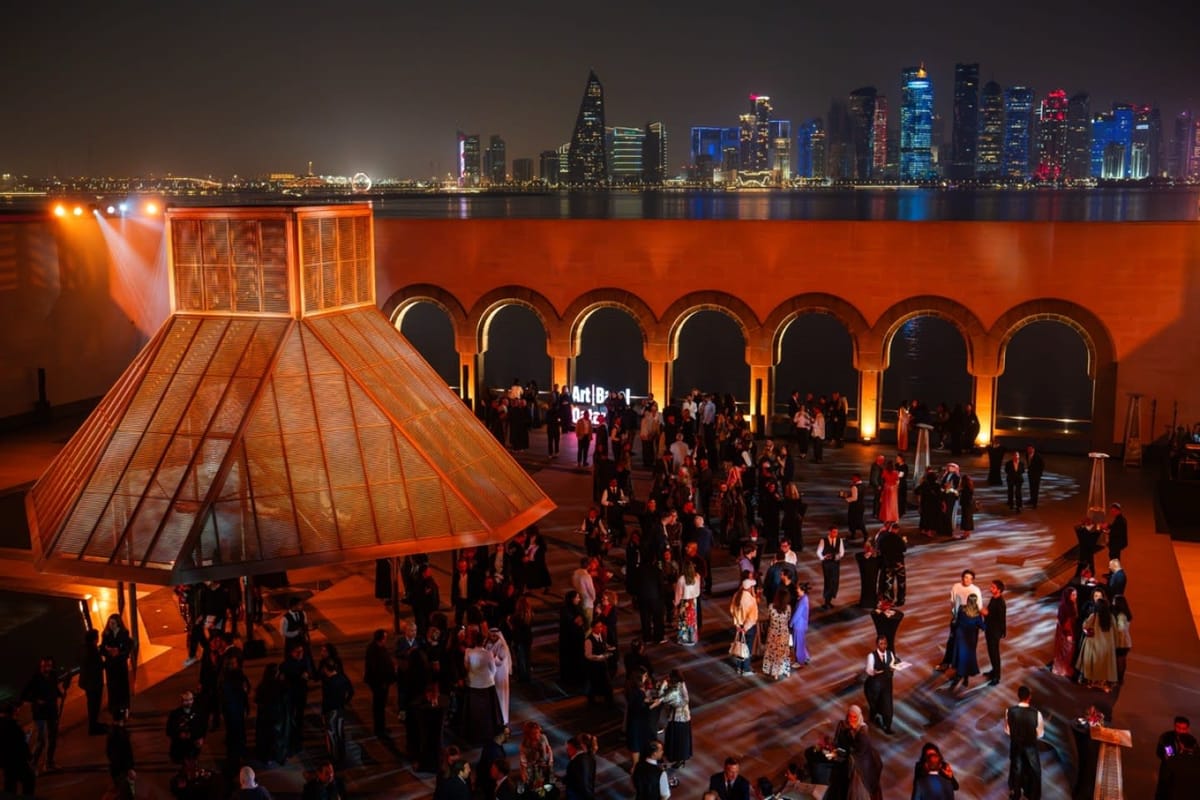
 Editorial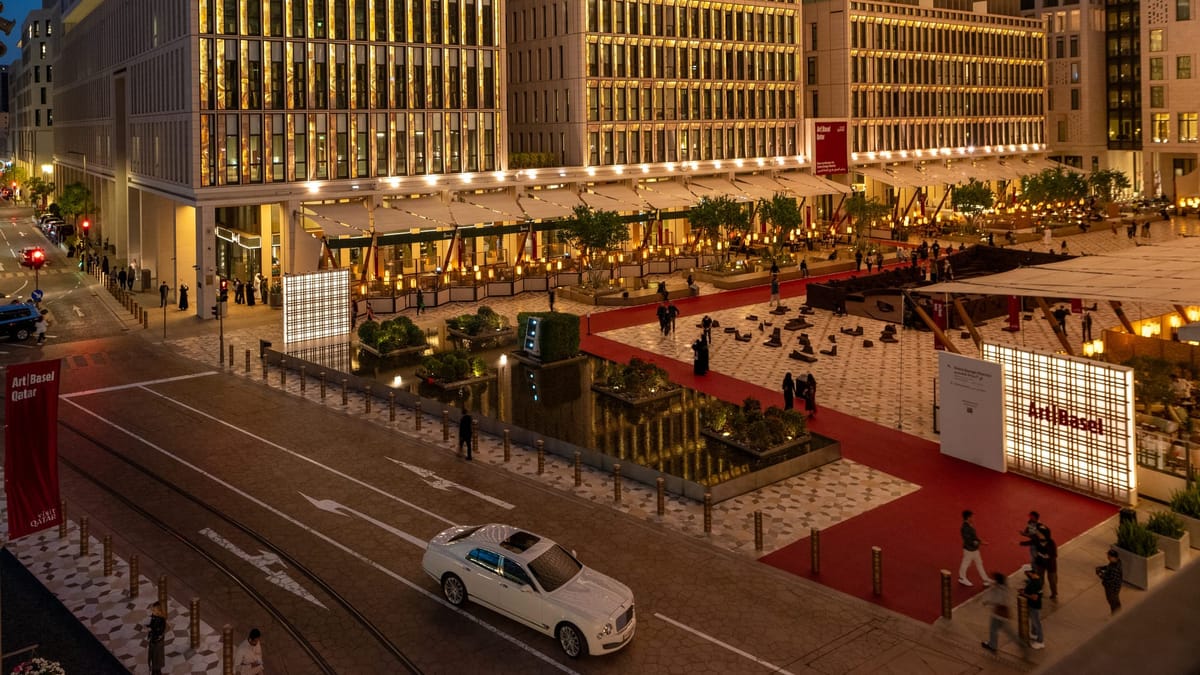
From Event to Condition
Art Basel Qatar has been positioned as an “anchor fair” for the MENASA region, a designation that matters less for what it promises than for what it presumes. Anchoring is not about arrival; it is about fixation. To anchor is to stabilize flows—of attention, capital, legitimacy—so they circulate predictably rather than episodically.
The fair’s design reflects this ambition. The gallery sector operates alongside a distributed Special Projects program of large-scale public works unfolding across Msheireb Downtown Doha. The effect is not simply expansion but diffusion. The fair no longer appears as a container one enters and exits, but as a condition one moves through. Market activity remains central, but it is no longer visually or spatially isolated as the fair’s defining function.
This matters because the contemporary fair no longer competes only with other fairs. It competes with biennials, museums, cultural districts, and civic programming for authority over what counts as serious culture. Distribution across the city is not merely generous; it is strategic. It allows the fair to operate with the optics of public culture while retaining the agility of a temporary platform.
At this point, the distinction between event and infrastructure begins to blur—not because the fair claims permanence, but because it establishes expectation. Once a city absorbs a fair at this scale, the question shifts from “Will it return?” to “How does everything else move around it?”
Curatorial Seriousness as Currency
The insistence on curatorial depth throughout the inaugural framing is best read not as reassurance, but as currency. In a global art economy saturated with spectacle, seriousness has become a scarce resource. To claim it convincingly is to gain access to spaces previously reserved for museums: public commissions, scholarly attention, and civic trust.
But seriousness is never neutral. It is a means of governance.
At Art Basel Qatar, curatorial seriousness performs a dual function. Internally, it aligns galleries under a shared conceptual umbrella, smoothing the friction inherent in aggregating diverse commercial interests. Externally, it allows the fair to speak in the voice of cultural stewardship rather than market orchestration. The theme does not merely interpret the works; it disciplines the field in which they appear.
This is why “Becoming” is effective. It absorbs contradiction. Environmental rupture, political transition, material experimentation, and institutional expansion can all be narrated as variations within the same process. The theme does not resolve tension; it renders tension legible without forcing decision.
That legibility is precisely what allows scale.
Public Work and the Question of Obligation
The Special Projects program—nine site-specific works distributed across public and semi-public sites—marks a clear escalation in how fairs deploy public art. At this point, the question is no longer whether fairs can host public work, but what kind of public authority they assume when they do.
Public art traditionally carries with it a burden: durability, accountability, and ongoing care. The fair model, by contrast, is predicated on temporariness. When these two logics meet, the result is not contradiction but asymmetry. The fair accrues the symbolic capital of public culture without inheriting its long-term obligations.
This asymmetry is not unethical by default. It is structural. And structure shapes expectation.
As fairs increasingly occupy public space, audiences become accustomed to intensity without continuity. Encounter replaces relationship. The city becomes a surface for cultural activation rather than a site of sustained negotiation. Over time, this recalibrates what publics expect from culture—and what they no longer ask for.
The question, then, is not whether these works succeed artistically. It is whether the expansion of public programming by market institutions begins to redefine public culture itself as episodic, branded, and itinerant.
Once that expectation sets in, reversing it becomes difficult.
Partnerships and the Design of Cultural Authority
Art Basel Qatar’s partnership structure—linking a global fair brand with Qatar Sports Investments, QC+, and Visit Qatar—makes explicit what has long been implicit in large-scale cultural production: culture is no longer adjacent to development strategy; it is one of its primary instruments.
This is not patronage in the classical sense. It is infrastructural alignment. Cultural events are expected to deliver visibility, soften geopolitical narratives, and activate urban districts. In return, they are granted scale, access, and institutional insulation.
Within this arrangement, the fair does not function as an independent cultural actor. It functions as a relay. It translates global artistic legitimacy into local symbolic capital, and local investment into global cultural relevance. The efficiency of this translation is the fair’s real value proposition.
At this point, critique framed in terms of “instrumentalization” misses the mark. Instrumentality is assumed. The more relevant question is how tightly coupled these systems become—and what room remains for cultural action that does not resolve cleanly into value.
Regional Visibility and the Narrowing of the Field
The emphasis on MENASA artists and galleries is central to the fair’s identity. It signals a correction to older geographies of validation and responds to long-standing demands for regional agency within global circuits. But visibility, once scaled, becomes selective.
Anchor structures do not simply amplify; they filter. As regional practice is routed through a global certification system, certain forms of work become easier to sustain—those that translate across contexts, fit thematic frameworks, and circulate visually. Others become harder to maintain: practices rooted in opacity, refusal, or local specificity that resist legibility at speed.
This is not a matter of intention. It is a consequence of alignment.
When legitimacy is centralized, pluralism depends on active counter-design. Without it, diversity persists rhetorically while narrowing operationally. The field appears broad, but the range of viable strategies contracts.
The risk is not homogenization of style. It is homogenization of conditions.
What Scale Forecloses
At this level, the most consequential effects are not what the fair produces, but what it forecloses.
It becomes harder to operate on unsynchronized timelines.
Harder to sustain institutions that refuse calendar capture.
Harder to justify practices that do not yield immediate visibility.
Harder to maintain ambiguity in an environment optimized for narrative clarity.
None of this is catastrophic. But it is cumulative.
As fairs take on museum-like authority and cities adapt to fair-time as cultural time, the ecosystem reorganizes around moments rather than durations. Cultural value becomes something that arrives, intensifies, and moves on. What remains between arrivals matters less.
Becoming as Constraint
“Becoming” is an elegant theme for a moment in which nothing wants to declare itself finished. It accommodates growth without closure, expansion without endpoint. But when adopted as an institutional posture, becoming can also delay reckoning.
If everything is in process, responsibility is always forthcoming.
If transformation is ongoing, evaluation can wait.
If identity is still forming, critique can be deferred.
At a certain scale, this flexibility becomes a constraint. Decisions that require refusal—limits on growth, protections for slowness, commitments to continuity—become harder to articulate within a grammar of perpetual emergence.
The inaugural edition of Art Basel Qatar does not create this condition. It exemplifies it with unusual clarity.
The fair is not simply reflecting transformation in the region. It is participating in the design of how transformation is experienced, narrated, and normalized. That design will shape what kinds of art, institutions, and publics remain viable as the system consolidates.
The question is no longer whether Art Basel Qatar succeeds. It almost certainly will.
The question is what kind of cultural ecology becomes thinkable once success at this scale is taken as the baseline—and what forms of practice will need to be actively protected if becoming is not to become the only permissible state.
© ART Walkway 2025. All Rights Reserved.