Art Basel Qatar 2026: Closure as Audit
What the inaugural edition installed once the week ended—how “Becoming” operated as governing grammar, how Msheireb functioned as an interface rather than a backdrop, and why the fair’s first closure mattered less as conclusion than as the proof condition for recurrence.
By the time Art Basel Qatar closed in early February 2026, the question of whether the fair could work in Doha had already been displaced by a more operational one: what kind of equilibrium the platform is built to manufacture, and what it must subtract from the conventional fair model in order to keep that equilibrium stable.
Closure is the audit: the moment a week designed as atmosphere becomes measurable as infrastructure.
 Editorial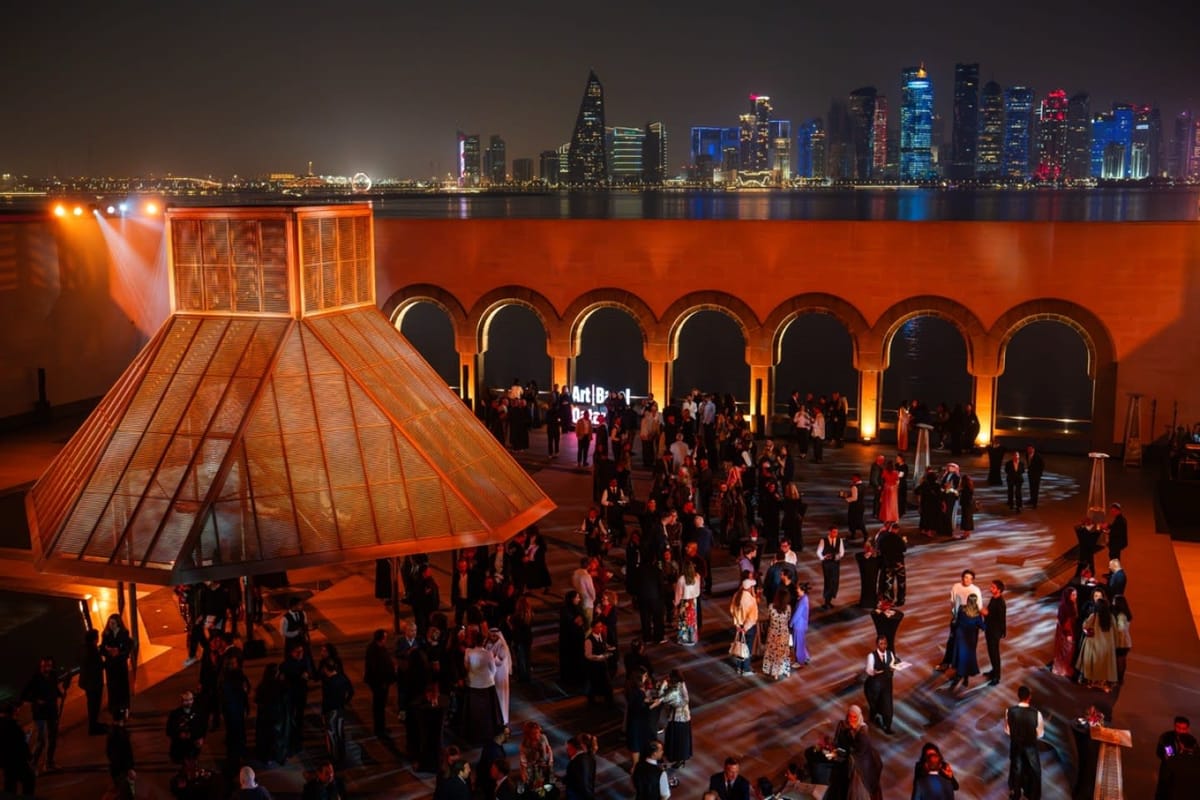
 Editorial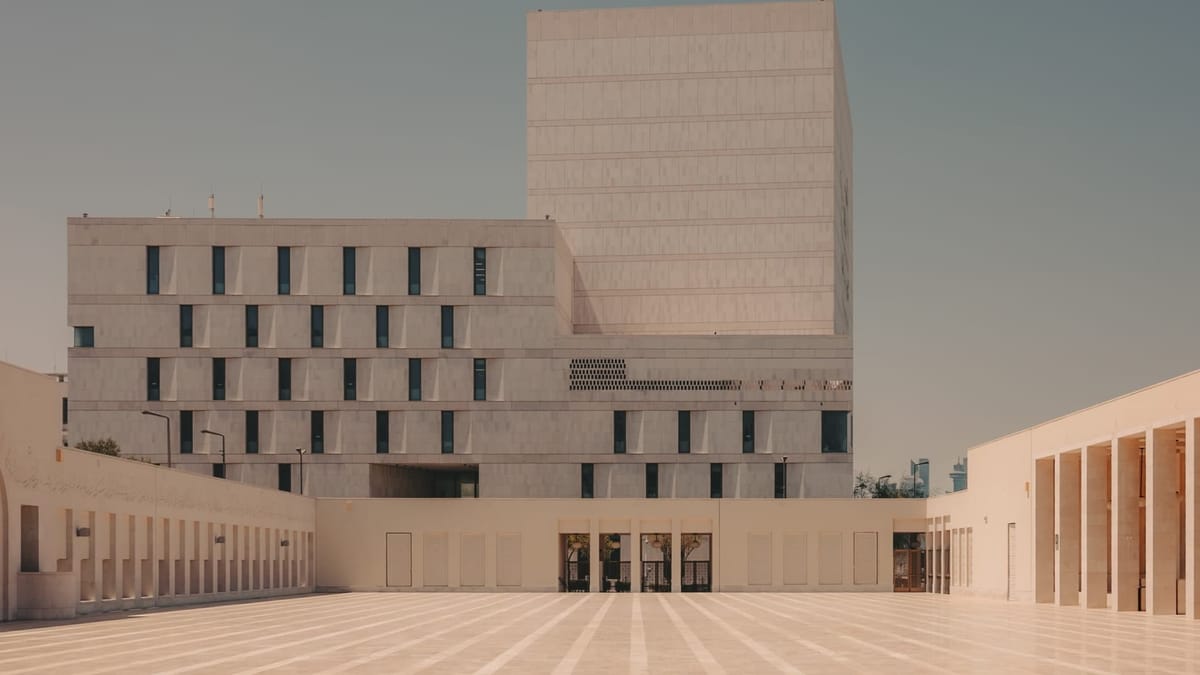
From Event to Condition
The inaugural edition arrived as a formatted proposition: a tight perimeter, a multi-venue circuit, and a structural shift away from booth-competition toward single-artist concentration. The effect has been described as “exhibition-like,” but the mechanism is administrative: attention is redistributed in a way that reads as curatorial care while stabilizing market contact.
The classic fair is designed to accelerate. Here, acceleration was treated as a liability.
By removing aisle logic—hierarchy as floor plan, prestige as congestion—the fair replaced friction with sequence. The visitor does not “shop” the field; the visitor moves through thresholds engineered to produce deliberation as an optic. Deliberation does not neutralize commerce. It converts commerce into institutional atmosphere.
This is what closure audits: whether the format holds once the week is over.
Msheireb as Interface
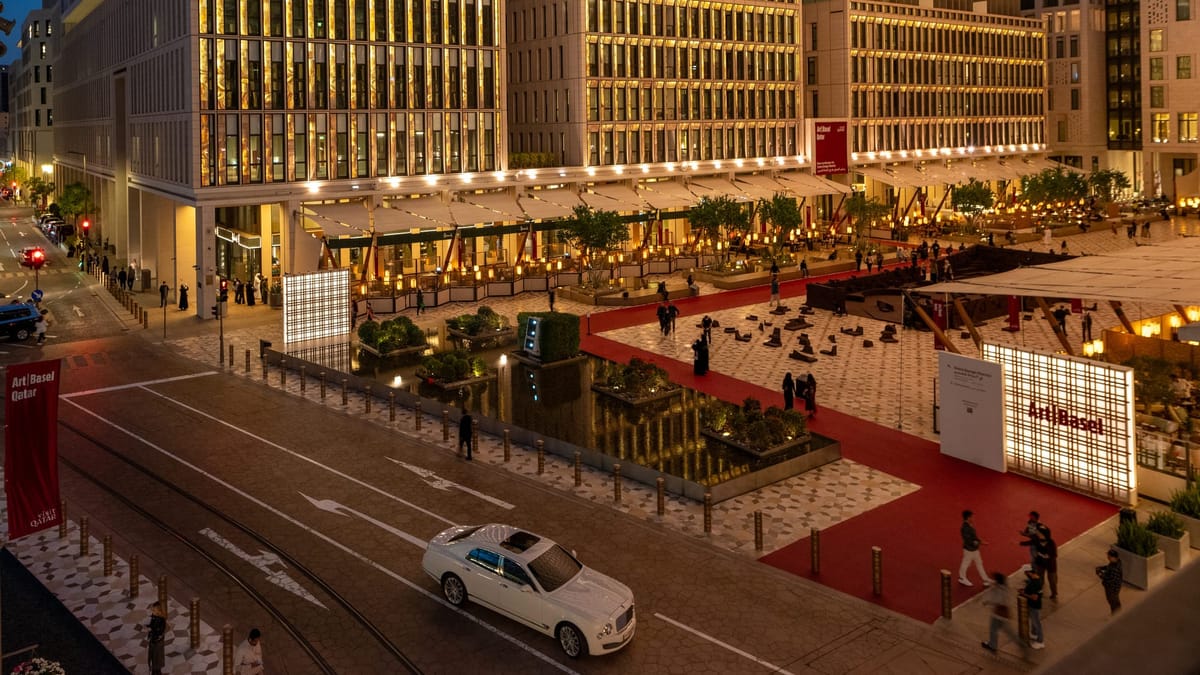
The fair’s most consequential claim was spatial. Msheireb was not treated as surrounding context; it was treated as the fair’s interface. M7 and the Doha Design District acted as anchors, but the platform extended itself across courtyards and civic surfaces—Barahat Msheireb as connective hinge, Msheireb Museums as a stabilizing institutional edge—collapsing the familiar distinction between “inside” (market) and “outside” (public culture).
Distribution here did not function as generosity. It functioned as design.
Barahat Msheireb became a managed threshold: neither fair hall nor neutral city, but a circulation zone where movement itself reads as participation. Walkability was not incidental to experience; it was the experience. The fair reads less as a container one enters and exits than as a condition one passes through. Movement becomes governance.
This is how anchoring begins: the platform makes its organization of space feel like the obvious one.
Becoming as Governing Grammar
“Becoming” did not operate primarily as a theme applied to artworks. It operated as a grammar that allowed multiple systems—commercial, civic, institutional, diplomatic—to speak in the same tense without agreeing on authorship.
A theme at this scale must do three things at once:
- align galleries under a shared umbrella without forcing uniformity,
- allow public programming to read as cultural stewardship rather than event marketing,
- translate development partnerships into a language that looks like artistic ambition.
Becoming performed that translation efficiently. It allowed contradiction to remain present without requiring adjudication. It held together a platform that is simultaneously marketplace, exhibition, city programming, and institutional relay.
The fair’s “slowness” belongs inside this grammar. It is not a retreat from market logic; it is a sovereign-market technology: a tempo that makes acquisition, relationship, and legitimacy-building feel like the natural outcome of cultural attention rather than the visible result of transaction.
Tempo as Patronage
What emerged most clearly was not scarcity, but tempo. This did not behave like a fair optimized for the visible heat of private-collector competition. It behaved like a platform calibrated for discreet acquisition, institutional pipelines, and long-range museum-building—the confidence of patronage that does not need urgency to produce value.
In a classic fair, urgency is manufactured by congestion: crowds, countdowns, fear of missing. Here, spaciousness was structural. Friction was treated as reputational risk. The atmosphere did not oppose the market; it re-coded the market as infrastructure.
That recoding clarifies why the week’s center of gravity sat as comfortably with museum directors, advisors, and institutional builders as with collectors. It also clarifies why “sales” could remain present without becoming the defining metric of the platform’s authority.
Legibility as Design
The fair’s insistence on a “curated” structure—pre-approved projects, single-artist focus, disciplined presentation—has been widely read as a solution to the headaches of the contemporary fair. Its deeper effect is upstream: legibility is designed before the week begins.
In contexts where political charge and reputational exposure are part of the operating field, governance tends to operate as selection architecture at this scale: what becomes viable to propose, easy to show, safe to circulate, difficult to justify.
One mechanism is structural rather than explicit: the single-artist rule compresses each gallery’s risk into a single proposition. In that compression, the “proposal phase” becomes the real exhibition-making moment. Work that requires interpretive sprawl or thrives on unresolved ambiguity becomes harder to defend as a sole bet; work that can carry complexity while remaining legible within a bounded presentation becomes easier to route through approval, installation, and audience recognition.
Single-artist concentration favors practices that can sustain narrative coherence. It favors work that can carry political or historical weight without collapsing into noise. It does not need to exclude opacity; it simply makes opacity hard to route through the platform’s speed of recognition.
This is the trade the system makes: the fair becomes easier to inhabit, easier to certify, easier to repeat—at the cost of narrowing the range of viable strategies.
Interior Authority, Exterior Authority
The fair’s spatial logic split authority into two registers.
Inside, works used architecture to concentrate attention: the M7 theatre as an instrument for enveloping projection, the fair floor as an anti-aisle field of paced encounters. Outside, authority was staged as civic permission: façades, courtyards, and open air treated as programmable surfaces. Nalini Malani’s projection on the M7 façade and Jenny Holzer’s SONG at the Museum of Islamic Art made this exterior register explicit: the city can be activated as a medium.
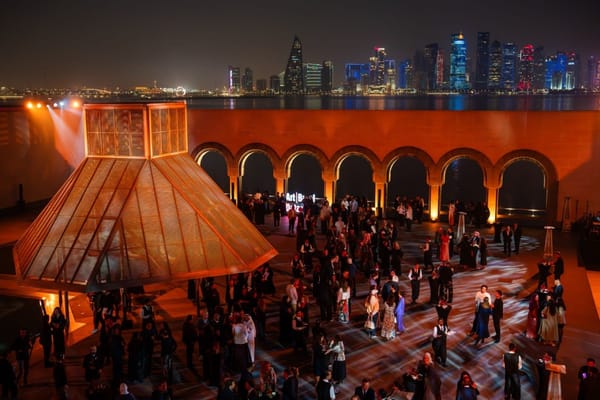
Holzer’s work—projections on the museum’s façade and inner court, accompanied by a choreographed drone performance—functioned as a seal. It demonstrated capacity: the ability to mobilize language, architecture, and the night sky as coordinated infrastructure. Spectacle here does not contradict institutional tone. It verifies jurisdiction.
Conversations as Voice Channel
The launch of the Conversations program in collaboration with Qatar Creates Talks mattered less as “programming” than as an institutional voice channel. A fair at anchor scale requires a parallel discursive structure that can speak with museum-like authority—producing panels, convenings, and public language that stabilizes legitimacy beyond the exhibition itself.
This is how the platform thickens. The fair does not only show works; it manufactures interpretive and policy-adjacent speech around them. That speech becomes part of what the city and the region are understood to be doing, culturally, in the fair’s wake.
What Repeatability Requires
The inaugural edition closed with the familiar signatures of validation: strong attendance, visible institutional presence, regional collector density, and the promise of continuation. The deeper consequence of closure is ecological. Once a city absorbs a fair at this scale, the ecosystem reorganizes around its calendar, its optics, and its standards of legibility.
It becomes harder to sustain institutions that refuse fair-time as cultural time.
Harder to justify multi-year programming that does not climax into a week of intensity.
Harder for small spaces to compete with city-as-interface optics once public space has been proven usable as branded cultural surface.
Harder for practices rooted in refusal, opacity, or local specificity to survive inside pre-approval culture without being translated into readable form.
Harder to demand continuity from public culture once encounter—episodic, curated, itinerant—becomes the default mode.
These effects do not announce themselves as crises. They accumulate as expectation.
After the Audit
The inaugural edition accomplished the task that matters at debut scale: it made recurrence feel inevitable. It demonstrated a model that can repeat without looking like repetition, because it presents recurrence as responsiveness—dialogue with context, process, calibration.
The system’s strength is its elegance: the ability to convert a commercial platform into civic atmosphere, and a week into a baseline. The system’s vulnerability is the same elegance: once the platform becomes the district’s most legible cultural grammar, other grammars begin to look like noise.
The next edition will not be evaluated only against its own promises. It will be evaluated against what the first edition taught the city to expect—and what it trained its institutions, artists, and publics to stop asking for.
© ART Walkway 2025. All Rights Reserved.