Art Basel Hong Kong 2026: Centrality as Proof Regime
How Art Basel Hong Kong turns regional density, institutional attendance, and slower collector behavior into a new evidentiary system—proving centrality less through Western symmetry than through Asia-Pacific concentration, calibrated seriousness, and managed selectivity.
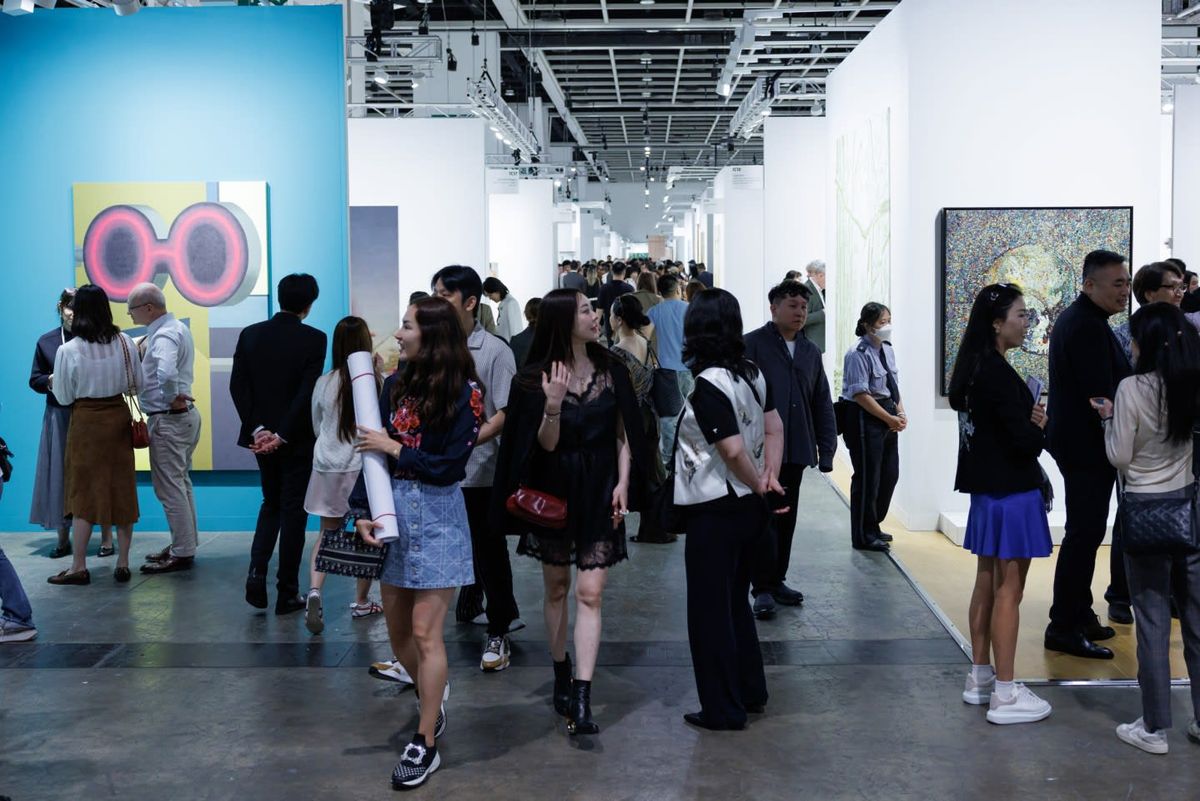
By the time Art Basel Hong Kong closed its 2026 edition, the question was no longer whether Hong Kong had recovered. The fair no longer needs to prove itself through the older image of return: strong Western symmetry, speculative heat, first-day velocity, and a visible rush of top-end buying powerful enough to certify confidence in public.
That image matters less now because it has become harder to reproduce. European private buyers were thinner on the ground than in earlier cycles. China’s high-velocity speculative phase has cooled. Regional competition has intensified. The old gateway story still circulates, but it no longer stabilizes the fair on its own.
What Art Basel Hong Kong had to prove instead was more precise: that Hong Kong can remain central even if the field is no longer evenly global in the old sense; that Asia-Pacific collector density, museum presence, and cross-regional circulation can now do the work that Western saturation and market heat once performed more visibly; that the city can still hold the week’s decisive attention even as the basis on which that importance is recognized changes.
This is no longer a recovery story. It is a proof regime.
The fair was full. Sales were strong across price bands. Museums and foundations were conspicuously present. Official language emphasized global participation, regional rootedness, public programming, and institutional engagement. Outside reporting, meanwhile, described a more specific reality: more regional than Western traffic, slower decision-making, stronger cross-Asian collector activity, and a broader sense that Hong Kong’s authority now rests less on reproducing old balance than on concentrating a different kind of seriousness.
A fair can remain important without looking the way importance once looked. But when centrality has to be proved under changed conditions, the fair begins reorganizing what counts as evidence.
Regional Density as Evidence
Art Basel still describes Hong Kong through the language of gateway, nexus, global hub, and ecosystem. Those terms remain useful, but in 2026 they explain less than they smooth over. The fair’s authority no longer seems to depend on presenting Hong Kong as a perfectly balanced meeting point between East and West. It depends on showing that regional concentration can itself operate as international proof.
That is a stronger and more selective claim.
Collectors from Hong Kong, Mainland China, Taiwan, Korea, Japan, and Southeast Asia supplied much of the fair’s visible force. Regional institutions were active. Asia-based curators were foregrounded. The city’s own infrastructure—M+, Tai Kwun, Asia Art Archive, commercial galleries, new spaces, satellites, and parallel programs—thickened the week around the fair. This does not make the fair less global. It makes it legible as a coordination point where Asia’s art scenes increasingly meet one another without requiring Western overrepresentation to ratify the encounter.
Hong Kong therefore looks less like a gateway than a relay: a place where flows do not simply pass through, but are sorted, concentrated, and certified.
That relay function matters because the older global image is harder to sustain. Yet none of this prevented the fair from reading as strong. Regional density was made to signify more than attendance. It was made to signify durability.
Art Basel Hong Kong no longer treats Asia-Pacific concentration as a fallback condition. It treats it as affirmative proof that the city remains indispensable to how the market, and the institutional field around it, organizes itself in the region.
What had to be shown was not universality.
What had to be shown was that enough of the right people, institutions, and transactions still gather here for centrality to remain undeniable.
Institutional Presence and the Manufacture of Seriousness
Museum and foundation attendance were not supplementary to the fair’s authority. They were one of its main proof units.
That is revealing in itself. When speculative appetite cools and collector behavior lengthens, fairs need other ways to make importance visible. Institutional presence performs that function efficiently. It converts the fair from a temporary market into a site of durable attention. A private sale proves demand. A museum conversation suggests placement. A foundation acquisition extends the fair’s symbolic horizon beyond the week itself.
In 2026, this institutional layer was unusually thick. Museum directors, curators, regional foundations, public institutions, and new Asian museum actors appeared not just as visitors but as a legitimizing surface. Friends of Art Basel Hong Kong, the fair’s deepening relationships with M+ and Tai Kwun, the emphasis on public programs, the offsite Encounters presentation, and the repeated insistence on Hong Kong’s broader cultural infrastructure all helped convert the fair’s week-long intensity into something closer to infrastructural seriousness.
This is not merely atmosphere. It is administrative value.
Institutional attendance also solves a representational problem. A fair built increasingly on regional density must still appear globally significant. Museums bridge that gap. They make regional concentration look like international consequence rather than local clustering.
But the passage is uneven. Galleries able to present historically anchored, curatorially legible, or institution-ready material move through this system more comfortably than those depending on open-floor spontaneity or on work that resists quick institutional framing. Practices that can travel fluently between market, museum, and public program are strengthened. Work requiring longer interpretive duration, more local contextualization, or less manageable forms of ambiguity remains present, but under greater friction.
Institutional seriousness never simply validates. It sorts.
Slower Buying, Reclassified
One of the clearest signals in the outside coverage was tempo. The buying was described as slower, more considered, more purposeful, less speculative. Collectors were said to be taking their time, building relationships, researching more, and buying with longer horizons in mind. Under other circumstances, such language might have read as euphemism for softness.
Here it was made to read as maturity.
That recoding is central to the fair’s new proof structure. Art Basel Hong Kong no longer needs first-day frenzy to demonstrate health. It can allow a more deliberate pace, provided that pace is surrounded by enough other forms of validation—museum presence, high-quality blue-chip placements, strong traffic, regional collector confidence, new institutional relationships, sector innovation—to keep slowness from appearing as hesitation.
This is not just narrative management. It changes what kind of market the fair claims to be.
A fair organized around visible urgency rewards heat, speed, and public competition. A fair organized around calibrated seriousness rewards different capacities: patience, relationship-building, institutional fluency, the ability to recognize value without immediate performative confirmation. The public message is that the market has grown healthier. The structural consequence is that pace itself becomes selective.
Not every participant benefits equally from slower proof. Blue-chip galleries with established regional networks, museum-linked artists, or inventory already carrying strong institutional recognition can absorb measured tempo comfortably. Smaller galleries, newer entrants, and practices requiring quicker conversion face a different pressure. Slowness is easier to call maturity when exposure is already buffered by prestige, capital, or long-horizon access.
A slower market is not automatically a flatter one.
It can be a more hierarchical one whose asymmetries are simply expressed more politely.
Newness Under Administration
The debut of Echoes and the Asia arrival of Zero 10 were among the fair’s clearest signs of renewal. Officially, these sectors demonstrate openness to current practice, digital forms, and younger collecting habits. Structurally, they perform a more exact task: they make newness manageable.
Echoes concentrates recent work into tightly curated booths of up to three artists. Zero 10 gives digital art a branded, context-rich space within the fair’s official architecture. Both are significant, but neither is free-form. Each channels uncertainty into bounded presentation models. Each allows the fair to incorporate emerging energies without letting them destabilize its larger hierarchy of seriousness.
That is why they matter.
Art Basel Hong Kong is operating in a field where newness cannot simply appear as raw novelty. It has to be edited into legibility. Recent work has to look focused rather than diffuse. Digital work has to look collectable rather than speculative. Younger audiences have to appear as evidence of future depth, not as a break from the structures that currently govern value.
These sectors do not weaken the fair’s main logic. They update it.
Echoes is especially telling in this respect. Work made within the last five years is not presented as a zone of disorder or open-ended experiment. It is presented in concentrated, dialogue-driven formats that make recentness easier to assess, compare, and institutionalize. Zero 10 does something similar for digital art: not abolishing uncertainty, but containing it inside a curated and transactable frame.
The issue is not whether these sectors are good additions. They are. The issue is what kind of innovation a central fair can absorb most comfortably.
Innovation passes more easily when it arrives pre-structured.
Citywide Thickness, Strategic Use
One of Art Basel Hong Kong’s strongest claims is that it now exceeds the fair hall. Film, Conversations, Exchange Circle, M+ facade commission, Tai Kwun partnerships, offsite Encounters, university support, nonprofit affiliations, ballet collaborations, and museum tie-ins all help the fair read as an engine of citywide cultural activation rather than a self-enclosed commercial event.
This does real work. It makes the fair’s centrality feel civic rather than merely transactional.
But the relation between fair and city is not equal. The week’s broader cultural landscape gives Art Basel Hong Kong thickness, legitimacy, and atmosphere. In return, the fair offers concentration, visibility, and international attention. The arrangement is mutually useful, but not neutral. As the fair becomes the most legible platform through which the city is read during art week, other institutional and local rhythms begin to appear as adjacent, supportive, or secondary—even when they possess histories, publics, and stakes that exceed fair-time.
This is where the fair’s ecosystem language becomes most powerful and most distorting.
Hong Kong clearly does have a broader and deeper ecology than the fair alone: Wong Chuk Hang’s gallery community, Tai Kwun’s long-view historical framing, Para Site’s independent trajectory, local media-art histories, new commercial and curatorial spaces, smaller collectors wanting relational access rather than only market prestige. That ecology is not created by Art Basel. But under a strong enough proof regime, the fair begins to look like the place where the city’s legitimacy is most efficiently aggregated.
The city becomes part of the argument the fair makes about itself.
And once that aggregation works, it becomes harder for slower, smaller, less brand-compatible, or less internationally legible structures to occupy the same level of visibility. The question is not whether Art Basel suppresses them directly. It usually does not. The question is what happens when the fair becomes the week’s dominant grammar of seriousness.
What does not fit that grammar begins to look marginal, even when it may be where the city’s deeper cultural life remains most alive.
What This Configuration Privileges
A fair built on centrality as proof regime privileges specific forms of passage.
It privileges galleries able to operate across regional and institutional networks at once. It privileges artists whose work can carry seriousness quickly, without losing force under compressed conditions. It privileges practices that can move between private collection, museum interest, and public programming without requiring fundamental translation at each step. It privileges recentness when recentness is concentrated, digitality when digitality is framed, regionality when regionality can be made to signify scale.
It becomes harder for other positions to move with equal ease.
Work that depends on prolonged local context, slower interpretive uptake, or unresolved opacity encounters more friction. Galleries without strong institutional bridges may find measured tempo less reassuring than it sounds. Local structures that cannot be easily folded into the fair’s ecosystem narrative remain visible, but not equally amplified. Slower buying may be healthier than speculative excess, but it also redistributes advantage toward those already equipped to survive without immediate conversion.
The field remains broad in appearance.
Its operating conditions become narrower in practice.
That is what this edition makes visible with unusual clarity. Hong Kong no longer proves its importance by reproducing the older fantasy of total global balance. It proves it by showing that Asia-Pacific concentration, institutional density, and calibrated expansion can now perform enough seriousness to keep the city central.
The fair did not restore the previous order. It demonstrated that a different one can now certify itself.
What it has not yet settled is whether this new maturity widens the field that can pass through Hong Kong’s central platform—or simply teaches the field to accept narrower passage as the price of centrality holding at all.
© ART Walkway. All Rights Reserved.